
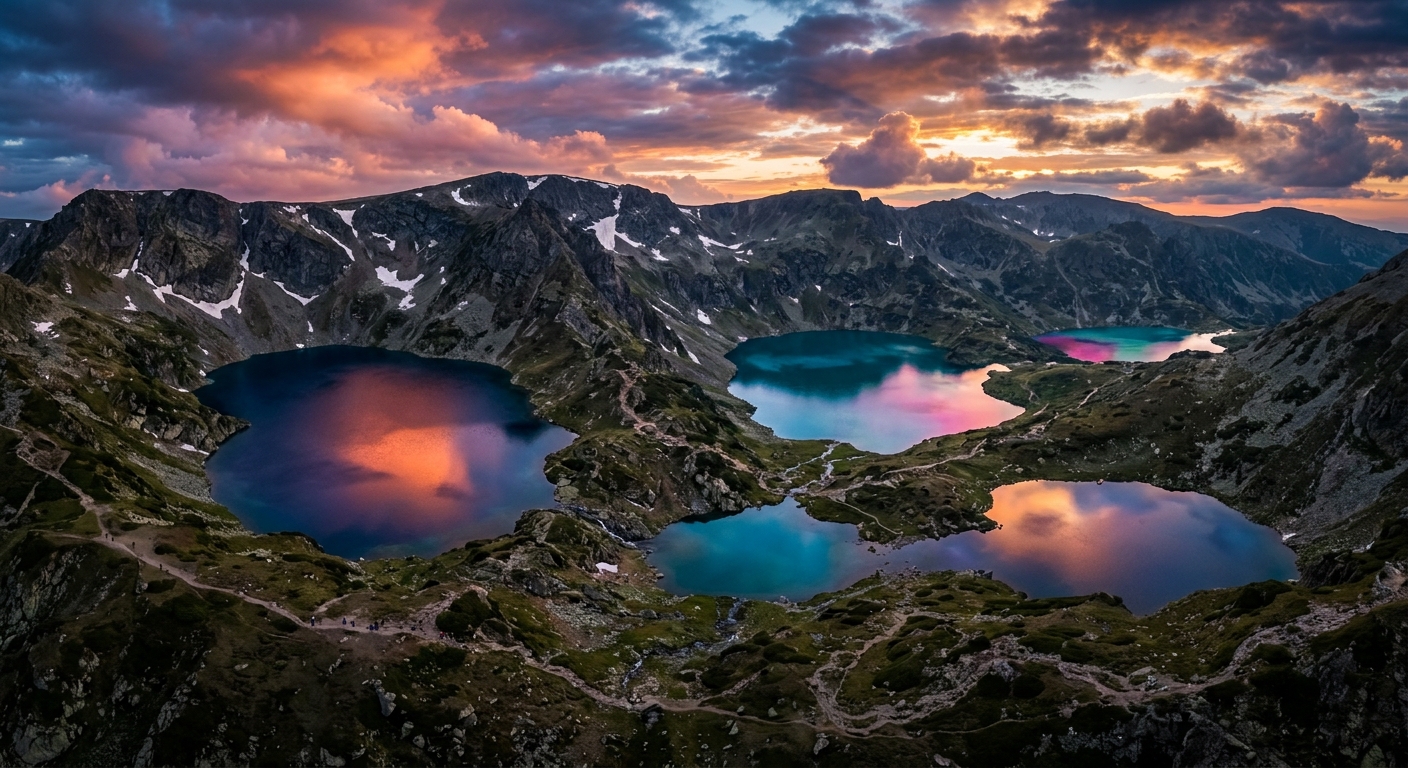
High in Bulgaria’s Rila Mountains, where the air grows thin and ancient legends whisper through the wind, lies one of Earth’s most mystifying phenomena. Seven pristine alpine lakes, each nestled like a jewel in the granite peaks, display an extraordinary characteristic that has baffled visitors for centuries: each lake mirrors a completely different section of the sky above.
Known as the Seven Rila Lakes (Седемте рилски езера), these glacial waters sit at elevations between 2,100 and 2,500 meters above sea level. What makes them truly extraordinary isn’t just their breathtaking beauty, but their seemingly impossible ability to reflect distinct portions of the heavens, as if each lake has chosen its own celestial window to display.
The Physics Behind the Phenomenon
While it might seem like magic, the secret lies in a perfect storm of geographical and atmospheric conditions that create this optical masterpiece. Each lake sits at a slightly different elevation and orientation, surrounded by unique rock formations that influence wind patterns and water surface conditions.
The lakes’ varying depths, ranging from shallow alpine pools to depths of over 37 meters, create different thermal layers that affect how light interacts with the water surface. Combined with the mountain’s complex topography, which creates distinct microclimates around each lake, these factors result in each body of water having its own atmospheric “fingerprint.”
The Role of Mountain Geography
The Rila Mountains’ jagged peaks and cirques (bowl-shaped depressions carved by glaciers) create a natural amphitheater around each lake. These formations channel winds differently, causing unique surface tension patterns on each lake. When sunlight hits these varying water surfaces, the reflection angles create the illusion that each lake is capturing a different slice of the sky.
Meet the Seven Celestial Mirrors
Each lake has earned its own poetic name based on its unique characteristics and the legends surrounding it:
The Tear (Salzata)
The highest lake at 2,535 meters, The Tear is known for its crystal-clear waters that seem to reflect the deepest blue of the sky. Its small size and perfect circular shape create an almost lens-like effect, concentrating the sky’s reflection into an intense azure mirror.
The Eye (Okoto)
Perhaps the most famous of the seven, The Eye is renowned for its deep, dark waters that reflect the sky with such clarity that visitors often feel vertigo when peering into its depths. The lake’s oval shape and steep sides create the illusion of gazing into a giant celestial eye.
The Kidney (Babreka)
Named for its distinctive shape, The Kidney reflects a broader section of sky due to its elongated form. The varying depths across its surface create a patchwork of different blue tones, as if pieces of heaven have been sewn together.
The Twin (Bliznaka)
This lake appears to split the sky’s reflection into two distinct sections, creating the optical illusion of twins within a single body of water. The phenomenon occurs due to an underwater ridge that divides the lake’s thermal layers.
The Trefoil (Trilistnika)
With its three-lobed shape, The Trefoil creates the most complex sky reflections, appearing to capture three different atmospheric moods simultaneously. Morning visitors often report seeing dawn, midday, and twilight colors all reflected in different sections of the same lake.
The Fish Lake (Ribnoto Ezero)
The shallowest of the seven, The Fish Lake’s reflection shimmers with constant movement, creating a living tapestry of sky that seems to breathe and pulse with the mountain winds.
The Lower Lake (Dolnoto Ezero)
The largest and lowest of the lakes, it captures the broadest expanse of sky, often reflecting weather systems approaching from different directions, creating a meteorological preview of the day ahead.
Scientific Explanations and Ongoing Mysteries
Atmospheric scientists have studied the phenomenon extensively, identifying several contributing factors:
- Differential atmospheric pressure: Each lake experiences slightly different air pressure due to its unique position, affecting how light particles interact with the water surface.
- Mineral content variations: The glacial origin of each lake means they contain different concentrations of minerals, subtly altering their reflective properties.
- Microclimate effects: The surrounding peaks create distinct weather patterns around each lake, influencing cloud formations and light refraction.
- Thermal stratification: Different water temperatures at various depths create layers that bend light in unique ways.
Despite these scientific explanations, some aspects of the phenomenon remain puzzling. Photography experts note that even advanced equipment sometimes captures different sky reflections in each lake simultaneously, even when atmospheric conditions appear identical.
Cultural Significance and Ancient Legends
For centuries, Bulgarian shepherds and mountain dwellers have woven tales around these mystical lakes. Ancient Thracian beliefs held that the lakes were windows to different realms of the gods, each reflecting a different aspect of divine will.
Orthodox Christian traditions later adapted these beliefs, suggesting that the seven lakes represent the seven heavens, with each water body offering a glimpse into a different spiritual realm. Pilgrims still visit the lakes seeking spiritual insight, believing that the reflected sky in each lake reveals different aspects of divine truth.
Visiting the Celestial Mirrors
The Seven Rila Lakes are accessible via hiking trails from the Rila National Park. The most popular route begins at the Rila Lakes Hut and takes approximately 3-4 hours of moderate hiking. The best time to witness the sky-mirroring phenomenon is during clear weather between June and September, when atmospheric conditions are most stable.
Photographers recommend visiting during the golden hour just after sunrise or before sunset, when the different sky reflections are most pronounced. Many report that the phenomenon is so striking that it’s visible even in smartphone photos, making it one of nature’s most photogenic mysteries.
The Seven Rila Lakes continue to remind us that our planet holds secrets that science can explain but never fully diminish. In an age of digital simulation and virtual reality, these natural mirrors offer something irreplaceable: a genuine window into the sublime connection between earth and sky, where the boundaries between reflection and reality blur into something approaching the miraculous.





This is such a beautiful piece about the Rila Lakes, though I have to admit my mind immediately went to wondering what marine life might exist in those glacial waters! It’s interesting how your comment touches on predator reintroduction, Wren – it makes me think about how apex predators in terrestrial ecosystems create those cascading effects, kind of like how keystone species such as whales shape entire ocean food webs through their migrations and feeding patterns. Have you noticed any connections between predator restoration work and freshwater ecosystem health in those alpine regions? I’m always fascinated by how interconnected these systems are, whether it’s mountains or oceans.
Log in or register to replyThis is genuinely cool, but I’m curious if anyone’s documented whether the predator reintroduction efforts in the Balkans have changed how wolves interact with these high alpine zones? The Rila Mountains would be perfect habitat, and I’m wondering if gray wolves moving through have altered ungulate behavior around the lakes in ways that might affect erosion patterns or vegetation density near the water. The trophic cascade effects in mountainous terrain are still so poorly understood compared to places like Yellowstone, so any ecosystem shifts from apex predator presence could totally reshape how these reflections work over time.
Log in or register to replyI’m genuinely curious what it would be like to be an aquatic creature in those glacial lakes, perceiving that fractured sky through water that reflects different sections of heaven – do you think fish or invertebrates there develop any kind of spatial awareness based on those distinct mirror zones, or is that too human-centric a way to think about it? The idea of sensory experience shaped by such a unique optical environment is kind of haunting to me.
Log in or register to reply