
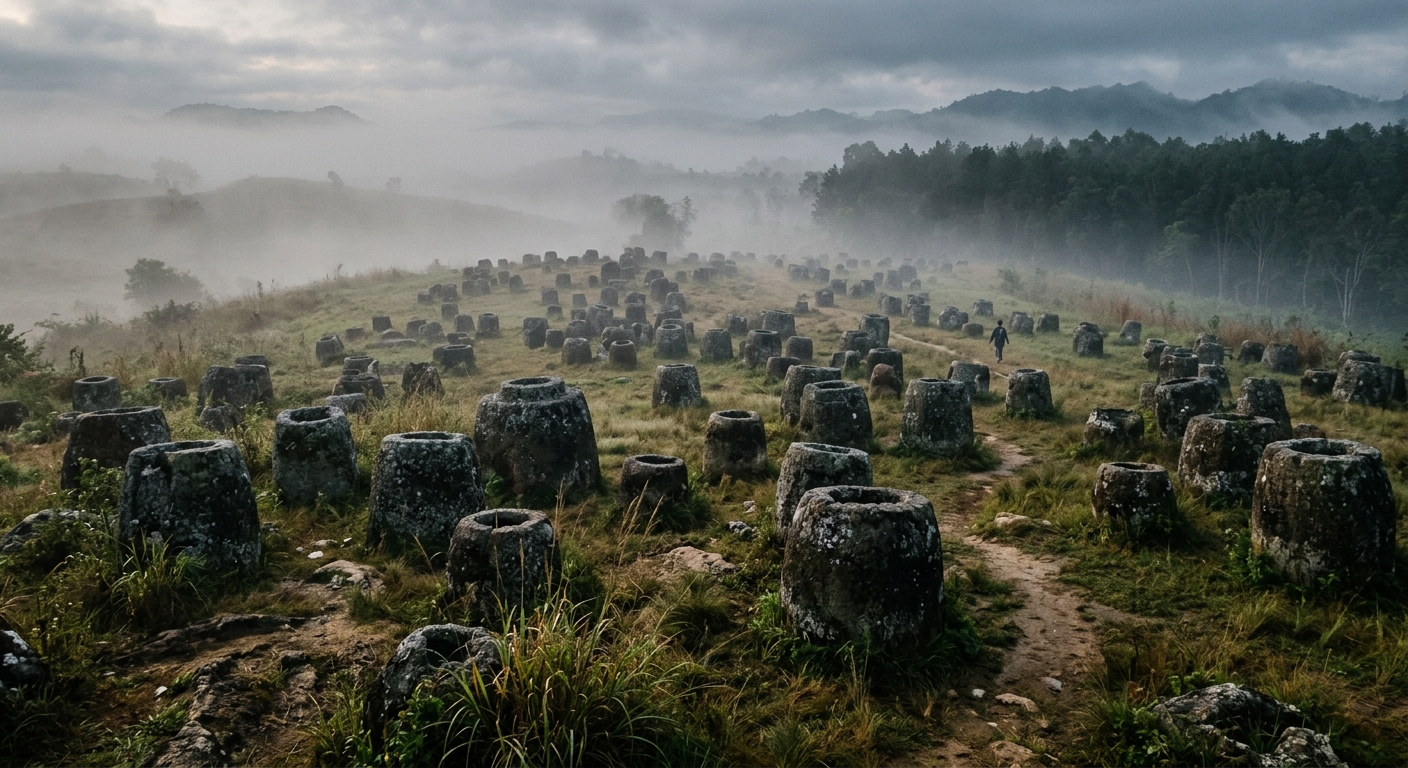
In the misty highlands of northern Laos, scattered across rolling grasslands and forested plateaus, lies one of Southeast Asia’s most perplexing archaeological mysteries. Thousands upon thousands of massive stone jars, each carved from solid rock and weighing several tons, dot the landscape in seemingly random arrangements that have baffled researchers for over a century.
Known as the Plain of Jars, this extraordinary site encompasses multiple locations across Xieng Khouang Province, where ancient craftspeople left behind a legacy that continues to defy explanation. Despite decades of study, archaeologists still cannot definitively answer the fundamental questions: Who made these enormous vessels? When were they created? And perhaps most intriguingly, why?
A Landscape Frozen in Time
The Plain of Jars consists of over 90 documented sites scattered across 1,000 square kilometers of mountainous terrain. The largest concentration, known as Site 1, contains 334 jars arranged in clusters that seem to follow no discernible pattern. These megalithic vessels range dramatically in size, from modest containers barely large enough to hold a person to colossal urns standing over three meters tall and weighing up to 14 tons.
Each jar represents an incredible feat of ancient engineering. Carved primarily from sandstone, with some crafted from granite and limestone, these vessels required sophisticated tools and techniques to hollow out their interiors. The largest specimens would have demanded coordinated efforts from multiple skilled artisans working for months or even years to complete a single piece.
What makes the site even more remarkable is the apparent deliberate placement of these massive objects. The jars aren’t simply scattered randomly across the landscape. Instead, they appear in distinct clusters and groupings, suggesting purposeful arrangement according to criteria that remain completely unknown to modern researchers.
Theories That Tantalize but Don’t Satisfy
Over the decades, archaeologists have proposed numerous theories to explain the Plain of Jars, but none have provided definitive answers. The most widely accepted hypothesis suggests these vessels served as funeral urns for an ancient civilization’s burial practices. Cremated remains and burial goods discovered in and around some jars lend credibility to this theory.
However, this explanation raises more questions than it answers. Why would a society invest such enormous effort into creating burial containers of this magnitude? The labor required to quarry, transport, and carve these massive stones would have been extraordinary for any ancient civilization.
Alternative Theories
Local folklore offers a more colorful explanation. According to Lao legend, the jars were created to brew and store massive quantities of rice wine for a celebration following a great military victory. The mythical king Khun Cheung supposedly commissioned these enormous vessels to commemorate his triumph over his enemies.
Other researchers have proposed theories ranging from grain storage to rainwater collection systems. Some suggest the jars might have served multiple purposes over different historical periods, evolving from practical containers to sacred burial vessels as cultures changed and developed.
One particularly intriguing theory proposes that the jars functioned as part of ancient trade routes, serving as way stations where merchants could store goods or supplies. The strategic positioning of many jar sites along what would have been natural travel corridors through the mountains supports this possibility.
Archaeological Challenges and Discoveries
Studying the Plain of Jars presents unique challenges for researchers. The region’s tumultuous recent history, including heavy bombing during the Vietnam War, has made systematic archaeological investigation extremely dangerous. Unexploded ordnance still litters much of the area, limiting access to many sites and making excavation work hazardous.
Despite these obstacles, researchers have made significant discoveries. Radiocarbon dating of organic materials found within the jars suggests they were created between 500 BCE and 500 CE, placing them within the Iron Age period of Southeast Asian history. This timeframe coincides with the emergence of complex societies and increased trade networks throughout the region.
Recent excavations have uncovered human remains, ceramic vessels, glass beads, and iron tools within and around the jars. These artifacts provide tantalizing clues about the people who created this monument, but they haven’t solved the fundamental mystery of the jars’ purpose.
Advanced Technology Reveals New Secrets
Modern technology has opened new avenues for investigation. Ground-penetrating radar has revealed previously unknown jar sites, while 3D scanning and photogrammetry allow researchers to document the vessels in unprecedented detail without physically disturbing them.
Perhaps most excitingly, recent discoveries have identified quarry sites where the jars were originally carved. These locations, sometimes dozens of kilometers from the final jar sites, raise fascinating questions about how ancient peoples transported such massive objects across difficult terrain without modern machinery.
A Living Mystery in a Changing World
Today, the Plain of Jars faces new challenges. Climate change, agricultural development, and increasing tourism threaten this irreplaceable archaeological treasure. The Lao government, working with international organizations, has implemented conservation measures and achieved UNESCO World Heritage status for the site in 2019.
For visitors brave enough to navigate the remaining dangers of unexploded ordnance, the Plain of Jars offers an unforgettable experience. Standing among these silent stone sentinels, surrounded by the vast landscapes of northern Laos, one cannot help but feel connected to the mysterious people who invested such tremendous effort into creating this enduring puzzle.
The Plain of Jars reminds us that despite all our technological advances and archaeological techniques, our planet still holds secrets that resist easy explanation. These massive stone vessels continue to guard their mysteries, challenging us to expand our understanding of ancient civilizations and the remarkable achievements of our ancestors.
Perhaps that’s the most remarkable thing about the Plain of Jars: in an age when satellite imagery can map every square meter of Earth’s surface and DNA analysis can reveal the contents of ancient pottery, thousands of enormous stone containers can still leave the world’s leading experts scratching their heads in wonder.





This is exactly the kind of mystery that keeps me coming back to museums, honestly. I spent an afternoon in front of our Southeast Asian exhibit last month realizing how much of that region’s archaeological story just… sits in gaps between what we think we know. The practical side of me wonders if ground-penetrating radar work has turned up anything about settlement patterns around these sites that might hint at their function, but I’m also just fascinated by how humbling it is that something this massive can still be so opaque after all this time.
Log in or register to replyhonestly the logistics angle is what gets me too, like if you really think about it these jar sites had to have had some kind of organizational system behind them, right? kinda like how ant colonies distribute workers across massive construction projects without central planning, except humans definitely needed some serious coordination and resource management to pull off moving multi ton stones in that terrain. i’d be really curious what those settlement patterns show up too because that infrastructure would tell you so much about the social structure that could even attempt something like this, the fact that its still such a mystery after all this research is genuinely humbling though
Log in or register to replyThis is fascinating, though I have to admit my brain immediately went to “how would ancient peoples in that climate have shaped and moved 14-ton stones” – the logistics alone must have required some seriously impressive adaptation to that environment. I wonder if there’s any correlation between the jar locations and historical climate patterns, since understanding how communities survived in different seasonal conditions might actually unlock some clues about their purpose and construction methods. The Arctic teaches us that humans are absurdly resourceful in extreme places, so imagine what that kind of determination could accomplish in Laos’s highlands!
Log in or register to reply