
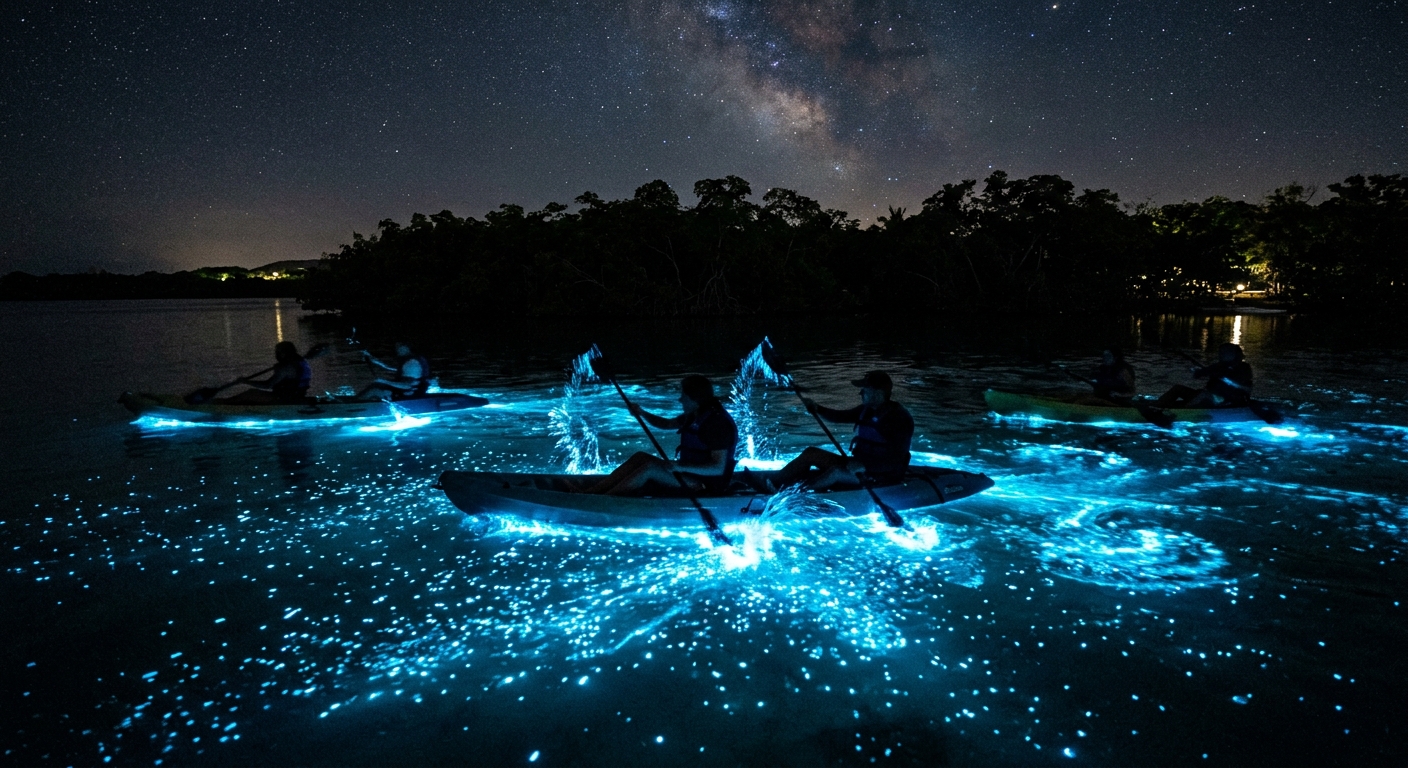
Imagine kayaking through water that sparkles like liquid starlight with every stroke of your paddle. Now picture that same ethereal glow intensifying during a thunderstorm, turning the entire bay into a supernatural light show. This isn’t science fiction or digital effects – it’s the incredible reality of Mosquito Bay in Vieques, Puerto Rico, one of the most spectacular natural phenomena on Earth.
The Living Light Show That Defies Explanation
Mosquito Bay holds the Guinness World Record as the brightest bioluminescent bay on the planet, and for good reason. The water here contains an astronomical concentration of Pyrodinium bahamense, microscopic organisms called dinoflagellates that create living light. But here’s where things get truly mind-bending: while most marine ecosystems suffer during heavy rains, this magical bay actually glows brighter when storms roll in.
The phenomenon has puzzled scientists for decades. Typically, freshwater runoff from rainfall dilutes seawater and disrupts marine microorganism populations. Yet in Mosquito Bay, the exact opposite happens. The harder it rains, the more spectacular the light show becomes.
The Science Behind the Supernatural Glow
To understand this paradox, we need to dive into the fascinating world of bioluminescence. The dinoflagellates in Mosquito Bay produce light through a chemical reaction involving luciferin (a light-emitting compound) and luciferase (an enzyme). When these tiny organisms are disturbed by movement, they flash brilliant blue-green light for about a tenth of a second.
This defense mechanism evolved to startle predators and attract larger predators to eat whatever is threatening the dinoflagellates. It’s essentially a microscopic alarm system that creates one of nature’s most beautiful displays.
Why Rain Makes the Magic Stronger
Recent research has revealed several factors that explain why rainfall enhances rather than diminishes the bioluminescent display:
- Nutrient Influx: Rainwater carries essential nutrients from the surrounding mangrove forests into the bay, providing food that allows dinoflagellate populations to explode
- Temperature Changes: Cool rainwater creates thermal layers that concentrate the organisms in specific zones
- Increased Agitation: Raindrops hitting the water surface constantly disturb the dinoflagellates, triggering continuous bioluminescent responses
- Reduced Light Pollution: Storm clouds block ambient light, making the bioluminescence appear dramatically brighter by contrast
A Delicate Balance Millions of Years in the Making
Mosquito Bay’s bioluminescent ecosystem represents an incredibly rare and fragile balance. The bay’s unique geography creates perfect conditions for this phenomenon. Surrounded by mangroves and connected to the ocean through a narrow channel, it forms a semi-enclosed lagoon where dinoflagellates can thrive without being swept out to sea.
The mangrove trees play a crucial role, releasing vitamin B12 and other nutrients essential for dinoflagellate reproduction. During rainstorms, this nutrient delivery system goes into overdrive, washing increased concentrations of these vital compounds into the water.
The Perfect Storm of Conditions
For bioluminescence to reach its peak intensity during rainfall, several factors must align perfectly:
- Water temperature between 75-85°F (24-29°C)
- Optimal salinity levels maintained despite freshwater input
- Minimal water pollution
- Healthy mangrove ecosystems providing nutrients
- Calm winds that don’t over-agitate the water
- Proper tidal conditions for nutrient circulation
A Natural Wonder Under Threat
While the rain-enhanced bioluminescence seems to suggest this ecosystem is resilient, Mosquito Bay faces serious environmental challenges. The dinoflagellate population is incredibly sensitive to chemical pollution, particularly sunscreen chemicals, boat fuel, and pesticides.
In the 1980s, the bay’s glow nearly disappeared completely due to pollution and development. Only through strict conservation efforts and protective regulations has this natural wonder recovered to its current spectacular state.
Witnessing the Phenomenon
The best time to experience the enhanced bioluminescence is during warm summer evenings after a tropical downpour. As rain clouds clear and reveal the star-filled Caribbean sky, the water below mirrors the heavens with its own constellation of living light.
Visitors describe the experience as otherworldly. Every movement creates streams of blue-green light that pulse and swirl through the water like underwater aurora. Fish leave glowing trails as they swim, and each stroke of a kayak paddle creates an explosion of sparkles that fade slowly into the darkness.
Conservation Efforts
Recognizing the incredible value of this natural phenomenon, Puerto Rico has implemented strict regulations to protect Mosquito Bay:
- Prohibition of chemical sunscreens in the water
- Restrictions on boat engines and fuel
- Limited visitor numbers during peak seasons
- Protection of surrounding mangrove habitats
- Monitoring of water quality and organism populations
Nature’s Ultimate Light Show
The rain-enhanced bioluminescence of Mosquito Bay represents one of nature’s most spectacular contradictions. In a world where human activity typically diminishes natural wonders, here we find an ecosystem that becomes more beautiful and vibrant when conditions intensify.
This incredible phenomenon reminds us that our planet still holds mysteries waiting to be understood and treasures worthy of protection. As climate change and development pressure threaten ecosystems worldwide, places like Mosquito Bay serve as luminous beacons, showing us what’s possible when nature is allowed to thrive in perfect balance.
The next time you find yourself caught in a tropical rainstorm in Puerto Rico, remember that somewhere in the darkness, an entire bay is lighting up like a living galaxy, turning one of nature’s most basic elements into pure magic.

Oh wow, I’d love to photograph the dinoflagellates causing this! People always assume bioluminescence is some magical mystery, but it’s actually such elegant biology, right? Those little organisms are basically using chemiluminescence to communicate and evade predators, and the rain just kickstarts the whole party by bringing in nutrients and mixing up the water. I have some macro shots of bioluminescent beetles from my backyard that show a similar principle, though obviously nothing as dramatic as an entire bay lighting up. Nature’s light show beats any Christmas decoration.
Log in or register to replyI love your point about the elegance of it, but here’s what keeps me up at night: what is it *like* to be a dinoflagellate experiencing the world through bioluminescence? Like, we call it communication and predator evasion, but those are human frameworks for understanding behavior. What if their light production is actually tied to sensory experiences we have no framework for at all, especially when the rain creates those intensity spikes? They might be perceiving or responding to something completely outside our current model of how those organisms work, and we’re just… not equipped to ask the right questions yet.
Log in or register to replyyou’re touching on something i think about constantly with all of this – we’ve mapped the *mechanism* so beautifully that we sometimes forget we might be missing the whole phenomenological layer, you know? like yeah, chemiluminescence explains the how, but does it explain what that surge during rainfall actually *means* to the dinoflagellate’s experience of its environment? they have light-sensing capabilities we’re still understanding, and if rain changes both the chemical triggers AND their visual/sensory input simultaneously, there could be emergent qualities to that moment we’re just not seeing because we’re looking for communication or predation logic instead of something entirely different.
Log in or register to reply