Imagine a bustling port city where Egyptian pharaohs ruled, Greek merchants traded precious goods, and massive temples honored ancient gods. Picture grand statues, ornate palaces, and busy harbors filled with ships from across the Mediterranean. Now imagine all of this vanishing beneath the waves in a single catastrophic event, lost to history for over a millennium.
This isn’t a fantasy or myth. This is the true story of Heracleion, also known as Thonis, an ancient Egyptian city that was swallowed by the Mediterranean Sea around 800 CE and remained hidden underwater until French archaeologist Franck Goddio made one of the most spectacular underwater discoveries of the 21st century.
The Egyptian City That Time Forgot
For centuries, Heracleion existed only in ancient texts and historical accounts. Greek historian Herodotus wrote about this mysterious city in the 5th century BCE, describing it as the place where the legendary Helen of Troy and her lover Paris fled before the Trojan War. Ancient Egyptian records mentioned it as Thonis, a crucial port city at the mouth of the Nile River.
But as the centuries passed and no physical evidence surfaced, many historians began to wonder if Heracleion was more legend than reality. Some scholars dismissed it as a mythical place, like Atlantis, created by ancient writers to embellish their stories.
They couldn’t have been more wrong.
The Discovery That Rewrote History
In 2000, Franck Goddio and his team from the European Institute for Underwater Archaeology were conducting a routine survey in Aboukir Bay, near Alexandria, Egypt. Using sophisticated sonar equipment and magnetometers, they detected unusual formations on the seafloor about 150 feet below the surface.
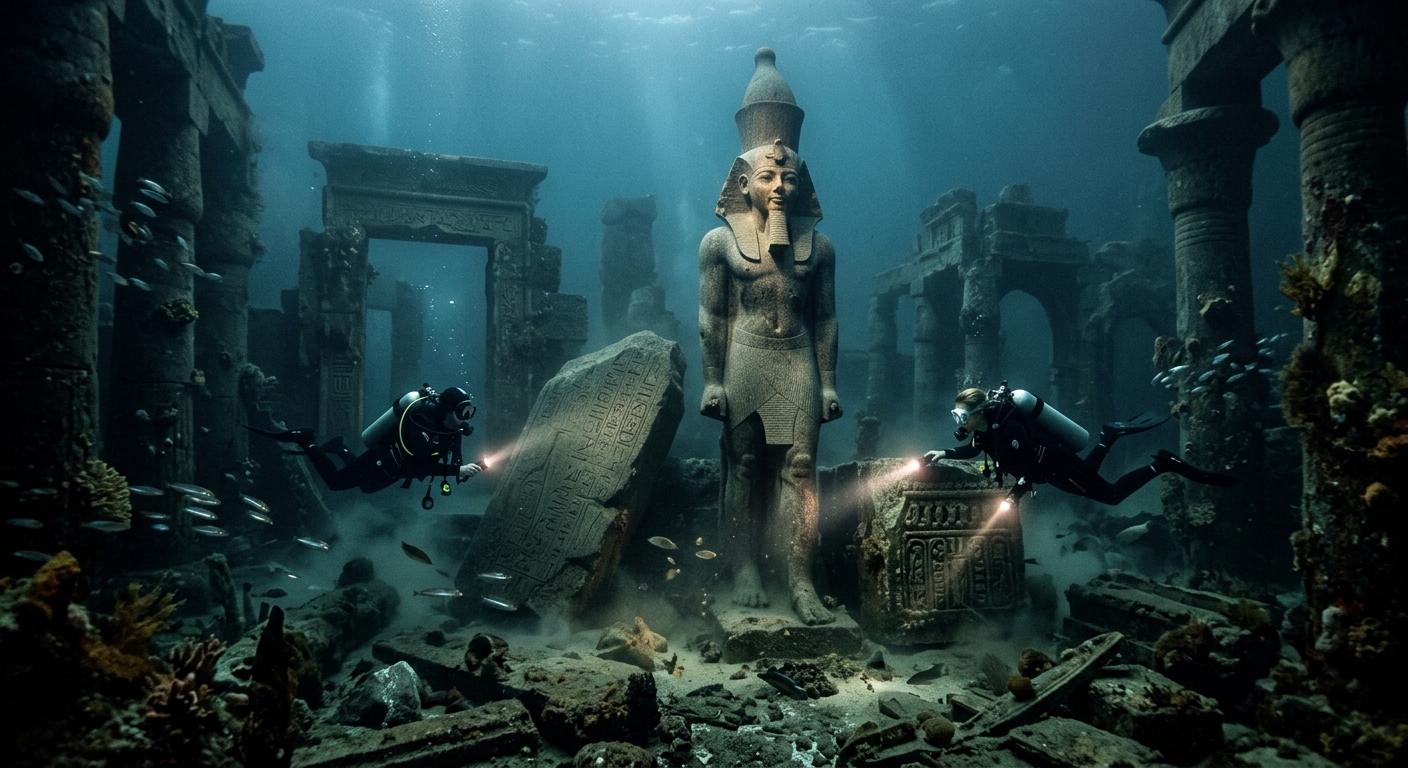
What they found defied their wildest expectations. Scattered across the Mediterranean seabed lay the remains of an entire ancient city, perfectly preserved by the protective embrace of sand and saltwater. Massive stone statues stood sentinel over sunken streets. Temple foundations stretched across the ocean floor. Ancient ships lay where they had sunk centuries ago, their cargo still intact.
This wasn’t just any underwater ruin. This was Heracleion, the lost city that scholars had debated for generations.
Treasures Beyond Imagination
The artifacts recovered from Heracleion read like an inventory from an ancient treasure chamber:
- A colossal 16-foot-tall red granite statue of a Ptolemaic pharaoh
- A massive statue of the Egyptian goddess Isis, standing over 8 feet tall
- Dozens of smaller statues depicting Egyptian gods and pharaohs
- Ancient anchors and the remains of more than 60 shipwrecks
- Gold coins and jewelry scattered across the seabed
- Stone tablets covered in hieroglyphics and ancient Greek text
- Ceramic vessels still containing ancient grain and food remains
Perhaps most remarkably, archaeologists discovered a perfectly preserved ancient Egyptian temple dedicated to Khonsu, son of Amun, the supreme god of ancient Egypt. The temple’s columns still stood upright, creating an surreal underwater cathedral that had remained undisturbed for over a thousand years.
How Does an Entire City Simply Disappear?
The destruction of Heracleion wasn’t a gradual decline. Evidence suggests that this thriving metropolis was destroyed in a series of catastrophic events that occurred around 800 CE. But what could cause an entire city to vanish beneath the waves?
The Perfect Storm of Destruction
Scientists believe that Heracleion fell victim to a combination of natural disasters that created the perfect conditions for urban annihilation:
Earthquakes: The Mediterranean region sits on several active fault lines. Powerful earthquakes could have cracked the city’s foundations and triggered massive landslides that sent portions of Heracleion sliding into the sea.
Soil Liquefaction: The city was built on unstable clay and sand sediments. When earthquakes struck, these sediments would have behaved like quicksand, causing buildings and monuments to sink rapidly into the earth.
Tsunamis: Underwater earthquakes could have generated massive tsunamis that swept over the low-lying coastal city, dragging structures and debris out to sea.
Rising Sea Levels: Climate changes and gradual sea level rise may have weakened the city’s foundations over time, making it more vulnerable to sudden collapse.
A Window Into Ancient Life
What makes Heracleion truly extraordinary isn’t just its dramatic destruction, but what its preservation tells us about ancient life. The cold, oxygen-poor environment of the Mediterranean seafloor created perfect conditions for preservation, maintaining organic materials that would have decomposed long ago on land.
Archaeologists have recovered ancient rope still tied in knots, wooden ship timbers with tool marks still visible, and even food remnants that reveal what the citizens of Heracleion ate for their last meals. These intimate details provide an unprecedented glimpse into daily life in ancient Egypt.
The International Trading Hub
Evidence from the site reveals that Heracleion was far more than just an Egyptian city. It was a crucial international trading post where goods from across the ancient world changed hands. Greek pottery sits alongside Egyptian artifacts, while coins from distant lands suggest trade relationships that spanned the entire Mediterranean.
The city served as Egypt’s main port for collecting taxes and customs duties on goods entering the country. Every ship bringing treasures from Greece, Rome, or other Mediterranean civilizations would have stopped at Heracleion first, making it one of the wealthiest cities in the ancient world.
The Search Continues
More than two decades after its discovery, Heracleion continues to yield new secrets. Archaeologists estimate they have explored less than 10% of the submerged city, meaning countless treasures still lie waiting on the Mediterranean seafloor.
Recent excavations have uncovered evidence of an even larger settlement surrounding the main city, suggesting that Heracleion was part of a vast urban complex that may have housed tens of thousands of people. Each diving season brings new discoveries that reshape our understanding of ancient Egyptian civilization and its connections to the broader Mediterranean world.
The lost city of Heracleion serves as a powerful reminder that our planet still holds countless secrets waiting to be discovered. Beneath the waves, buried in desert sands, or hidden in remote jungles, entire civilizations may be waiting for the right moment to reveal their stories once again. In a world where we think we’ve mapped and explored everything, Heracleion proves that the greatest discoveries may still be waiting just beneath our feet.


Pretty cool discovery, though I have to say the herpetology nerd in me is more interested in what ancient Egyptian ecosystems looked like back then. I wonder if they had different reptile species thriving in that region 1,200 years ago, or if the Nile cobras and Egyptian vipers were already established like they are now. Either way, underwater archaeology like this is fascinating stuff and really shows how much of history we’ve literally just buried beneath layers of sediment.
Log in or register to replyhonestly this is wild that whole underwater cities thing gets me thinking about extremophiles and how life just adapts to literally any environment, like imagine what organisms are thriving in that sediment around heracleion right now – theres probably tardigrades down there just chilling in the mud completely unbothered by the crushing pressure and darkness, and hank you raise such a good point about the ecosystems! those ancient reptiles probably had their own microbial communities living on and in them, which makes you wonder how much of ancient biodiversity we’ll never know about because the microscopic stuff doesnt fossilize well, but tardigrades could survive that whole submersion event no problem theyd just enter a cryptobi
Log in or register to replyYeah, tardigrades are legitimately wild, though I’d gently push back that most reptiles wouldn’t survive that kind of submersion event the way tardigrades do, you know? But you’re totally onto something with the microbial angle – I think about that a lot with Copernicus and other keepers talk about the bacteria and fungi that live on reptile skin, it’s a whole ecosystem in itself. The ancient Egyptian species like the Nile monitor or various colubrid snakes probably had their own specialized microbiota that we’ll never fully understand, which is honestly kind of heartbreaking when you think about lost biodiversity. Really fascinating that you connected the extremophile stuff to ancient life
Log in or register to reply