
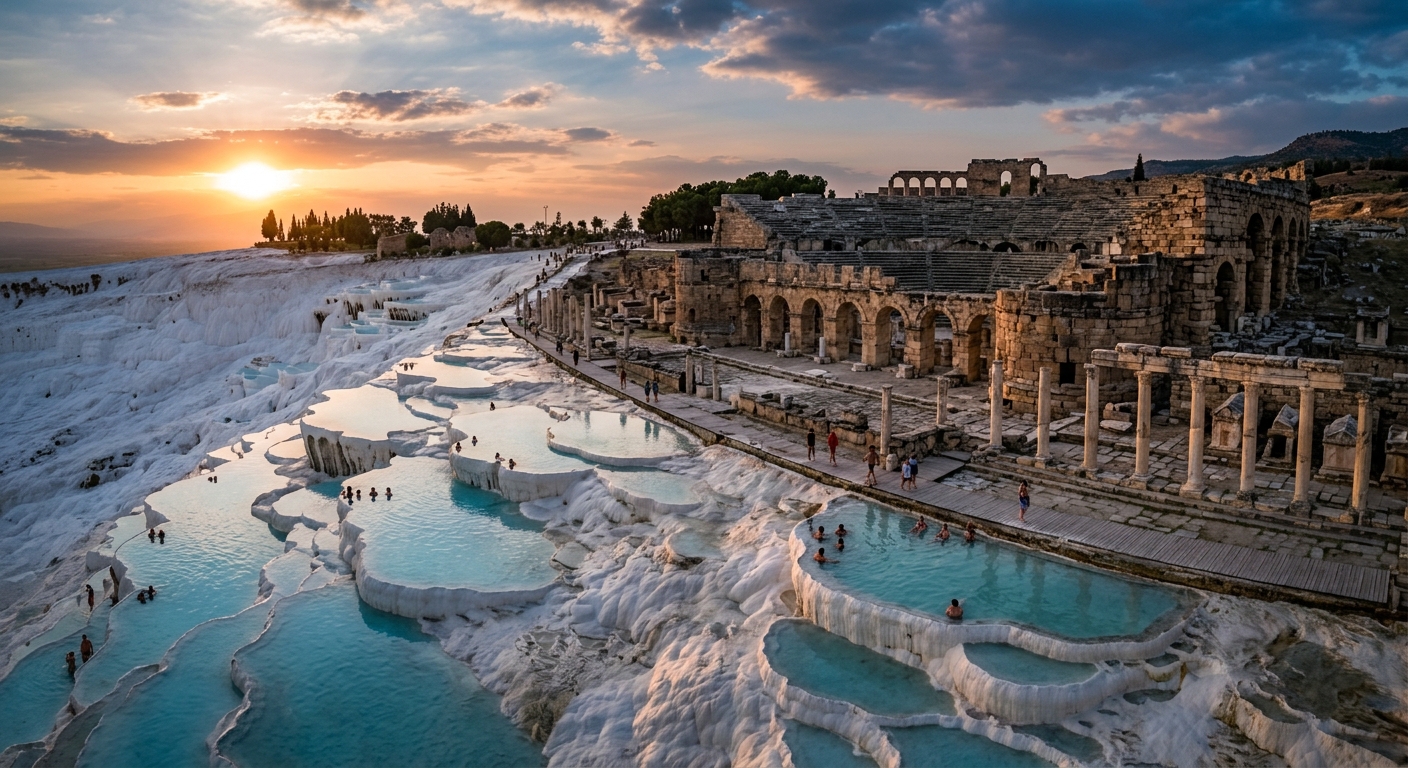
High in the mountains of southwestern Turkey lies one of nature’s most surreal creations: a cascade of brilliant white terraces that look like frozen waterfalls tumbling down a mountainside. But these aren’t ice formations at all. They’re the famous travertine pools of Pamukkale, which have been delivering miraculous healing experiences to visitors for over two millennia.
The ancient city of Hierapolis was built directly atop this geological wonder, transforming what nature created into humanity’s most enduring spa destination. For 2,000 years, emperors, warriors, and pilgrims have soaked in these mineral-rich waters, believing in their power to cure everything from arthritis to heart disease.
Nature’s Architect: How Travertine Pools Form
The stunning white terraces of Pamukkale are the result of a fascinating geological process that has been ongoing for thousands of years. Deep beneath the earth, hot springs rich in calcium carbonate bubble up from underground sources heated by geothermal activity.
As this mineral-laden water flows over the cliff face, something magical happens. The calcium carbonate precipitates out of the cooling water, slowly building up layer upon layer of white travertine limestone. Over millennia, this process has created the stepped pools that resemble a frozen waterfall caught in time.
The Chemistry Behind the Magic
The water emerging from these springs maintains a constant temperature of around 95°F (35°C) and contains an extraordinary cocktail of minerals:
- Calcium carbonate (the primary pool builder)
- Magnesium
- Bicarbonate
- Sulfate
- Small amounts of iron, strontium, and fluoride
This mineral composition is what ancient peoples believed gave the waters their healing properties, and modern science has found some truth in these age-old beliefs.
Ancient Hierapolis: The World’s First Medical Tourism Destination
Around 190 BCE, the ancient Greeks recognized something special about this location and founded the city of Hierapolis, literally meaning “Holy City.” What started as a small settlement quickly grew into one of the ancient world’s premier health resorts.
The Romans later expanded Hierapolis into a magnificent city complete with theaters, temples, and elaborate bath complexes. Roman engineers channeled the hot springs into sophisticated spa facilities, creating what was essentially the world’s first luxury medical resort.
Imperial Endorsement
The healing reputation of Hierapolis became so renowned that Roman emperors made regular pilgrimages to the site. Marcus Aurelius, the philosopher emperor, visited multiple times for his various ailments. The wealthy and powerful from across the Roman Empire traveled hundreds of miles to experience the supposed curative powers of these white pools.
Archaeological evidence shows that Hierapolis attracted visitors suffering from:
- Rheumatism and arthritis
- Skin conditions
- Digestive disorders
- Respiratory ailments
- Eye problems
- High blood pressure
The Science of Ancient Healing
While ancient claims of miraculous cures might sound like superstition, modern medical research has revealed that mineral-rich thermal waters do indeed offer legitimate health benefits. The specific combination of minerals found in Pamukkale’s waters has been shown to:
Therapeutic Benefits
Studies conducted by Turkish and international researchers have documented several measurable health improvements from bathing in these mineral waters:
- Improved circulation: The warm temperature and mineral content help dilate blood vessels, improving blood flow
- Reduced inflammation: Certain minerals, particularly magnesium, have anti-inflammatory properties
- Enhanced skin health: The calcium and bicarbonate can help with various skin conditions
- Muscle relaxation: The combination of heat and minerals helps reduce muscle tension and joint stiffness
- Stress reduction: The warm water triggers the release of endorphins and promotes relaxation
A Living Geological Wonder
What makes Pamukkale truly extraordinary is that it’s a living, breathing geological formation. The travertine pools continue to grow and change daily as the mineral-rich water flows over them. Some pools fill up and overflow, while others dry up as the water finds new paths down the mountainside.
The brilliant white color that gives Pamukkale its name (which means “Cotton Castle” in Turkish) comes from the pure calcium carbonate deposits. When the sun hits these formations at different angles throughout the day, they create an almost otherworldly landscape that seems to glow against the blue sky.
Conservation Challenges
By the 1980s, uncontrolled tourism and hotel development threatened to destroy this natural wonder. Hotels had been built directly on top of the formations, and millions of visitors were wearing away the delicate travertine with their footsteps.
UNESCO’s designation of Pamukkale as a World Heritage Site in 1988 led to dramatic conservation efforts. Hotels were demolished, access was restricted, and careful management protocols were established to preserve the formations for future generations.
Modern Medical Tourism Continues
Today, Pamukkale continues to attract visitors seeking the healing benefits that have drawn people to this site for two millennia. Modern hotels and spa facilities in the nearby town of Denizli offer treatments that combine ancient wisdom with contemporary medical understanding.
Turkish health authorities have established protocols for therapeutic use of the thermal waters, and several medical studies continue to investigate the specific benefits of Pamukkale’s unique mineral composition.
A Testament to Nature’s Pharmacy
The travertine pools of Hierapolis represent something remarkable: a place where natural geological processes have created a therapeutic environment that humans have recognized and utilized for over 2,000 years. Long before modern medicine understood the science behind mineral therapy, ancient peoples intuitively recognized the healing potential of these extraordinary formations.
As we continue to study and understand the complex relationships between geology, chemistry, and human health, places like Pamukkale remind us that nature often provides solutions that humanity takes centuries to fully comprehend. The white cascades that have been healing visitors since ancient times continue to flow today, offering the same mineral-rich benefits that once attracted Roman emperors to this magical corner of Turkey.



ooh frederica you’re asking the right questions tbh! the microbial angle is so much more intresting than ppl realize – like those thermophilic bacteria could actually be contributing to the perceived “healing” effects through biofilm production and mineral cycling, not just the water chemistry itself. it reminds me of how ppl used to attribute giant squid attacks to sea monsters when really it was just an animal we didnt understand yet – sometimes the real biology is way cooler than the legend, you know?
Log in or register to replyoh absolutely, this is what gets me so excited about these spaces – the actual biology *is* cooler than the myth, you’re so right! I’ve been reading about thermophilic biofilms and honestly the way they can precipitate minerals and basically help sculpt the travertine formations themselves is just wild. Like, those ancient people might have been soaking in pools that were actively being shaped and chemically altered by microbial communities in real time, which could explain why different pools supposedly had different healing properties. Now I’m wondering if anyone’s done genetic sequencing on samples from Pamukkale to map out what’s actually living there, because I feel like that would be the ultimate way to bridge the
Log in or register to replyThis is fascinating stuff about Pamukkale, though I’m curious if anyone’s studied the microbial communities thriving in those mineral pools? The travertine itself is geologically stunning, but I’d wager there’s a whole hidden ecosystem of thermophilic bacteria and possibly some really interesting fungi colonizing those calcium carbonate deposits that might actually contribute to the “healing” properties people experienced. The ancients were probably tapping into something way more complex than just soaking in minerals, you know?
Log in or register to reply