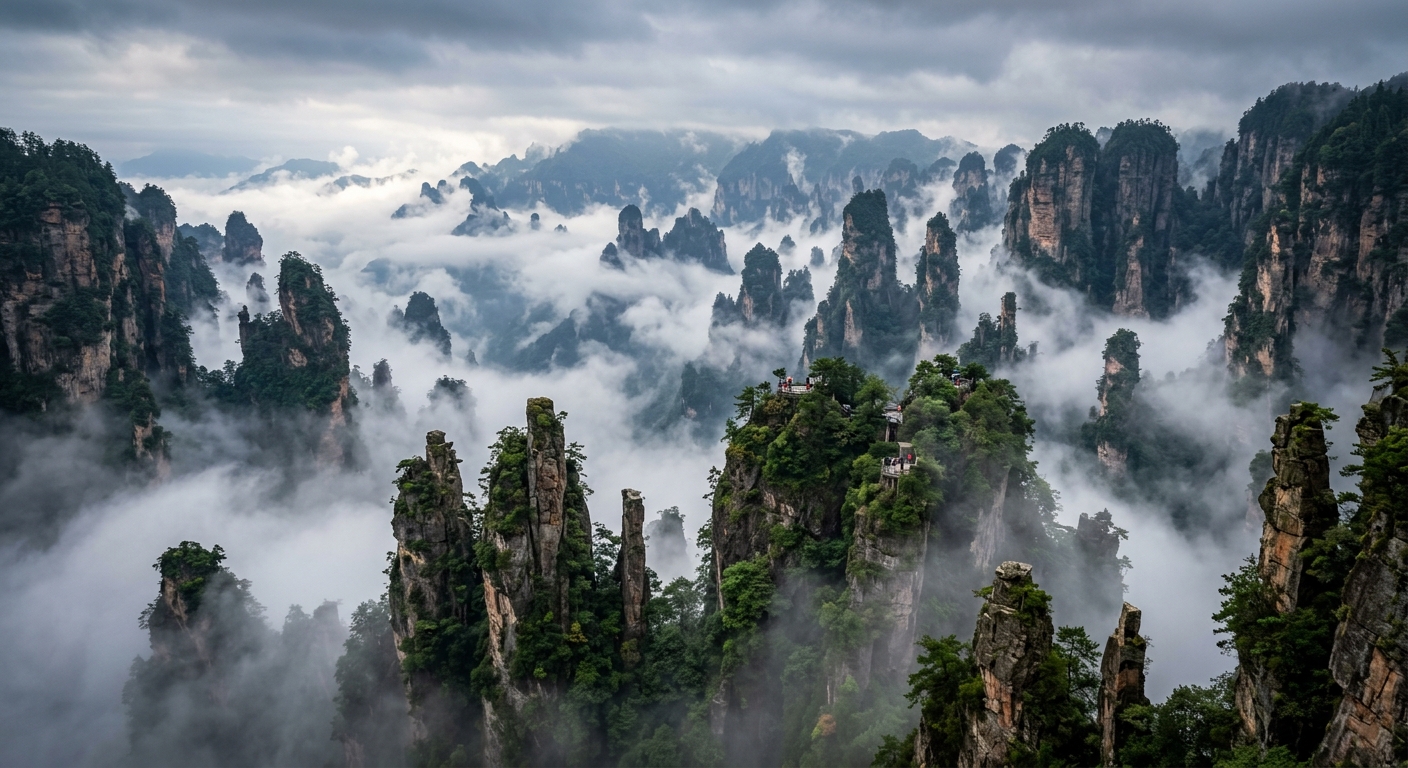
Deep in the misty mountains of China’s Hunan Province lies a landscape so otherworldly that it forced Hollywood to reimagine what alien worlds could look like. The Tianzi Mountains, towering like impossibly tall stone pillars through swirling clouds, became the visual blueprint for Pandora’s legendary floating Hallelujah Mountains in James Cameron’s Avatar. But the real story behind these geological giants is more fascinating than any science fiction.
A Landscape Carved by Time Itself
The Tianzi Mountains, whose name translates to “Son of Heaven Mountains,” rise like ancient skyscrapers from the Zhangjiajie National Forest Park. These quartzite sandstone pillars, some reaching heights of over 4,000 feet, were sculpted by millions of years of erosion that carved away the surrounding rock, leaving behind these dramatic vertical columns.
What makes these formations truly spectacular is how they appear to float above a sea of clouds during certain weather conditions. When morning mist and low-hanging clouds settle in the valleys between the pillars, only the tops of these stone giants remain visible, creating an illusion of mountains suspended in mid-air.
How Avatar Found Its Floating World
When James Cameron’s production team was designing Pandora, they needed landscapes that felt both believable and utterly alien. Traditional mountain ranges wouldn’t capture the sense of wonder required for an extraterrestrial world. Enter the Tianzi Mountains, discovered through extensive location scouting and geological research.
The visual effects team spent months studying the unique erosion patterns, the way light plays across the quartzite surfaces, and how vegetation clings to seemingly impossible cliff faces. They were particularly fascinated by:
- The vertical nature of the rock formations
- The way mist creates natural floating effects
- The lush vegetation that grows on the pillar tops
- The dramatic height differences between formations
- The surreal lighting conditions created by filtered sunlight through clouds
Cameron later admitted that seeing photographs of the Tianzi Mountains made him realize that Earth already contained landscapes more alien than anything his imagination had conceived.
The Science Behind the Stone Pillars
The formation of the Tianzi Mountains began approximately 380 million years ago when this region was covered by a vast sea. Layer upon layer of sediment accumulated on the sea floor, eventually forming thick beds of quartzite sandstone under immense pressure.
As tectonic forces lifted this ancient seabed, creating the foundation for modern China’s landscape, the exposed rock began its transformation. The secret to the Tianzi Mountains’ unique appearance lies in the differential erosion process:
The Erosion Process
Water, the ultimate sculptor, began carving channels through the lifted quartzite. Unlike softer rock types that erode uniformly, quartzite sandstone has varying densities and compositions. The harder sections resisted erosion while softer areas were gradually carved away, creating deep gorges and valleys.
Over millions of years, this selective erosion process isolated sections of the most resistant rock, leaving behind the towering pillars we see today. The process continues even now, with each rainfall and seasonal change slowly reshaping these ancient monuments.
A Living Laboratory of Evolution
The isolation of these stone pillars has created unique microenvironments that support endemic plant and animal species. Each pillar top functions as an isolated ecosystem, similar to islands in the ocean, leading to fascinating evolutionary adaptations.
Scientists have discovered plant species that exist nowhere else on Earth, having evolved specifically to survive on these isolated stone platforms. The challenging growing conditions, with limited soil and extreme exposure to wind and weather, have produced remarkably hardy vegetation that adds to the otherworldly appearance of the landscape.
The Mist Factor
The region’s climate creates the perfect conditions for the mystical floating effect that so inspired Avatar’s designers. The Tianzi Mountains experience high humidity year-round, and the dramatic elevation changes create temperature variations that produce consistent mist and cloud formation.
During optimal viewing conditions, typically in early morning or after rain, the valleys fill with dense white clouds while the pillar tops emerge like islands in a cotton sea. This natural phenomenon occurs so regularly that local weather patterns can be predicted with remarkable accuracy.
Cultural Significance and Modern Recognition
Long before Avatar brought international attention to these formations, the Tianzi Mountains held deep cultural significance in Chinese history and folklore. Local legends speak of the pillars as petrified soldiers from ancient armies, while others describe them as the earthly pillars supporting the heavens.
Following Avatar’s massive success, one of the most prominent pillars was officially renamed “Avatar Hallelujah Mountain” in 2010, cementing the connection between this real-world wonder and its fictional counterpart. This recognition has brought both benefits and challenges, dramatically increasing tourism while raising concerns about environmental protection.
Visiting the Real Pandora
Today, visitors can experience these Avatar-inspiring landscapes through a network of trails, glass walkways, and the world’s longest cable car system. The Zhangjiajie Grand Canyon Glass Bridge offers breathtaking views of the pillars from above, while hiking trails provide close-up encounters with the geological giants.
The best viewing times remain early morning and late afternoon when the interplay of light and mist creates the most dramatic effects. Photography enthusiasts often wait hours for the perfect moment when clouds settle at just the right elevation to recreate the floating mountain illusion that captivated movie audiences worldwide.
The Tianzi Mountains prove that sometimes reality surpasses imagination, offering landscapes so extraordinary that they redefine our understanding of what’s possible on our own planet. These ancient stone pillars continue to inspire artists, scientists, and dreamers, reminding us that Earth itself contains wonders that rival any alien world Hollywood could imagine.

This is such a beautiful example of how erosion works as a sculptor over deep time, Caroline and Sam – you’ve both hit on something I always tried to get students excited about, which is that the *process* of making these mountains is orders of magnitude more dramatic than any fiction. Those quartzite pillars are essentially the resistant cores left behind after everything softer eroded away, so you’re literally looking at millions of years of patient geology on display. I’d be curious whether either of you has stood in a misty valley like that in person, because the visual illusion you mention reminds me that our brains are pattern-recognition machines that fill in what they expect to see, which makes the actual geological truth even stranger
Log in or register to replyomg this is exactly like the scenes in planet earth where david attenborough talks about how erosion literally sculpts entire ecosystems into existance, the zhangjiajie formations are just insane and honestly thier geological history is way more dramatic than any sci-fi movie lol. have you seen any footage of how the local wildlife adapted to living on those isolated pillars, like do they have endemic species that evolved seprately from the lowland populations??
Log in or register to replyngl the misty valleys are such a perfect example of how concealment works at a landscape scale – like the mountains arent actually floating but the mist creates this visual illusion that completly changes how you perceive them. makes me think about how organisms use fog and shadows the same way, you know? its the same evolutionary principle where visibility and concealment are locked in this constant arms race, except here its just geology doing the work for you’re eyeballs lol. nature didnt need to evolve camouflage when it can just let erosion and weather do teh job
Log in or register to reply