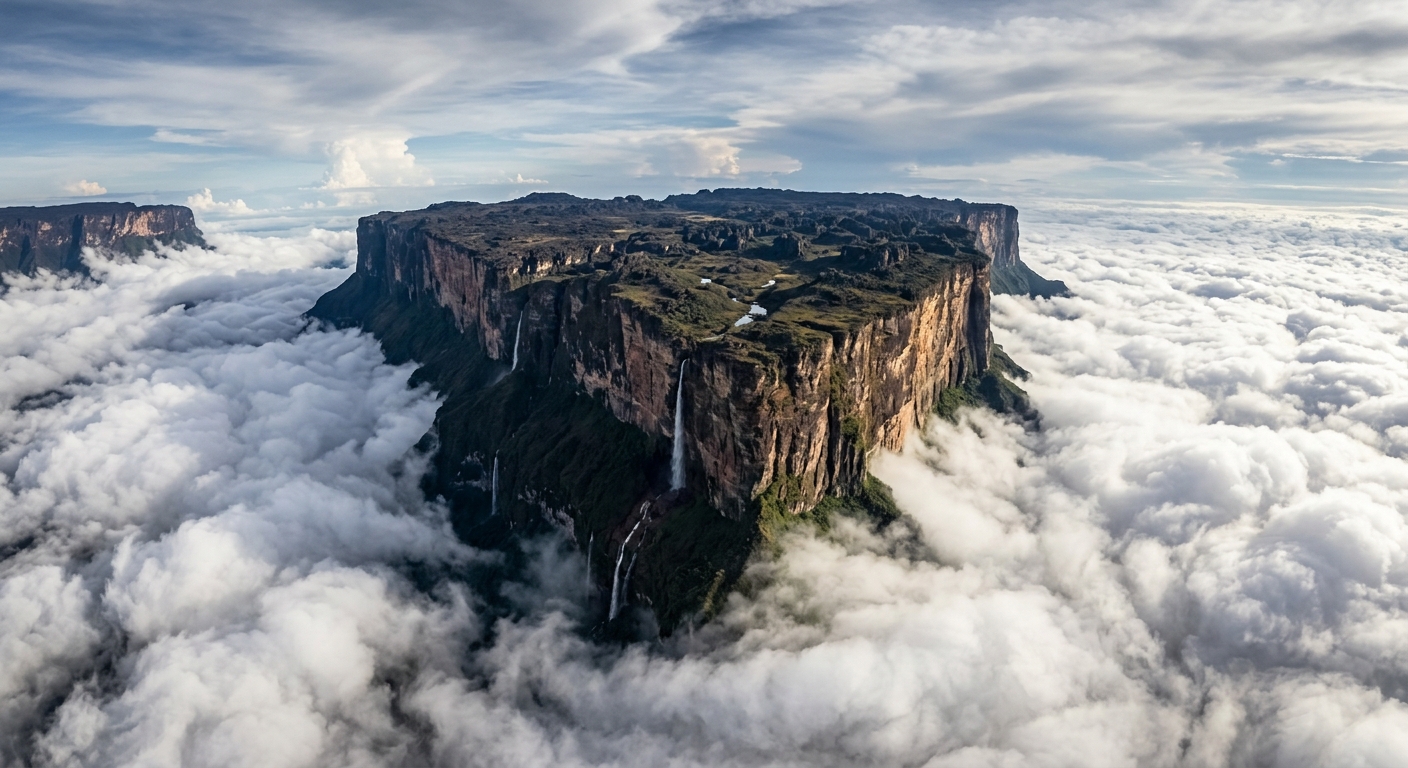
Rising like a colossal fortress from the dense Venezuelan rainforest, Mount Roraima stands as one of Earth’s most mysterious and scientifically fascinating formations. This ancient tepui (table mountain) has been cut off from the surrounding world for millions of years, creating what scientists call a ‘sky island’ where evolution has taken some truly extraordinary paths.
A Fortress Two Billion Years in the Making
Mount Roraima isn’t just any mountain. At 2,810 meters (9,219 feet) above sea level, this massive sandstone plateau covers approximately 31 square kilometers at its summit. What makes it truly special is its age and isolation. The mountain’s rock formations date back nearly two billion years, making it one of the oldest geological structures on our planet.
The tepui’s sheer vertical walls, some rising over 1,000 meters straight up, have created an almost impenetrable natural barrier. For millions of years, the plants and animals living on top have been completely separated from their relatives in the lowlands below. This isolation has turned Mount Roraima into a living laboratory of evolution, where species have developed in complete isolation from the rest of the world.
The Endemic Species That Exist Nowhere Else
The most mind-blowing aspect of Mount Roraima is its incredible collection of endemic species. Scientists have discovered plants and animals here that exist absolutely nowhere else on Earth. The isolation has been so complete that these organisms have evolved unique characteristics found in no other ecosystem.
The Carnivorous Plants of the Summit
Perhaps the most famous endemic species are the carnivorous plants that have adapted to the nutrient-poor soils of the plateau. The Heliamphora, or sun pitcher plants, are found only on the tepuis of this region. These remarkable plants have evolved elaborate pitcher-shaped leaves that trap insects, which they then digest to supplement their nutrition in the harsh, rocky environment.
What’s particularly fascinating is that each tepui in the region has its own species of Heliamphora. Mount Roraima’s version has unique characteristics that distinguish it from its cousins on neighboring mountains, showing how even short distances can lead to dramatic evolutionary divergence when populations are completely isolated.
The Black Frogs That Defy Explanation
Among the most intriguing discoveries are several species of small, dark frogs that have evolved specifically for life on the tepui. These tiny amphibians have developed unique reproductive strategies and physical adaptations to survive in an environment that seems impossibly harsh for creatures that typically need moist conditions to survive.
The Oreophrynella quelchii, a small black toad found only on Mount Roraima and a few neighboring tepuis, has lost its ability to swim. When threatened, instead of jumping into water like most frogs, it curls into a ball and literally bounces down the rocks like a rubber ball. This bizarre defensive strategy evolved because there simply aren’t any large bodies of water on the plateau to escape into.
A Harsh Paradise Unlike Anywhere Else
Life on Mount Roraima is far from easy. The summit experiences some of the most challenging conditions on Earth. The plateau is almost constantly shrouded in clouds and mist, with temperatures that can fluctuate dramatically. The ancient sandstone has been weathered into bizarre formations, creating a landscape that looks more like an alien world than anything terrestrial.
The soil is extremely nutrient-poor, consisting mainly of sand and organic matter. Most of the plateau’s surface is bare rock, punctuated by strange formations carved by millions of years of wind and water erosion. Despite these harsh conditions, life has found a way to not just survive, but thrive and diversify.
Adaptations That Seem Almost Alien
The plants that grow here have developed some of the most unusual adaptations found anywhere on Earth. Many have thick, waxy leaves to conserve moisture in the constant wind. Others have developed extensive root systems that can extract nutrients from seemingly barren rock.
Some endemic orchids have evolved to grow directly on the sandstone, their roots penetrating tiny cracks in the rock to find the minimal nutrients available. These plants represent evolution pushed to its absolute limits, finding ways to extract life from one of Earth’s most challenging environments.
The Inspiration for Conan Doyle’s Lost World
Mount Roraima’s otherworldly appearance and mysterious nature inspired Sir Arthur Conan Doyle to write ‘The Lost World’ in 1912. While Doyle imagined dinosaurs still roaming the plateau, the reality of what scientists have discovered there is arguably even more fascinating than fiction.
The mountain continues to yield new discoveries. Almost every scientific expedition to the summit results in the discovery of new endemic species. In recent years, researchers have found new species of insects, spiders, plants, and even bacteria that exist nowhere else on Earth.
A Window Into Deep Time
Mount Roraima offers us something incredibly rare: a glimpse into how evolution works over geological time scales. The species living on the plateau represent evolutionary experiments that have been running in isolation for millions of years. They show us what happens when life is given complete freedom to adapt and diversify without outside interference.
Perhaps most remarkably, Mount Roraima reminds us that our planet still holds profound mysteries. In an age when we think we’ve explored every corner of Earth, this ancient plateau continues to reveal new forms of life that challenge our understanding of what’s possible. It stands as a testament to the incredible creativity of evolution and the endless capacity of life to surprise us with its ingenuity and persistence.
The next time you think about the diversity of life on Earth, remember Mount Roraima. This isolated table mountain, rising like an island in the sky, harbors an entire world of creatures that exist nowhere else in the universe. It’s a living reminder that our planet is far stranger and more wonderful than we often imagine.

Eve makes a really good point about the gene flow piece, which I think gets lost when we use that “lost world” language (guilty of doing this at the museum too, honestly). What really gets me is how Mount Roraima shows us that even *relative* isolation over geological time is enough to produce wild divergence, not that species just popped into existence in a vacuum, and I think that’s somehow even *more* amazing once you sit with it for a minute.
Log in or register to replyokay this is such a cool example of adaptive radiation in action, though i’d gently push back on the “complete isolation” framing since those species didnt just spontaneously generate – theres definitely been some gene flow and colonization events from the surrounding areas, just super limited ones. but what i love most is how you could compare this to other mountaintop islands like the hawaiian volcanoes or even isolated caves, its the same evolutionary principle playing out in different theaters and thats just *chef’s kiss* for understanding how life adapts to constraints. do you know if theres any research on whether roraima’s current isolation is recent (in geological timescales) or if it was always disconnected?
Log in or register to replyI love how this reminds me of what Jane Goodall discovered with chimp populations in Gombe, where even seemingly isolated groups showed surprising connections and influences from neighboring communities. Eve and Nick are totally right about the gene flow thing, but what really fascinates me is how these endemic species still develop such distinct behaviors and social structures within their constraints, kind of like how different chimp populations have their own cultures and tool use traditions. I wonder if researchers are studying the behavioral ecology of Mount Roraima’s creatures the way primatologists study chimpanzees, because understanding how isolation shapes social complexity in other species could tell us so much about what makes us human too.
Log in or register to reply