
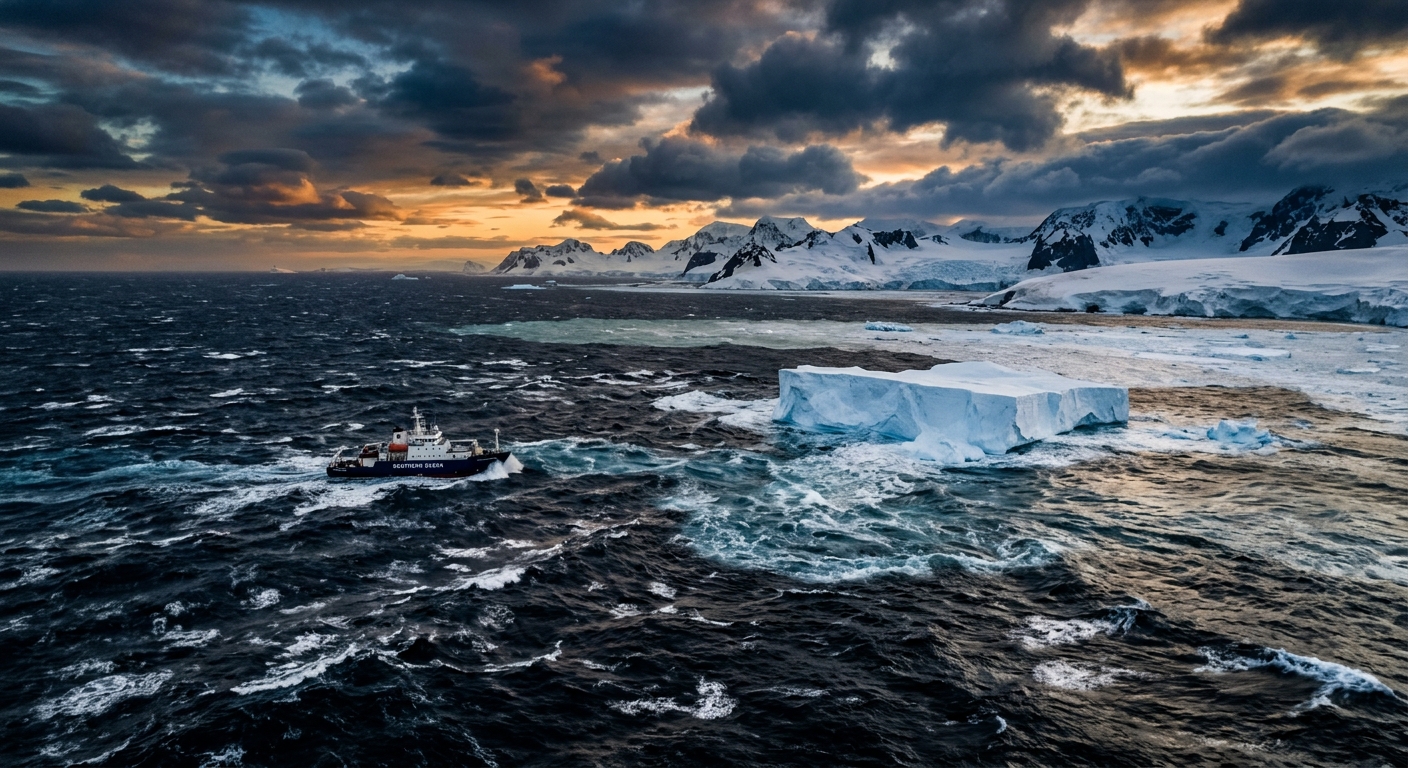
For over a century, scientists have debated whether the waters surrounding Antarctica constitute a separate ocean or simply extensions of the Atlantic, Pacific, and Indian Oceans. In a groundbreaking decision that rewrote geography textbooks worldwide, the National Geographic Society officially recognized the Southern Ocean as Earth’s fifth ocean in June 2021, settling one of the longest-running disputes in oceanography.
This wasn’t just a case of drawing new lines on a map. The recognition of the Southern Ocean represents a fundamental shift in how we understand our planet’s water systems, ocean currents, and marine ecosystems. But what took so long, and why does this decision matter so much for science and conservation?
The Great Ocean Debate: A Century in the Making
The controversy surrounding the Southern Ocean’s status began in the early 1900s when the International Hydrographic Organization first proposed the concept. However, by 1953, the organization had reversed course, deciding that insufficient evidence existed to justify a separate ocean designation. This left geographers, oceanographers, and educators in limbo for decades.
Unlike other oceans defined primarily by the continents that surround them, the Southern Ocean’s boundaries are determined by something far more dynamic: the Antarctic Circumpolar Current. This massive current system, the strongest on Earth, creates a natural barrier that effectively isolates Antarctic waters from the rest of the world’s oceans.
What Makes an Ocean an Ocean?
The challenge in defining the Southern Ocean lay in establishing clear criteria for what constitutes a separate ocean. Traditional oceanography relied heavily on continental boundaries, but the waters around Antarctica presented a unique case. Here, the defining feature isn’t land but rather a colossal moving wall of water.
The Antarctic Circumpolar Current flows clockwise around Antarctica at depths reaching 13,000 feet and spans roughly 1,200 miles in width. This current transports more water than any other current system on Earth, moving approximately 600 times more water than the Amazon River. It effectively creates a water barrier that prevents warmer waters from the north from mixing freely with the frigid Antarctic waters.
The Science Behind the Decision
Modern oceanographic research provided the evidence needed to finally settle the debate. Advanced satellite monitoring, deep-sea sensors, and computer modeling revealed that the Southern Ocean possesses distinct characteristics that set it apart from its neighboring water bodies:
Unique Physical Properties
- Temperature: Southern Ocean waters are significantly colder, with surface temperatures rarely exceeding 35°F (2°C)
- Salinity: Lower salt content due to massive ice melting and minimal evaporation
- Density: Cold, less salty water creates distinct density layers that don’t readily mix with warmer ocean waters
- Current systems: The Antarctic Circumpolar Current dominates water movement, creating clockwise flow patterns unique to this region
Distinct Marine Ecosystem
Perhaps the most compelling evidence for the Southern Ocean’s separate status comes from its unique ecosystem. The combination of extremely cold water, seasonal ice coverage, and isolation has created an environment unlike anywhere else on Earth.
The Southern Ocean supports species found nowhere else, including Antarctic krill, which forms the foundation of the region’s food web. These small, shrimp-like creatures exist in such vast numbers that their collective biomass may exceed that of any other animal species on Earth. The ocean also hosts unique fish species with antifreeze proteins in their blood, allowing them to survive in sub-zero waters.
Why This Recognition Matters
The official recognition of the Southern Ocean carries implications far beyond academic geography. This decision has profound impacts on conservation efforts, climate science, and international maritime law.
Conservation and Environmental Protection
Giving the Southern Ocean official status strengthens arguments for its protection under international environmental agreements. The region plays a crucial role in global climate regulation, absorbing vast amounts of carbon dioxide and heat from the atmosphere. As a recognized ocean, it may receive enhanced protection under various international treaties and conservation initiatives.
The Southern Ocean is also home to some of the last pristine marine environments on Earth. Official recognition helps highlight the need to protect these waters from threats like overfishing, pollution, and climate change.
Climate Science Implications
Understanding the Southern Ocean as a distinct system is crucial for climate modeling and prediction. The ocean acts as a massive heat and carbon sink, and its currents play a vital role in global ocean circulation patterns. Changes in the Southern Ocean can affect weather patterns, sea levels, and marine ecosystems worldwide.
Recent studies have shown that the Southern Ocean absorbs about 40% of all human-generated carbon dioxide stored in oceans globally, despite covering only about 6% of the ocean surface. This makes it critically important for understanding and predicting future climate change scenarios.
The Future of Ocean Science
The recognition of the Southern Ocean marks a significant moment in oceanography, demonstrating how scientific understanding continues to evolve. As technology advances and our knowledge of ocean systems deepens, we may see further refinements in how we categorize and understand our planet’s water bodies.
The decision also highlights the importance of dynamic features like currents and ecosystems in defining ocean boundaries, rather than relying solely on static continental margins. This approach may influence how scientists study and classify other marine regions in the future.
Educational Impact
For educators and students worldwide, the Southern Ocean’s recognition represents an opportunity to update understanding of Earth’s geography and oceanography. Textbooks, maps, and educational materials are being revised to reflect this new reality, ensuring that future generations learn about all five of Earth’s oceans from the start.
The change also provides an excellent case study in how scientific consensus develops over time, showing students that our understanding of the natural world is constantly evolving based on new evidence and improved analytical techniques.
The official recognition of the Southern Ocean as Earth’s fifth ocean represents more than just a cartographic update. It reflects our growing understanding of the complex systems that govern our planet and highlights the unique and vital role that Antarctic waters play in global climate and marine ecosystems. After a century of debate, science has finally given the Southern Ocean the recognition it deserves, ensuring that this critical body of water receives the attention and protection necessary for its preservation.



Really glad this got the official recognition it deserves, though I’ll admit my expertise is more in freshwater systems than oceans. That said, those Antarctic waters are crucial for global climate regulation, and I’ve definitely noticed shifts in migratory amphibian patterns over my 20 years of monitoring that seem linked to ocean circulation changes. It makes you wonder how many other critical ecosystems are flying under the radar while we’re still debating their official status, you know?
Log in or register to replyThis is such wonderful news! The Southern Ocean’s official recognition matters so much for marine protection, especially since it’s home to some of the most incredible cetacean populations on the planet. Humpbacks migrate thousands of miles to those Antarctic waters to feed, and the acoustic environments there are absolutely pristine for their communication, which is something we desperately need to preserve. I’m really hoping this designation will strengthen enforcement against illegal whaling in the region and help protect minke whales and other species that depend on those rich Southern Ocean ecosystems.
Log in or register to replyThis hits different at 2am when you’re actually out looking at the southern sky, you know? The Antarctic waters regulate so much of what we see overhead in terms of weather patterns and atmospheric conditions, and I’ve noticed how light pollution down there is still relatively minimal compared to the north, which means those nocturnal species from penguins to fish are experiencing the sky the way it’s supposed to be. It’s wild to think about how official recognition could actually help protect those dark skies and the creatures that depend on them for navigation and hunting, especially as climate change keeps pushing species around.
Log in or register to reply