
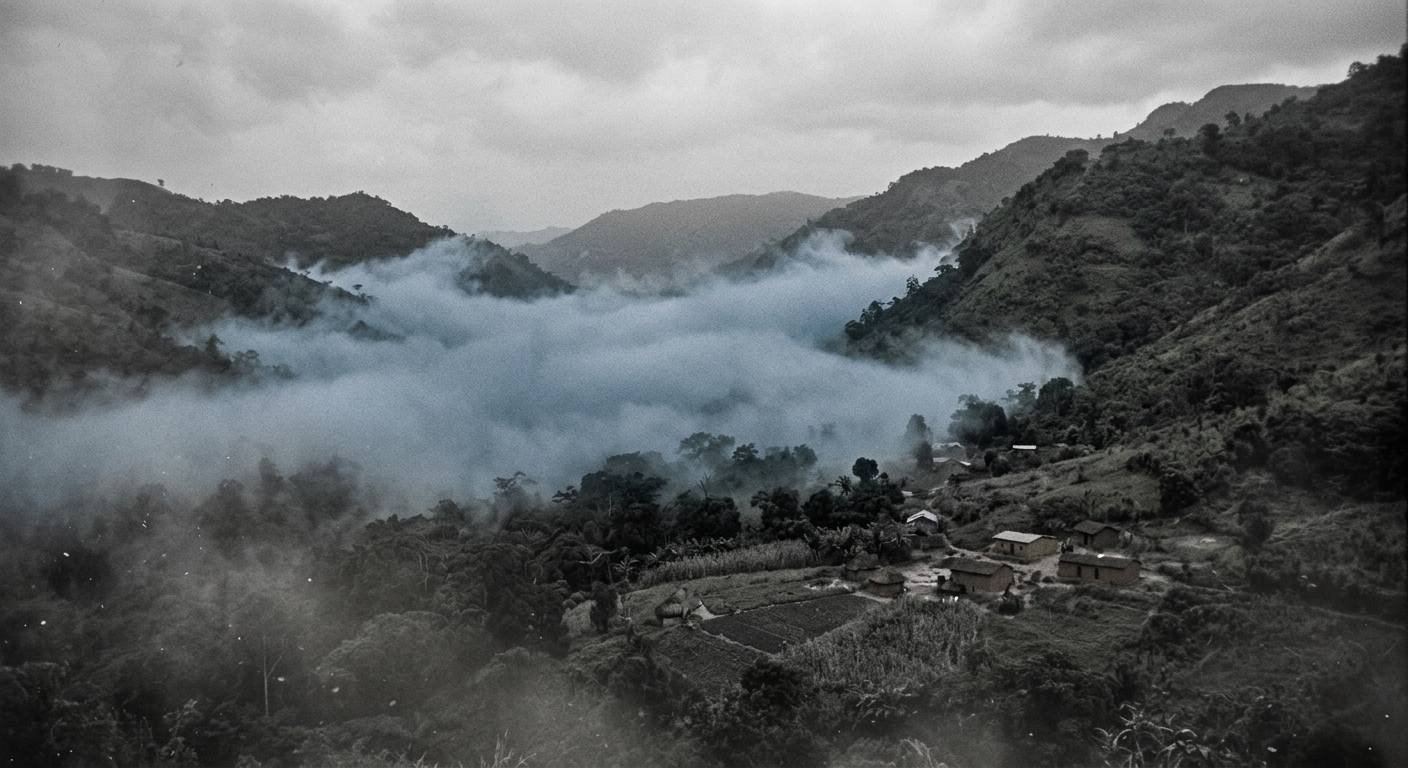
In the early morning hours of August 21, 1986, the villages surrounding Lake Nyos in Cameroon experienced something that defied explanation. Residents who had gone to sleep the night before simply never woke up. Over 1,700 people died in their sleep, along with thousands of livestock, all within a radius of 25 kilometers from a seemingly peaceful crater lake. No explosion was heard, no earthquake felt, and no visible signs of destruction remained. The lake had literally burped death.
The Mystery of the Silent Killer
Lake Nyos sits in a volcanic crater in Cameroon’s Northwestern Province, formed roughly 400 years ago. This seemingly tranquil body of water, measuring about 1.2 miles long and 0.9 miles wide, concealed a deadly secret beneath its surface. Unlike typical lakes, Lake Nyos is what scientists call a “meromictic” lake, meaning its layers of water do not mix naturally.
The lake’s bottom layer, fed by underground springs connected to volcanic chambers deep below, had been slowly accumulating carbon dioxide for decades. This CO2, dissolved under pressure in the deep, cold waters, created a massive underwater reservoir of death waiting to be released.
The Deadly Chemistry
Carbon dioxide is heavier than air and completely odorless and colorless. When the lake suddenly released an estimated 1.6 million tons of CO2 in what scientists call a “limnic eruption,” the gas formed a deadly cloud that hugged the ground as it spread outward from the lake.
The victims never knew what hit them. Carbon dioxide displaces oxygen in the air, and at concentrations above 30%, it causes immediate unconsciousness. The gas cloud, traveling at speeds of up to 45 miles per hour, swept through valleys and villages like an invisible tsunami of death.
What Triggered the Catastrophe?
Scientists believe the trigger was likely a landslide or small earthquake that disturbed the stratified layers of the lake. This disturbance caused the CO2-saturated deep water to suddenly rise to the surface, where the decreased pressure allowed the dissolved gas to rapidly escape, much like opening a violently shaken bottle of soda.
Some theories suggest that heavy rainfall in the days preceding the disaster may have upset the lake’s delicate balance. Others point to possible seismic activity or even a small rockfall into the lake. Regardless of the exact trigger, the result was catastrophic.
The Aftermath of Silence
Rescue workers arriving at the scene described an apocalyptic landscape. Entire families were found dead in their homes, apparently having died peacefully in their sleep. Cattle, birds, and insects were scattered across the countryside, all victims of the invisible killer.
The lake itself had changed dramatically. Its normally blue waters had turned a rusty red-brown color due to iron-rich water that had been stirred up from the depths. The water level had risen by about three feet, and a strong smell of gunpowder and rotten eggs hung in the air.
A Rare But Deadly Phenomenon
Lake Nyos was not the first limnic eruption on record. Two years earlier, in 1984, nearby Lake Monoun had experienced a similar but smaller event that killed 37 people. These incidents brought global attention to a phenomenon that scientists had previously only theorized about.
Only three lakes worldwide are known to pose this specific threat:
- Lake Nyos in Cameroon
- Lake Monoun in Cameroon
- Lake Kivu on the border of Rwanda and Democratic Republic of Congo
All three are located in the East African Rift valley system, where volcanic activity provides the underground CO2 sources that feed these deadly reservoirs.
The Solution: Making the Lake Burp Safely
Following the disaster, international scientists worked with the Cameroonian government to develop a solution. In 2001, they installed a degassing system in Lake Nyos consisting of pipes that extend from the lake’s surface down to its CO2-rich depths.
These pipes create a continuous fountain effect, allowing the dissolved CO2 to escape gradually and safely rather than building up to dangerous levels. The system essentially forces the lake to “burp” continuously in small, harmless amounts rather than storing up gas for another potentially catastrophic release.
Lessons from Nature’s Gas Chamber
The Lake Nyos disaster serves as a stark reminder of the hidden dangers that can lurk in Earth’s most peaceful-seeming places. It also demonstrates how rare geological phenomena can have devastating human consequences when populations live unknowingly in harm’s way.
Scientists continue to monitor Lake Nyos and similar bodies of water around the world. Climate change and human activities could potentially trigger similar events in the future, making ongoing research and monitoring crucial for preventing another silent catastrophe.
The tragedy at Lake Nyos fundamentally changed our understanding of limnic eruptions and led to the development of early warning systems and prevention methods. Today, the lake remains potentially dangerous but is carefully managed to prevent another deadly outgassing event.
The Ongoing Threat
While the degassing system has significantly reduced the risk, scientists estimate that it would take decades to fully degas Lake Nyos. The lake continues to accumulate CO2, though at a much slower rate than it releases it through the artificial system.
Perhaps most concerning is Lake Kivu, which contains not only dissolved CO2 but also methane, and sits near a population of over 2 million people. Unlike Lake Nyos, Lake Kivu has yet to be equipped with comprehensive degassing systems, making it a ticking time bomb that could potentially affect far more people than the 1986 Cameroon disaster.



This is genuinely terrifying and a sobering reminder of how nature operates on scales we can barely comprehend. That said, I have to gently point out that while limnic eruptions are rare and devastating, we actually have way more localized “invisible killers” to worry about that get almost no attention, and I’m talking about white-nose syndrome wiping out millions of bats every year with barely a news cycle. Both are examples of how geological and ecological systems can spiral beyond our control, but one of them has a solution we’re actively working on if people would just care about bats as much as they care about lakes trying to murder us! Sorry, I just get passionate about this stuff.
Log in or register to replyok this is genuinely terrifying and i love how nature just casually finds new ways to be deadly. the crazy part is how long these gases can build up undetected – like your’re literally living next to an invisible time bomb that just needs the rite conditions to trigger. makes me think how many other crater lakes might have teh same setup waiting to happen tbh
Log in or register to replyThis is absolutely haunting, and while it’s a completely different mechanism than what I study with reefs, it really drives home how much we still don’t fully understand about our planet’s systems. I’ve actually used Lake Nyos as a teaching moment with my dive students when we talk about dissolved gases and stratification, because the same layering principles that trap CO2 in that crater lake are what create dead zones in our oceans. The difference is we can actually prevent ours through restoration and policy changes, which is what keeps me going. Have you looked into whether the degassing infrastructure they installed afterward actually prevented another catastrophic release?
Log in or register to reply