
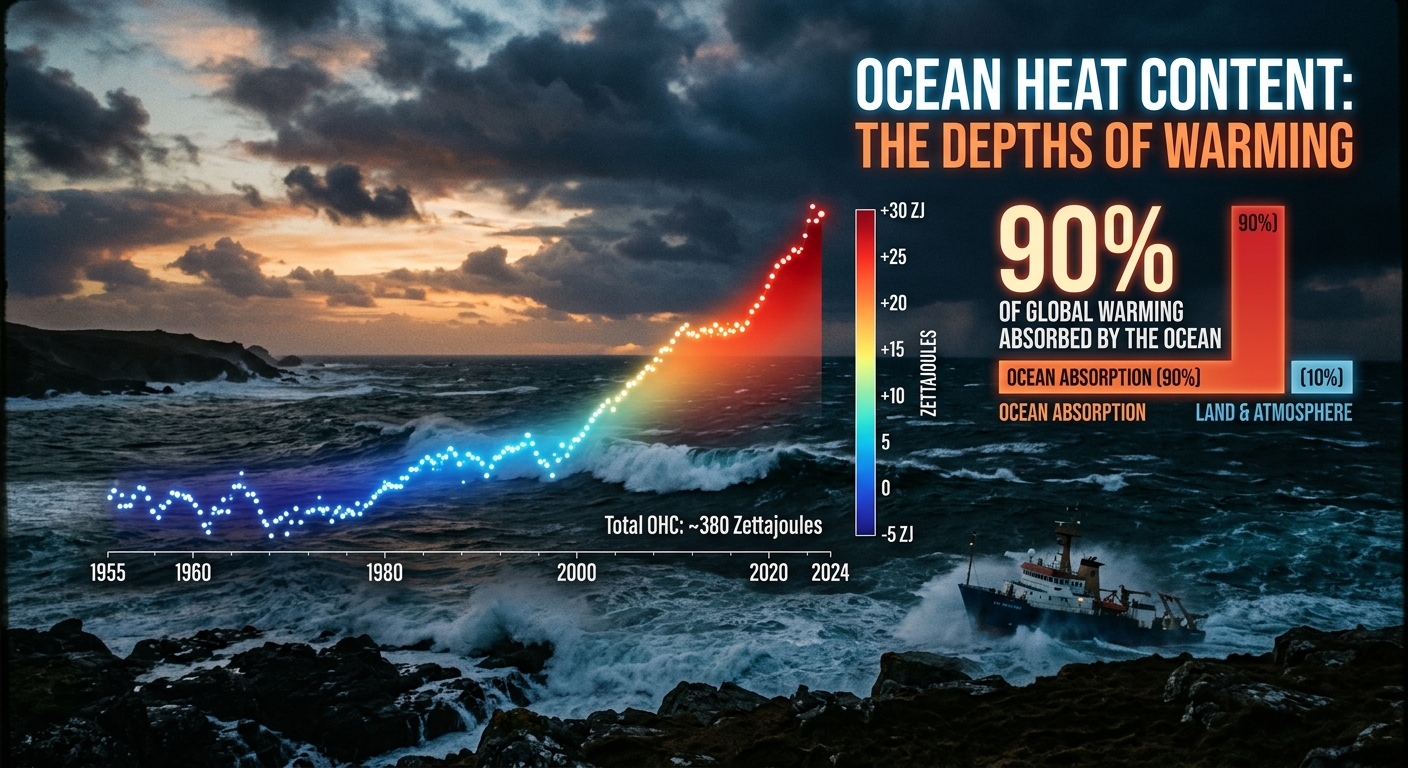
Imagine stepping outside tomorrow morning and feeling temperatures of 122°F (50°C) scorching your skin. The air would be so hot that breathing becomes difficult, and survival outdoors nearly impossible. This apocalyptic scenario isn’t science fiction: it’s what our planet would feel like if not for one incredible, unsung hero quietly working beneath the waves.
Our oceans are performing the ultimate disappearing act, absorbing a staggering 90 percent of all excess heat generated by global warming. This mind-blowing fact means that while we debate climate change on land, the real battle is happening in the depths of our blue planet, where an invisible thermal war determines the fate of all life on Earth.
The Ocean’s Incredible Heat-Eating Superpower
To understand just how extraordinary this phenomenon is, we need to grasp the sheer scale of heat we’re talking about. Every second, our oceans absorb the equivalent energy of 400,000 Hiroshima bombs. Let that sink in: 400,000 nuclear explosions worth of heat energy, every single second, vanishing into the blue depths that cover 71 percent of our planet’s surface.
This incredible capacity comes from water’s unique molecular structure. Water has an exceptionally high specific heat capacity, meaning it can absorb enormous amounts of thermal energy with relatively small increases in temperature. While land surfaces heat up quickly when the sun shines on them, water acts like a massive thermal sponge, soaking up heat and distributing it throughout its vast volume.
The Numbers That Will Blow Your Mind
Scientists have calculated that since the 1960s, the oceans have absorbed more than 93 percent of the excess heat trapped by greenhouse gases. To put this in perspective:
- The top 6,500 feet of ocean water has absorbed 10 times more heat than the entire atmosphere
- If all this absorbed heat had remained in the atmosphere instead, global air temperatures would have risen by approximately 97°F (54°C)
- The ocean absorbs heat at a rate of 250 trillion watts continuously
- This is equivalent to exploding 1.5 billion atomic bombs in the ocean every single day
How Deep Does the Heat Go?
The ocean’s heat absorption isn’t just a surface-level phenomenon. Advanced scientific instruments have revealed that this thermal invasion penetrates to extraordinary depths. The top 2,000 meters of ocean water, known as the upper ocean, has warmed significantly over the past five decades. But perhaps most remarkably, scientists have detected warming signatures as deep as 4,000 meters below the surface.
This deep heat penetration happens through a complex dance of ocean currents, a global conveyor belt of water that circulates warm surface water to the depths and brings cold deep water to the surface. The Gulf Stream, for example, carries warm water from the tropics toward the poles, while deep ocean currents transport heat downward, effectively burying it in the planet’s liquid basement.
The Thermal Timeline
What makes this process even more fascinating is its timeline. Heat absorbed at the ocean’s surface today might not reach the deepest ocean layers for hundreds or even thousands of years. This means our oceans are essentially a time capsule of thermal energy, storing heat from decades past while continuing to absorb the excess heat we produce today.
The Hidden Consequences of This Thermal Heroism
While the ocean’s heat absorption has undoubtedly saved land-dwelling creatures from catastrophic temperature increases, this heroic act comes with serious consequences that are reshaping our planet in ways we’re only beginning to understand.
Thermal Expansion: The Invisible Sea Level Rise
As seawater warms, it expands. This thermal expansion is responsible for approximately 50 percent of the sea level rise we’ve observed since 1993. The physics is simple but the implications are staggering: warmer water takes up more space, and with billions of gallons of seawater heating up, the ocean literally grows larger.
Marine Life in Hot Water
Ocean creatures have evolved over millions of years to thrive in specific temperature ranges. The rapid warming is forcing entire ecosystems to adapt, migrate, or face extinction. Coral reefs, often called the rainforests of the sea, are particularly vulnerable. When water temperatures rise just 2-3 degrees above normal, corals expel the colorful algae living in their tissues, leading to coral bleaching events that can kill entire reef systems.
Disrupted Ocean Circulation
The global ocean conveyor belt that distributes heat around the planet depends on temperature and salinity differences to drive circulation. As surface waters warm and ice melts, adding fresh water to the oceans, this delicate circulation system shows signs of slowing down. Some scientists worry that major ocean currents could weaken or even shut down entirely, dramatically altering regional climates worldwide.
What This Means for Our Future
The ocean’s remarkable ability to absorb heat has bought humanity precious time to address climate change, but this thermal buffer isn’t infinite. As the oceans continue to warm, their capacity to absorb additional heat diminishes. Scientists describe this as approaching a saturation point, where the oceans can no longer protect us from rapid atmospheric warming.
Furthermore, the heat stored in our oceans represents a massive reservoir of energy that will continue influencing our climate for centuries to come. Even if we stopped all greenhouse gas emissions tomorrow, the heat already stored in the oceans would continue driving climate change for generations.
The Research Revolution
Understanding ocean heat absorption has revolutionized climate science. Networks of robotic floats called Argo buoys now patrol the world’s oceans, diving to depths of 2,000 meters and measuring temperature, salinity, and other properties as they surface. This army of 4,000 robotic sentinels provides real-time data on how heat moves through our oceans, giving scientists unprecedented insight into our planet’s thermal state.
A Planet-Sized Thermal Battery
Perhaps the most mind-blowing way to think about our oceans is as a planet-sized thermal battery. This enormous battery has been charging up with excess heat for decades, storing energy equivalent to billions of atomic bombs while keeping our atmosphere relatively stable. But like any battery, it has limits, and understanding those limits is crucial for predicting our planet’s future.
The next time you stand at the ocean’s edge, remember that you’re looking at Earth’s greatest climate hero. Those waves lapping at your feet are part of a vast, three-dimensional system that has quietly absorbed enough heat to turn our planet into a furnace. The ocean’s incredible thermal sacrifice has given us a livable world, but it’s also a reminder of the enormous forces at play in our changing climate and the urgent need to protect the blue planet that protects us.






This is fascinating stuff about ocean heat buffering, though I have to say it makes me think about how the mycosphere does something similarly crucial for terrestrial ecosystems that we barely talk about. Fungal networks literally regulate soil temperature and moisture retention, which cascades into carbon sequestration and nutrient cycling, yet they get zero of the ocean’s press attention. Not diminishing what you’ve written here at all, just wondering if there’s a future post exploring how mycelial systems and ocean systems work together as this interconnected thermoregulation machinery?
Log in or register to replyYou’re touching on something that really resonates with me, Frederica / the interconnectedness angle is huge! I think about it a lot through the lens of animal behavior too – like how Jane Goodall’s research showed us that chimps aren’t just passive inhabitants of their forests, they’re actively shaping ecosystem dynamics through tool use and social knowledge transfer, and now we’re realizing similar complexity exists in how organisms at every scale from fungi to marine species are co-engineering their environments. Your point about mycorrhizal networks doing invisible thermoregulation work while oceans get the spotlight actually makes me think we need to shift how we frame “saving the planet” away from single heroes and toward understanding these interdependent
Log in or register to replythe ocean heat absorption thing is wild but what really gets me is thinking about whats happening down at like 2000-4000 meters where the cold water masses are actually sequestering carbon and heat for centuries, its not just passive cooling its this incredible biological pump that we’re only starting to understand tbh. the mycosphere is def important for sure but ngl theres something almost haunting about how the deep ocean is doing this massive planetary service in complete darkness while bioluminescent creatures are down there just… existing in that alien world, and we know more about mars than we do about our own abyssal zones lol
Log in or register to reply