
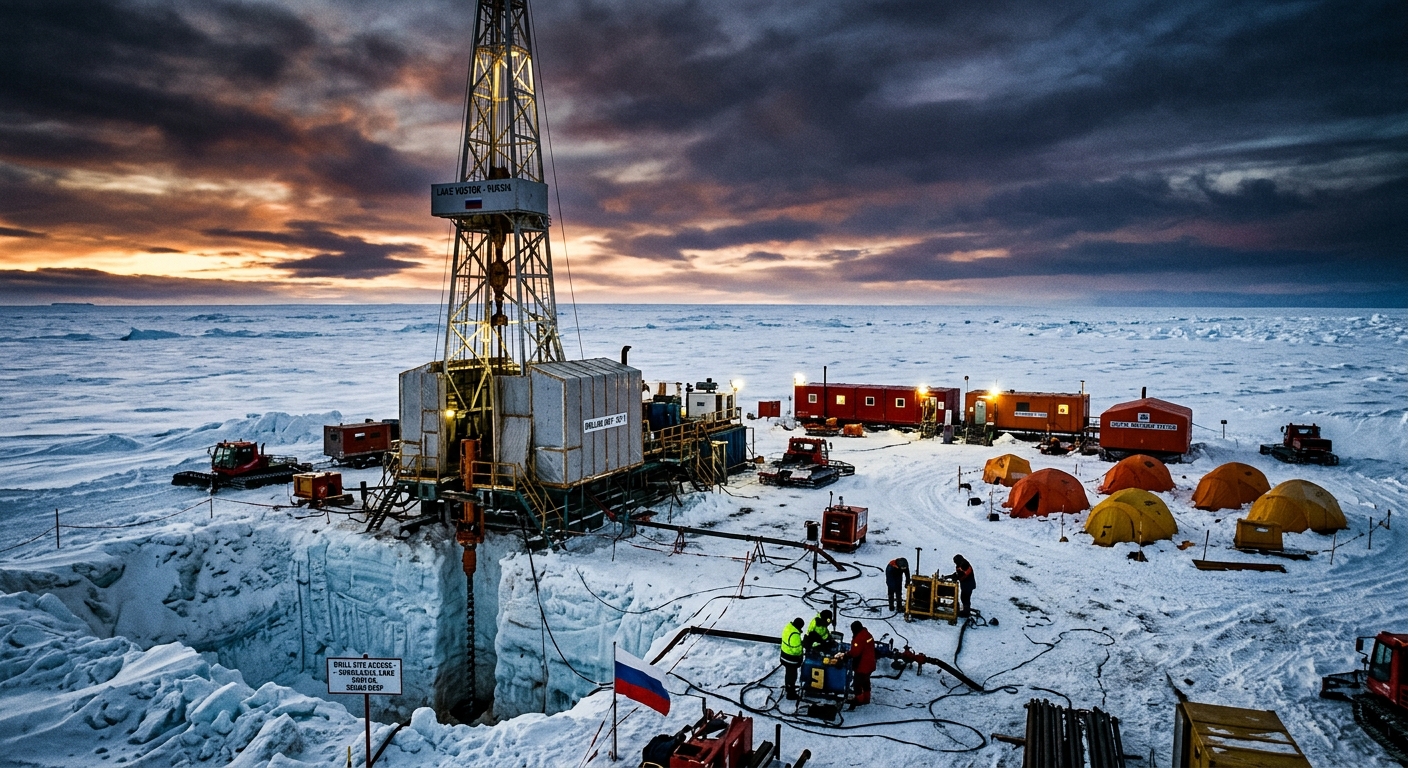
Buried beneath two and a half miles of Antarctic ice lies one of Earth’s most extraordinary secrets: Lake Vostok, a body of water that has remained completely sealed off from the outside world for an estimated 15 million years. This subglacial lake, roughly the size of Lake Ontario, represents the ultimate time capsule, potentially harboring life forms that evolved in complete isolation since before humans walked the Earth.
A Lake Hidden in Plain Sight
Lake Vostok wasn’t discovered until 1996, despite sitting beneath one of the most studied regions of Antarctica. Russian scientists at Vostok Station had been drilling ice cores for decades, unaware that their efforts were bringing them closer to one of the planet’s most remarkable features. The lake stretches approximately 160 miles long and 30 miles wide, making it the largest known subglacial lake in Antarctica.
What makes this discovery truly mind-boggling is the timeline. When Lake Vostok was first sealed beneath the ice, the Antarctic continent looked drastically different. Mastodons roamed North America, and early human ancestors were just beginning to walk upright. The lake has remained in darkness, under crushing pressure, and in complete isolation ever since.
Extreme Conditions That Shouldn’t Support Life
The conditions within Lake Vostok are nothing short of extreme. The water temperature hovers around minus 3 degrees Celsius (27 degrees Fahrenheit), staying liquid only due to the immense pressure from the ice above and geothermal heat from below. The pressure itself is more than 350 times greater than atmospheric pressure at sea level.
The lake exists in perpetual darkness, with no contact with Earth’s atmosphere for millions of years. Oxygen levels are estimated to be 50 times higher than typical surface waters, created by the slow melting and refreezing of the ice above. These conditions create an environment unlike anywhere else on our planet, and possibly similar to conditions that might exist beneath the icy surfaces of Jupiter’s moon Europa or Saturn’s moon Enceladus.
The Drilling Challenge of a Lifetime
Reaching Lake Vostok presented scientists with an unprecedented challenge. Russian researchers spent decades drilling through the ice, but as they approached the lake, concerns mounted about contamination. The drilling process used antifreeze and other chemicals that could potentially poison this pristine environment.
In 2012, after more than 20 years of drilling, Russian scientists finally broke through to the lake’s surface. However, they immediately sealed the borehole to prevent contamination, allowing the lake water to freeze in the shaft. This frozen water was later extracted and analyzed, providing the first direct samples from this ancient ecosystem.
What Lives in a 15-Million-Year Time Capsule?
The question that captivated scientists worldwide was simple yet profound: could anything possibly survive in such extreme isolation? Early analysis of ice samples and lake water revealed surprising answers:
- Microbial life: DNA analysis revealed thousands of different microbial species, many completely unknown to science
- Ancient bacteria: Some microorganisms appeared to have evolved in complete isolation, potentially representing evolutionary pathways not seen anywhere else on Earth
- Extremophiles: Organisms adapted to the high-pressure, oxygen-rich, nutrient-poor environment
- Possible multicellular life: Some samples suggested the presence of more complex organisms, though this remains under investigation
Evolutionary Laboratory
Lake Vostok essentially functions as a natural laboratory for evolution. Cut off from external genetic influences, any life forms present have had 15 million years to adapt and evolve in ways impossible in connected ecosystems. This isolation could have produced organisms with unique metabolisms, survival strategies, and genetic codes.
Some scientists speculate that life in Lake Vostok might rely on chemosynthesis rather than photosynthesis, deriving energy from chemical reactions rather than sunlight. Others suggest that the high oxygen content might have allowed for unusual respiratory adaptations.
Implications for Life Beyond Earth
The discoveries in Lake Vostok have profound implications for astrobiology and our search for life beyond Earth. The lake’s conditions closely mirror those hypothesized to exist in the subsurface oceans of several moons in our solar system.
Europa, Jupiter’s ice-covered moon, likely harbors a vast ocean beneath its frozen surface. Similarly, Saturn’s moons Enceladus and Titan may contain subsurface water bodies. If life can thrive in Lake Vostok’s extreme conditions, it dramatically increases the possibility that life could exist in these alien environments.
Ongoing Mysteries and Future Exploration
Despite the groundbreaking discoveries, Lake Vostok still holds many secrets. Scientists continue to analyze samples and develop new techniques for exploring the lake without contaminating it. Future missions may include sophisticated robotic probes designed to explore the lake’s depths while maintaining its pristine condition.
The lake’s bottom sediments could contain an even more detailed record of ancient life and climate conditions. Some researchers believe these sediments might preserve fossils or genetic material from organisms that lived in Antarctica before it became ice-covered.
A Window Into Earth’s Deep Past
Lake Vostok represents more than just an isolated ecosystem; it’s a window into Earth’s deep past and a glimpse of life’s incredible adaptability. This hidden world, sealed away for longer than our species has existed, continues to challenge our understanding of life’s limits and expand our imagination about what might be possible in the universe’s most extreme environments.
As research continues, Lake Vostok may yet reveal its greatest secrets: how life adapts to complete isolation, what new forms of existence might emerge in extreme conditions, and whether the building blocks of life we discover here might guide us to life among the stars.


This is wild stuff, but I gotta say it makes me think about what we’re losing in real-time with our accessible lakes and rivers. Like, Lake Vostok’s microbes survived 15 million years in isolation, but we’re fragmenting living freshwater ecosystems with dams and pollution every single year, which destroys the genetic diversity and resilience we might actually need to understand extreme life. Curious if anyone’s studying how isolated populations in heavily dammed river systems compare to healthier connected watersheds, because I suspect the analogy works in reverse too.
Log in or register to replyRachel E. nailed it, and this hits me hard as someone who’s watched the canopy in Borneo shrink while studying it. Lake Vostok’s microbes persisted in perfect isolation for millions of years, but our tropical freshwater systems and the rainforests feeding them are fragmenting in real-time, losing species we haven’t even catalogued yet. It’s almost cruel how we’re destroying accessible biodiversity while being amazed by ancient microbial survivors, you know?
Log in or register to replyThis is absolutely fascinating, though I have to admit my brain immediately jumped to thinking about isolated populations and how Lake Vostok’s microbial communities might mirror what we see in primate groups cut off geographically for millennia. Those extremophile organisms have adapted so specifically to their environment, just like how isolated chimp populations in different forests develop distinct cultures and tool-use traditions – it really drives home how life finds its own path when separated. Makes you wonder what similar pressures might reveal about the origins of complex behavior in our closest relatives too.
Log in or register to reply