
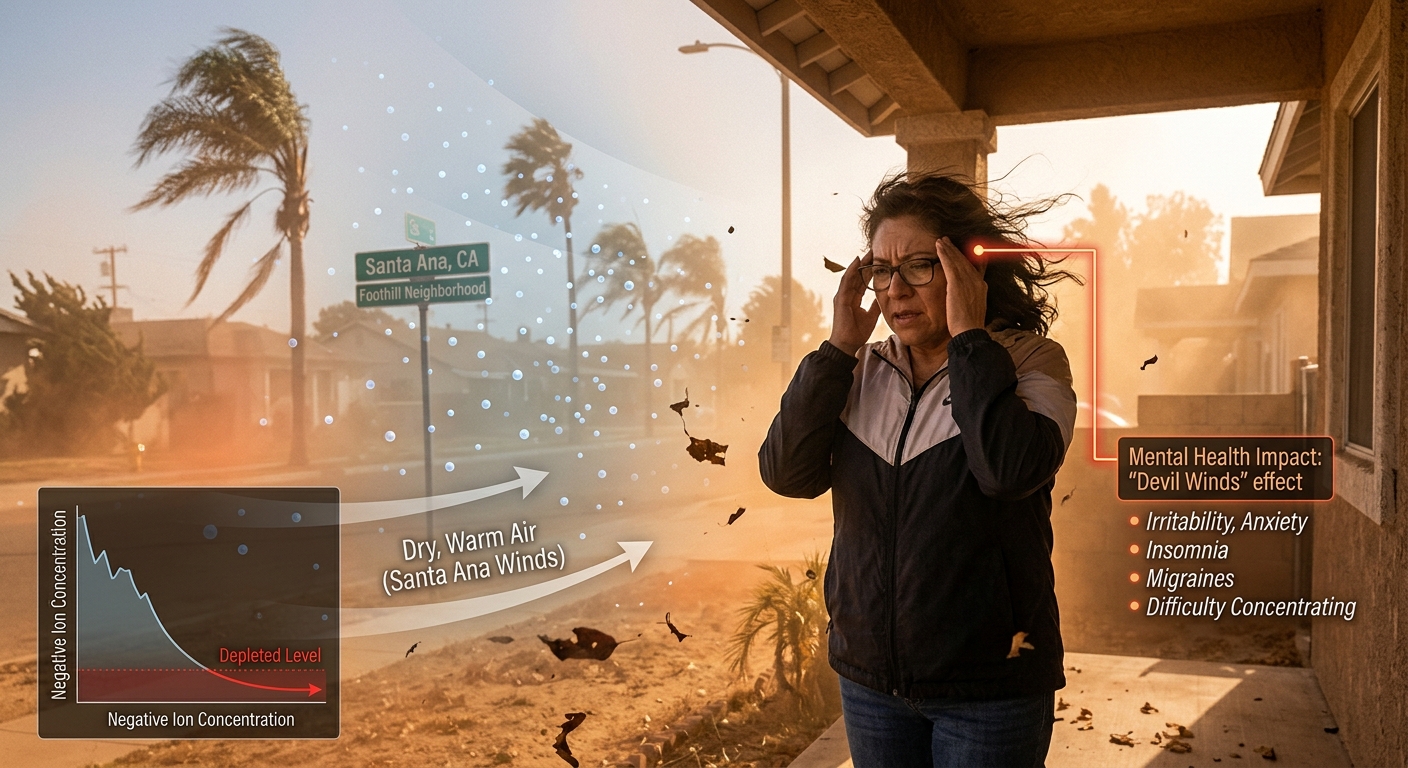
Picture this: a perfectly rational person suddenly becomes agitated, depressed, or even violent for no apparent reason. Meanwhile, their neighbor experiences inexplicable headaches and anxiety. What if I told you the culprit might be floating right outside their window?
Around the world, certain winds carry more than just dust and debris. They carry a reputation for driving people to madness, triggering crime sprees, and sending hospital admissions skyrocketing. These aren’t just old wives’ tales or folklore. Modern science has revealed that these “devil winds” create very real atmospheric conditions that can profoundly affect human psychology and physiology.
The Global Gallery of Mind-Bending Winds
From the Santa Ana winds of Southern California to the Föhn winds of the Alps, these atmospheric phenomena share disturbing similarities. The Santa Anas, nicknamed “devil winds” by locals, blow hot and dry from the inland deserts toward the Pacific coast. During these events, Los Angeles police departments report significant spikes in domestic violence, road rage incidents, and emergency psychiatric admissions.
In Europe, the warm, dry Föhn winds that cascade down the Alps have been linked to increased suicide rates, migraines, and what locals call “Föhn sickness.” The Chinook winds of the Rocky Mountains, the Sirocco of the Mediterranean, and the Sharav of the Middle East all share this eerie ability to influence human behavior across entire regions.
What makes these winds particularly unsettling is their predictability. Weather forecasters can warn when they’re coming, and emergency services often brace for the psychological chaos that follows.
The Science Behind the Madness
So what exactly turns wind into a mental health crisis? Scientists have identified several interconnected mechanisms that transform these atmospheric events into psychological storms.
Positive Ion Bombardment
The most well-documented culprit is the dramatic increase in positive ions in the atmosphere. When air masses move rapidly over mountain ranges and through dry conditions, friction strips electrons from air molecules, creating an abundance of positively charged particles. Research shows that high concentrations of positive ions can trigger the release of serotonin in the human body.
While serotonin is often called the “happiness hormone,” too much of it creates the opposite effect. Excess serotonin can cause anxiety, irritability, respiratory problems, nausea, and what researchers term “serotonin syndrome.” This explains why people report feeling “wired” and agitated during devil wind events.
Barometric Pressure Chaos
These wind systems also create rapid changes in atmospheric pressure. The human body, which is roughly 60% water, acts like a biological barometer. Sudden pressure drops can cause tissues to expand slightly, potentially affecting everything from joint pain to brain pressure. Many people report severe headaches, dizziness, and cognitive fog during these weather events.
Sleep Disruption and Circadian Chaos
The physical characteristics of devil winds create perfect conditions for sleep disruption. The constant noise, static electricity buildup, and rapid temperature changes make quality rest nearly impossible. Sleep deprivation compounds the other physiological stresses, creating a cascade effect that can trigger or worsen mental health conditions.
The Statistical Evidence
The correlation between devil winds and human behavior isn’t just anecdotal. Multiple studies have documented significant statistical relationships:
- Hospital emergency departments report 10-15% increases in psychiatric admissions during Santa Ana wind events
- Domestic violence calls spike by as much as 20% during strong Föhn wind periods
- Traffic accidents increase significantly, often attributed to increased aggressive driving
- School disciplinary problems show measurable increases during these weather patterns
- Worker productivity drops, and workplace accidents rise
Insurance companies in affected regions have even begun factoring these weather patterns into their risk assessments for certain types of claims.
Historical Perspectives and Cultural Recognition
Ancient cultures recognized these connections long before modern science could explain them. Native American tribes in Southern California had specific names for the Santa Ana winds and associated them with periods of conflict and unrest. European alpine communities developed folk wisdom about staying indoors and avoiding important decisions during Föhn events.
Even legal systems have grappled with these phenomena. Some European courts have historically considered Föhn conditions as mitigating factors in certain criminal cases, though this practice has largely disappeared in modern jurisprudence.
Personal Protection and Preparation
Understanding these effects empowers people to take protective measures. During devil wind events, health experts recommend:
- Using negative ion generators or air purifiers indoors
- Staying hydrated and avoiding alcohol
- Practicing stress-reduction techniques like meditation
- Postponing important decisions or confrontational conversations
- Seeking cool, humid environments when possible
- Using white noise machines to mask wind sounds for better sleep
The Broader Implications
As climate change alters global weather patterns, some regions are experiencing more frequent or intense devil wind events. This has important implications for urban planning, mental health services, and emergency preparedness. Cities in affected areas are beginning to incorporate these considerations into their public health strategies.
The study of these winds also opens fascinating questions about how much of our daily mood and behavior might be influenced by atmospheric conditions we barely notice. It challenges our assumptions about free will and personal responsibility while highlighting the profound connections between human consciousness and the natural world.
The next time you feel inexplicably agitated during a windstorm, remember: you’re not imagining things. You’re experiencing one of nature’s most mysterious and powerful influences on the human psyche. These devil winds remind us that we’re not separate from our environment but intimately connected to the atmospheric ocean that surrounds our planet.






I really appreciate Natalie pushing back here, because this is exactly the kind of thing that frustrates me at the museum when visitors want a simple villain to blame. The ion hypothesis has been around forever, but honestly the evidence is way messier than “ions = mad people” – we’ve got confounding factors like heat stress, dehydration, seasonal light changes, and the fact that people *expect* these winds to make them crazy, which… hello, nocebo effect. There are real atmospheric phenomena worth understanding, but the neat causal chain in that post oversells what the research actually shows.
Log in or register to replyI really respect both of you pressing on the actual science here, because honestly this reminds me of why studying animal behavior matters so much – we see these patterns in chimps and other primates where we can control variables way more precisely, and it gets messy fast. Like, Goodall’s observations of chimp behavior changes with seasons were groundbreaking precisely because she tracked so many factors, not just one “villain” like atmospheric pressure, and even then drawing conclusions took decades of careful work. I think when we want simple explanations for human psychology and violence, we kind of do ourselves a disservice compared to what serious researchers actually know.
Log in or register to replyI’m really curious about what studies are backing the “positive ion bombardment” claim here, because I’ve seen this pop up a lot but the neuroscience actually seems way more complicated than direct ion-to-behavior links. Like, we know atmospheric pressure and temperature affect mood in measurable ways, but I think framing it as “sinister” and “predictable” might oversell what the research actually shows? That said, it makes me wonder: if humans are this sensitive to atmospheric conditions, what must it be like for animals with completely different sensory systems – like how do birds experience rapid pressure changes before storms, or what is it like to be a shark detecting ionic shifts in water? The psychology of weather feels like
Log in or register to reply