
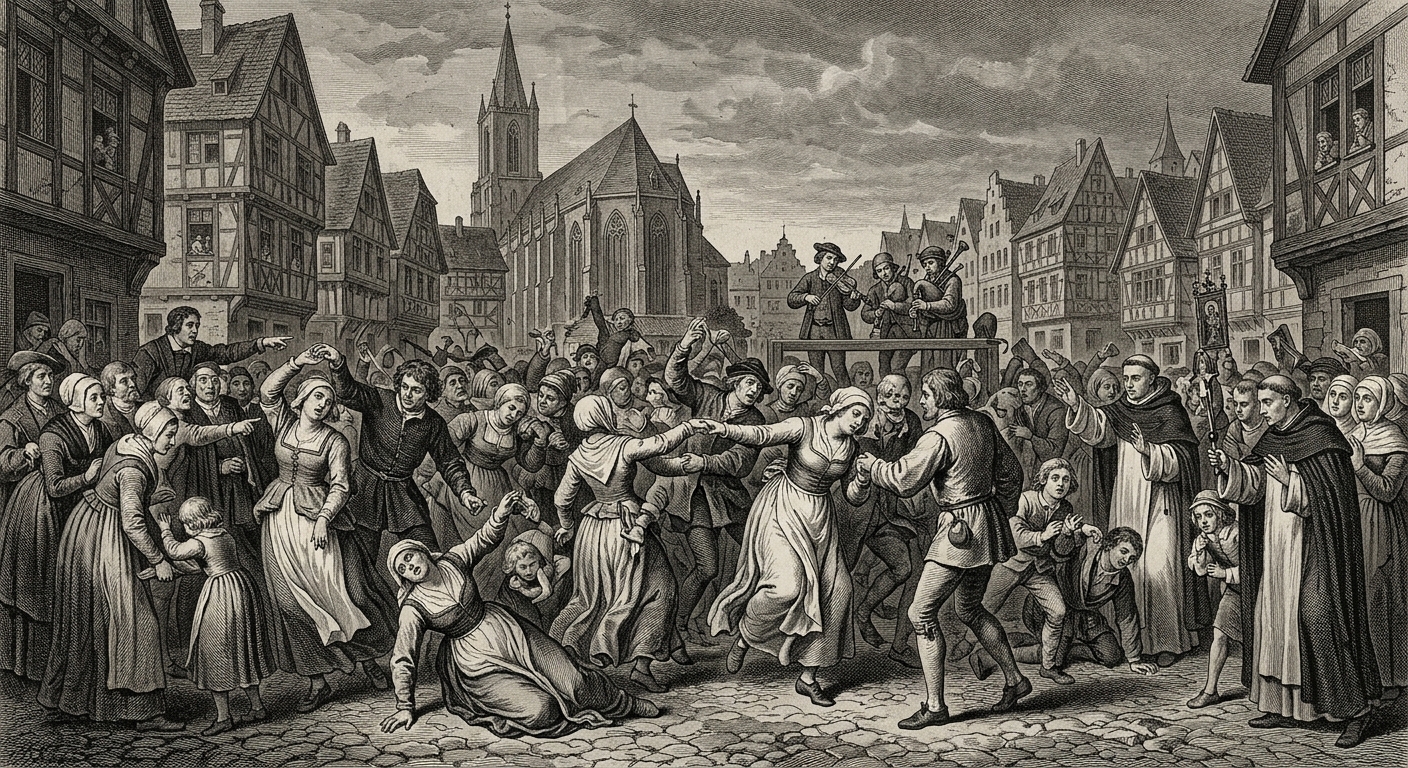
In the sweltering summer of 1518, the streets of Strasbourg witnessed one of history’s most bizarre and terrifying phenomena. What began as a single woman dancing alone in the town square escalated into a mass hysteria that would claim dozens of lives and baffle historians for centuries to come.
The Woman Who Started It All
It all began with Frau Troffea, a middle-aged woman who stepped into a narrow street in Strasbourg and began to dance. Not the joyful, celebratory dancing of festivals, but a frenzied, compulsive movement that seemed to possess her entire being. She danced for hours without rest, her feet bleeding, her body convulsing to an unheard rhythm that drove her forward relentlessly.
Local authorities initially dismissed her behavior as a temporary madness, perhaps brought on by the summer heat or personal troubles. But Frau Troffea didn’t stop. She danced through the night, and when dawn broke, she was still moving, her body wracked with exhaustion but unable to cease the violent gyrations that had consumed her.
The Contagion Spreads
Within a week, the impossible happened: others began to join her. One by one, residents of Strasbourg found themselves gripped by the same irrepressible urge to dance. The affliction spread like wildfire through the community, affecting men, women, and children alike.
By the end of the month, approximately 400 people had been consumed by the dancing mania. The streets of Strasbourg became a nightmarish spectacle of writhing bodies, with victims dancing in a state of delirium, many crying out in anguish as their bodies betrayed them.
The Symptoms Were Horrifying
Witnesses described the dancers as being in a trance-like state, their eyes rolled back, foam emerging from their mouths as they moved in jerky, uncontrolled motions. The afflicted seemed to be fighting against their own bodies, desperately wanting to stop but finding themselves physically unable to do so.
- Dancers would continue for days without eating or drinking
- Many collapsed from exhaustion but resumed dancing upon regaining consciousness
- Victims often danced until their feet bled through their shoes
- Some dancers appeared to hallucinate, seeing visions while they moved
- The dancing was described as violent and convulsive rather than rhythmic
Medical Intervention Gone Wrong
The local physicians and authorities, operating under medieval medical understanding, made a decision that would prove catastrophic. Believing that the afflicted could only be cured by dancing the mania out of their systems, they hired professional dancers and musicians to encourage even more vigorous dancing.
Stages were constructed in the town square, and the authorities organized what amounted to a sanctioned dance marathon. The logic was that if the dancers could reach the peak of their affliction, they would eventually collapse and recover. Instead, this intervention likely worsened the situation and contributed to the death toll.
The Death Toll Mounts
Historical records suggest that at the height of the plague, people were dying at a rate of approximately 15 per day. The cause of death was typically attributed to heart attack, stroke, or sheer exhaustion. Some accounts describe dancers literally dancing themselves to death, their bodies giving out after days of continuous movement without rest or sustenance.
The sight of people dying while still attempting to dance created an atmosphere of terror throughout the region. Families watched helplessly as their loved ones were consumed by an affliction that seemed to mock every attempt at intervention.
Attempts at Treatment
When the dancing cure proved disastrous, authorities tried various other remedies:
- Religious ceremonies and prayers for divine intervention
- Herbal treatments and bloodletting
- Physical restraint, which often resulted in violent struggling
- Exorcism rituals to drive out supposed demonic possession
- Pilgrimages to nearby religious sites
Modern Theories About the Dancing Plague
Contemporary historians and medical experts have proposed several theories to explain this extraordinary event, though none can fully account for all aspects of the phenomenon.
Mass Psychogenic Illness
The most widely accepted explanation is that the Dancing Plague was an outbreak of mass psychogenic illness, also known as mass hysteria. This psychological phenomenon occurs when physical symptoms spread through a population with no identifiable physical cause, typically triggered by stress, fear, or social tension.
Strasbourg in 1518 was experiencing significant social and economic stress, including famine, disease, and political instability, creating ideal conditions for such an outbreak.
Ergot Poisoning
Some researchers have suggested that ergot poisoning may have played a role. Ergot is a fungus that grows on rye and other grains, and when consumed, it can cause hallucinations, convulsions, and spasms that might resemble frenzied dancing. However, this theory doesn’t fully explain the contagious nature of the outbreak.
Religious Ecstasy and Cultural Beliefs
The medieval period was rife with beliefs about divine punishment and supernatural intervention. Some historians argue that the dancing plague was a form of religious ecstasy gone wrong, possibly triggered by cultural beliefs about Saint Vitus, who was associated with both protection from and punishment through uncontrollable dancing.
The Mysterious End
As suddenly as it had begun, the Dancing Plague of 1518 came to an end. The dancers were reportedly taken to a mountain shrine dedicated to Saint Vitus, where they were given blessed red shoes and participated in religious ceremonies. Whether through divine intervention, the natural course of the hysteria, or the psychological impact of the religious ritual, the compulsive dancing finally stopped.
The survivors slowly returned to normal life, though many bore permanent physical and psychological scars from their ordeal. The city of Strasbourg was left to grapple with the aftermath of one of the most bizarre medical mysteries in human history.
Legacy of the Dancing Death
The Dancing Plague of 1518 remains one of the most documented cases of mass hysteria in history, offering insight into the power of psychological contagion and the complex relationship between mind and body. It serves as a reminder that even in our modern age, there are aspects of human behavior and consciousness that remain deeply mysterious.
This extraordinary event continues to fascinate researchers, artists, and the general public, standing as a testament to the strange and often inexplicable nature of human experience. The dancing plague reminds us that reality can indeed be stranger than fiction, and that our planet’s history is filled with events that challenge our understanding of what is possible.






ok so this is fascinating but i gotta say the “plague” framing gets me every time – its almost certainly ergot poisoning from contaminated grain causing convulsions and hallucinations, not some mysterious curse, and while that doesnt make it any less tragic it does kinda bug me when we dress up historical events in spookier language than whats actually happening. that said convergent evolution is wild so its interesting how mass psychogenic illness can also produce similar movement patterns across different cultures, like our brains sometimes just… go to the same places under extreme stress. anyway great post though, love when people dig into these weird historical mysteries!
Log in or register to replyYeah Eve brings up a really solid point about the ergot angle, and honestly the ergot hypothesis makes way more geological sense when you think about it – wet conditions in medieval grain storage would absolutely favor that fungus growth, and Strasbourg’s location in the Rhine valley with its flood plains creates exactly the right damp environment for that kind of contamination to happen. The convulsions and delirium from ergotamine poisoning would totally explain the dancing compulsion better than any mystical cause, which is way more interesting to me anyway since it shows how climate and local geology literally shaped human history. Feels like historians sometimes miss the environmental context that sets the stage for these events!
Log in or register to replyGregory, you’re hitting on something I think about constantly with historical ecology – the environment as an active agent in human events. I’ve spent time in wet rainforest regions and seen how fungal growth explodes in certain moisture conditions, so the ergot hypothesis feels viscerally real to me. What’s wild is that this same pattern of climate creating crisis probably played out across Europe way more often than we realize, and it connects to why understanding local hydrology and soil chemistry matters for interpreting history. Makes me wonder how many other “mysterious plagues” were actually just environmental conditions we’ve stopped paying attention to.
Log in or register to reply