Imagine a world without iron, steel, or modern metallurgy. Now picture civilizations separated by thousands of miles somehow creating a trade network so sophisticated that it would make Amazon’s logistics team jealous. Welcome to the Bronze Age tin trade, one of history’s most remarkable examples of early globalization that connected the misty shores of Cornwall to the ziggurats of Mesopotamia.
The Metal That Changed Everything
Bronze revolutionized human civilization around 3200 BCE, but creating this game-changing alloy required something incredibly rare: tin. While copper was relatively abundant across the ancient world, tin existed in only a handful of locations. This scarcity created one of history’s first global supply chains, forcing civilizations to reach across continents for a metal that would determine their survival and prosperity.
The demand for tin wasn’t just about making better tools and weapons. Bronze Age societies discovered that mixing roughly 10% tin with 90% copper created an alloy harder than pure copper, easier to cast, and far more durable than stone implements. This wasn’t just an upgrade, it was a technological revolution that separated the bronze-wielding civilizations from those still stuck in the Stone Age.
Cornwall: The Ancient World’s Silicon Valley
The windswept peninsula of Cornwall, jutting into the Atlantic from southwestern England, became one of the ancient world’s most valuable real estate. Beneath its rugged landscape lay some of Europe’s richest tin deposits, making this remote region as strategically important as oil fields are today.
Archaeological evidence reveals that Cornish tin mining began as early as 2150 BCE. The ancient miners, working with bronze and stone tools, followed tin-bearing veins deep underground, creating a network of shafts and tunnels that would be worked continuously for over 4,000 years. The last Cornish tin mine didn’t close until 1998, making it possibly the longest-running industrial operation in human history.
The Cassiterides: Islands of Mystery
Ancient Greek and Roman writers referred to mysterious “Cassiterides” or “Tin Islands” somewhere in the far western ocean. For centuries, Mediterranean traders knew tin came from these legendary islands, but the exact location remained a closely guarded secret. The Phoenicians, masters of Bronze Age commerce, deliberately spread false information about dangerous sea monsters and treacherous waters to protect their tin routes.
The Web of Ancient Commerce
The Bronze Age tin trade created a complex network of routes that spider-webbed across Europe, Asia, and Africa. Cornish tin traveled multiple pathways to reach distant civilizations:
- The Atlantic Route: Phoenician ships carried tin directly from Cornwall down the Atlantic coast to the Mediterranean
- The Overland Path: Tin crossed the English Channel and traveled overland through France and the Alps
- The River Network: European river systems, particularly the Rhine and Danube, carried tin deep into continental Europe
- The Amber Road: This famous trade route didn’t just carry Baltic amber southward; it also moved tin eastward toward the Black Sea and beyond
From Britain to Babylon: Following the Tin Trail
The journey of Cornish tin to Mesopotamian workshops represents one of antiquity’s most impressive logistical achievements. A piece of tin mined in Cornwall might pass through dozens of hands before reaching its final destination:
Cornish miners extracted cassiterite (tin ore) from underground workings. Local smelters processed the ore into tin ingots using charcoal-fired furnaces. Phoenician or other Mediterranean traders then transported these ingots, along with other valuable goods like amber and furs, along established trade routes.
The tin would cross the Bay of Biscay, navigate the Strait of Gibraltar, and enter the Mediterranean trading network. From major ports like Gades (modern Cadiz) or later Massalia (Marseille), the precious metal continued eastward, changing hands in trading centers across the Mediterranean.
The Final Destinations
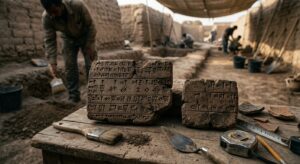
In Mesopotamian cities like Ur, Babylon, and Nineveh, master bronzesmiths waited for these precious shipments. Cuneiform tablets from ancient Mesopotamia record detailed inventories of tin imports, revealing the metal’s extraordinary value. Some tablets show that tin was worth more than silver and was often used as a form of currency itself.
The Archaeological Evidence
Modern archaeology has revealed the stunning scope of this ancient trade network. Lead isotope analysis allows scientists to trace the origin of bronze artifacts with remarkable precision. Bronze objects found in Mesopotamian sites show chemical signatures matching Cornish tin deposits. Similarly, amber from the Baltic Sea appears in Egyptian tombs, while Mediterranean pottery shows up in Bronze Age British archaeological sites.
Perhaps most remarkably, the Uluburun shipwreck, discovered off the Turkish coast, contained a Bronze Age cargo that reads like an inventory of the ancient world. Dating to around 1300 BCE, this ship carried Cornish tin, Cypriot copper, Baltic amber, African ebony, and goods from at least seven different cultures. It’s a time capsule proving just how interconnected the Bronze Age world really was.
The Cultural Exchange Network
The tin trade didn’t just move metal; it created highways for ideas, technologies, and cultural practices. Bronze-working techniques spread along these same routes, as did artistic styles, religious beliefs, and even languages. The shared need for tin created a form of ancient globalization that connected disparate cultures in ways that wouldn’t be seen again until the age of exploration.
This network explains puzzling similarities between distant Bronze Age cultures. Similar bronze-working techniques appear simultaneously across Europe and Asia. Artistic motifs show up in locations thousands of miles apart. Even religious symbols and mythological elements spread along these ancient superhighways of commerce.
The End of an Era
The Bronze Age tin trade began to decline around 1200 BCE during the mysterious Bronze Age Collapse, when many Mediterranean civilizations fell into chaos. The rise of iron technology further reduced demand for tin, though the metal remained valuable for specialized applications.
However, the trade networks established during the Bronze Age didn’t disappear. Many of these routes continued to carry goods throughout antiquity and beyond. The Roman road system often followed paths first established by Bronze Age tin traders, and some modern highways still trace routes that began with the ancient quest for Cornish tin.
Legacy of the Ancient Tin Trade
The Bronze Age tin trade stands as humanity’s first truly global commerce network. It demonstrates that our ancient ancestors were far more connected and sophisticated than often imagined. This remarkable system moved a precious metal across thousands of miles using nothing more than human ingenuity, bronze tools, and wooden ships.
Today, as we marvel at global supply chains and international commerce, we’re simply following paths blazed by Bronze Age traders who understood that the world’s resources and peoples are interconnected. The tin that connected Cornwall to Mesopotamia reminds us that globalization isn’t a modern invention, it’s a fundamental human drive that has shaped our species for over 5,000 years.