Hidden in the archives of a small museum in Crete lies one of archaeology’s most maddening puzzles. For over a century, the world’s brightest minds have thrown themselves against this ancient riddle, only to walk away defeated. The Phaistos Disc, a 4,000-year-old clay artifact covered in mysterious symbols, continues to mock every attempt at decryption.
The Discovery That Started a Century of Obsession
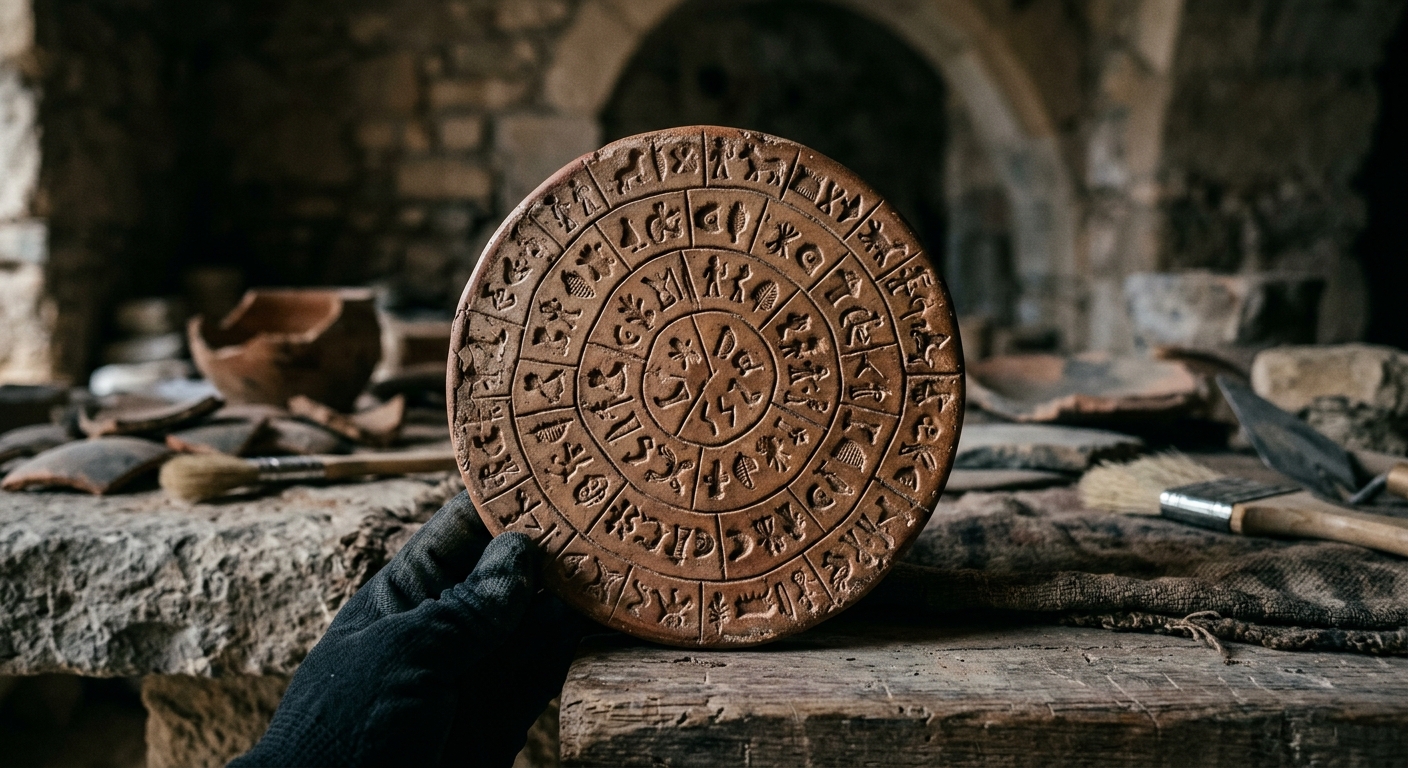
In 1908, Italian archaeologist Luigi Pernier was excavating the ancient Minoan palace complex at Phaistos on the island of Crete when he uncovered something extraordinary. Buried in a layer of ash and debris was a fired clay disc, roughly 15 centimeters in diameter, covered on both sides with 242 symbols arranged in a spiral pattern.
What made this discovery truly remarkable wasn’t just the age of the artifact, but the sophistication of its creation. The symbols weren’t carved or painted. Instead, they appeared to be pressed into the clay using individual stamps or seals, making the Phaistos Disc potentially the world’s oldest example of movable type printing, predating Gutenberg’s printing press by over 3,000 years.
A Symbol System Like No Other
The disc contains 45 distinct symbols, each more intriguing than the last. Among the pictographs, you’ll find:
- A figure wearing what appears to be a feathered headdress
- Various animals including fish, birds, and what might be a cat
- Human heads in profile
- Geometric shapes and plant-like forms
- Tools and weapons including shields and axes
- Architectural elements resembling buildings or ships
The symbols are arranged in groups separated by vertical lines, suggesting they form words or concepts. The spiral reads from the outside edge toward the center, but even this basic fact took years to establish and remains debated by some scholars.
The Theories That Captured Imaginations
A Prayer to Ancient Gods
Many scholars believe the disc contains religious text, possibly a hymn or prayer to Minoan deities. The presence of what appear to be ritual objects and the careful, deliberate arrangement of symbols supports this theory. Some researchers have identified possible references to the Mother Goddess, a central figure in Minoan religion.
An Ancient Game Board
A more unconventional theory suggests the disc might be a board game or divination tool. The spiral pattern could represent a path or journey, with the symbols indicating moves, challenges, or fortunes. This would explain why no similar artifacts have been found: games and their rules often remain unique to specific cultures.
A Calendar or Astronomical Guide
The mathematical precision of the symbol arrangements has led some to propose the disc functions as a calendar or astronomical calculator. The number of symbols and their groupings might correspond to celestial cycles important to Minoan agriculture and religious practices.
A Geographical Map
Some researchers have interpreted the symbols as representing locations, suggesting the disc might be an ancient map or travel guide. The variety of symbols could indicate different cities, landmarks, or territories throughout the Minoan world.
Why Every Decryption Attempt Has Failed
The Sample Size Problem
Unlike successful ancient script decryptions, which typically rely on thousands of examples, the Phaistos Disc stands alone. The Rosetta Stone succeeded because scholars could compare Egyptian hieroglyphs with known Greek text. With only 242 symbols on a single artifact, cryptographers lack the statistical foundation necessary for breakthrough analysis.
No Bilingual Text
Successful decryptions often depend on bilingual inscriptions where the same text appears in both unknown and known languages. The Phaistos Disc offers no such luxury. Without a translation key, researchers must rely entirely on pattern analysis and educated guesswork.
Unique Symbol System
The symbols on the disc don’t clearly match any other known writing system from the ancient Mediterranean world. While some researchers have claimed similarities to Linear A, Hieroglyphic Egyptian, or early Anatolian scripts, these connections remain tenuous at best.
Modern Technology Meets Ancient Mystery
Computer analysis and artificial intelligence have been enlisted in recent decades to crack the disc’s code. Researchers have used statistical analysis, pattern recognition software, and machine learning algorithms to identify potential linguistic structures. While these approaches have revealed interesting patterns in symbol distribution and grouping, they haven’t produced any universally accepted translation.
3D scanning and high-resolution photography have allowed scholars to examine minute details invisible to earlier researchers. These technologies have confirmed the sophistication of the printing technique and revealed subtle variations in how symbols were impressed into the clay.
The Hoax Question
The disc’s unique nature has led some skeptics to question its authenticity. A few scholars have suggested it might be a modern hoax, created to deceive archaeologists. However, the clay’s composition matches other authentic Minoan artifacts, and the archaeological context of its discovery strongly supports its ancient origin. The sophisticated printing technique would have been extremely difficult to fake in 1908, when printing history was far less understood.
Why the Mystery Endures
Perhaps the Phaistos Disc’s greatest mystery isn’t what it says, but why nothing like it has ever been found. If the Minoans possessed such advanced printing technology and used this writing system, where are the other examples? Did the disc represent a failed experiment in mass communication? Was it created by a visiting culture that left no other trace?
The disc challenges our understanding of ancient technological development and suggests that sophisticated innovations could appear and disappear without leaving a clear historical trail. It reminds us that ancient civilizations were far more complex and capable than we often assume.
Today, the Phaistos Disc continues to attract new generations of would-be decoders. Amateur cryptographers and professional linguists alike remain convinced they’ll be the ones to finally crack its code. But after 120 years of attempts, this ancient artifact keeps its secrets locked away, a testament to the enduring mysteries our planet still holds.





This is fascinating stuff, though it makes me think about how we’re still decoding ancient systems while simultaneously destroying the “codebooks” of modern ecosystems, you know? The rainforest canopy in Borneo alone contains thousands of species we haven’t even catalogued yet, and we’re losing them faster than we can understand what they do. I’d love to know what secrets the Phaistos Disc holds, but I’m more worried about the biological mysteries we’re erasing before we get a chance to read them.
Log in or register to replyYou’re totally onto something Trevor, though I’d add that we’re also literally destroying the instruction manuals of living systems in real time, not just losing them before we read them. I spend half my time monitoring the Deschutes River in Oregon and watching how dam removal is slowly restoring native fish populations and aquatic insect diversity, and it’s like we’re finally learning to read what the river was trying to tell us all along, if that makes sense. The biodiversity loss in freshwater ecosystems is genuinely catastrophic compared to terrestrial ones but nobody talks about it, so yeah, maybe the real mystery isn’t the Phaistos Disc but why we’re so focused on cracking ancient codes while actively
Log in or register to replyYou both are touching on something that really gets to me, honestly. I spend so much time listening to humpback song recordings and tracking how whales communicate across entire ocean basins, and it breaks my heart knowing we’re simultaneously destroying the very acoustic environments they depend on with shipping noise and sonar. We’re literally drowning out their “codebooks” in real time, and cetaceans have been developing complex communication systems for millions of years that we’re only starting to understand. It’s like we’re so obsessed with deciphering the past while actively silencing the voices still trying to speak to us right now.
Log in or register to reply