
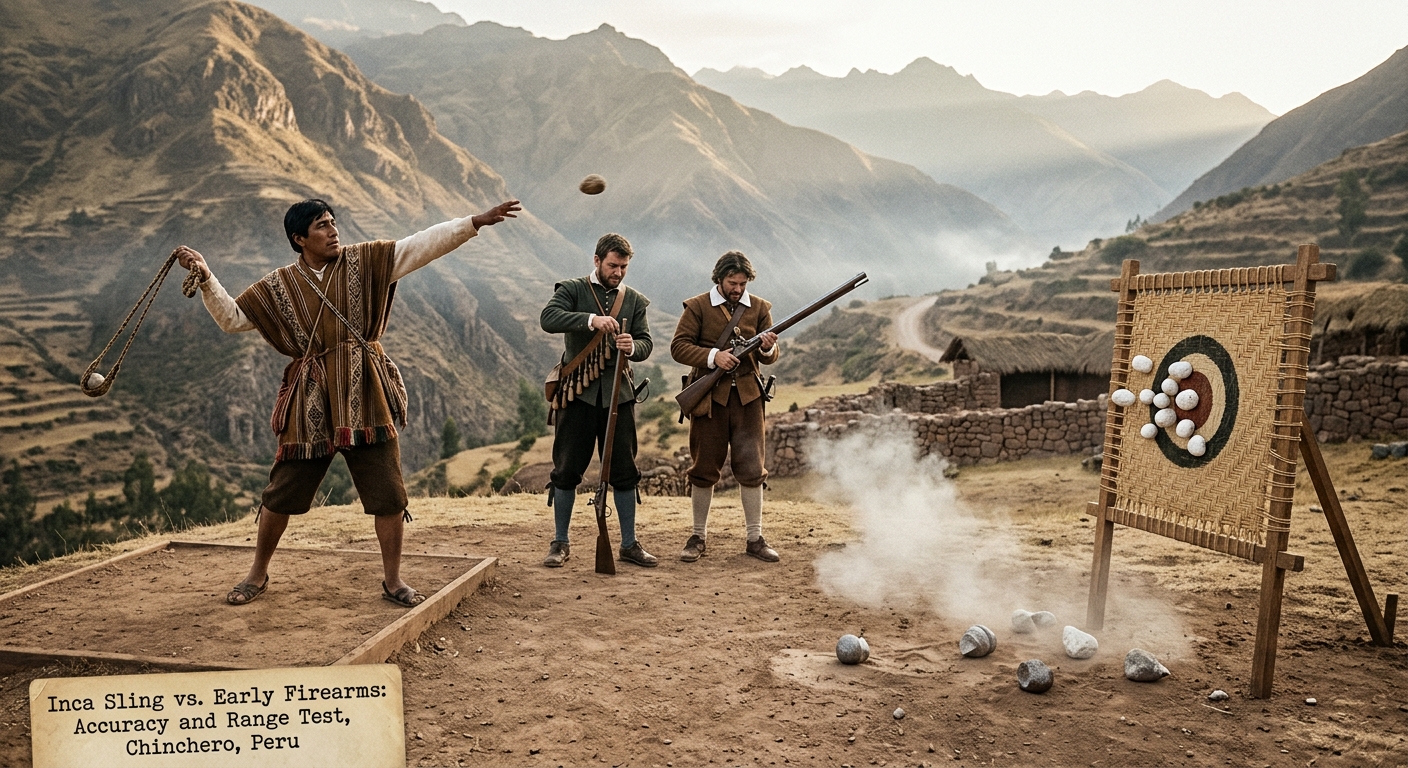
The Forgotten Art of Ancient Warfare
In the misty highlands of Peru, centuries before the Spanish conquistadors arrived with their thundering firearms, indigenous warriors wielded a weapon so deceptively simple yet devastatingly effective that it could outperform the most advanced military technology of its time. The Peruvian sling, nothing more than woven fibers and a leather pouch, achieved accuracy levels that would make modern marksmen envious and put 16th-century muskets to shame.
When Francisco Pizarro and his conquistadors first encountered Inca warriors in the 1530s, they discovered that their prized muskets, representing the pinnacle of European military innovation, were routinely outclassed by weapons that appeared to be little more than toys. Spanish chronicles from the period describe with grudging admiration how indigenous slingers could consistently strike targets at distances that left European soldiers stunned and demoralized.
The Science Behind Stone Age Precision
Modern ballistics testing has revealed the remarkable truth behind these historical accounts. While a 16th-century musket could hit a man-sized target at 100 meters roughly 50% of the time under ideal conditions, skilled Andean slingers achieved accuracy rates of 80-90% at the same distance. This wasn’t just luck or exaggeration by Spanish chroniclers; it was the result of sophisticated engineering principles that the ancient Peruvians had perfected over millennia.
The secret lay in the sling’s elegant design and the physics of projectile motion. Unlike the crude lead balls fired from muskets, sling stones were carefully selected and often shaped for optimal aerodynamics. Warriors chose smooth, dense rocks, typically ranging from 50 to 200 grams, with weight distribution that maximized both range and accuracy. The stones naturally stabilized in flight, maintaining consistent trajectories that musket balls, affected by powder inconsistencies and barrel imperfections, simply couldn’t match.
The Mechanics of Deadly Accuracy
The physics behind sling effectiveness reveal why this ancient weapon was so superior to early firearms:
- Consistent Release Point: Experienced slingers developed muscle memory that allowed them to release projectiles at precisely the same point in their swing arc, eliminating the variability that plagued musket firing
- Superior Ballistics: Well-chosen stones maintained stable flight paths, while musket balls often tumbled unpredictably due to imperfect spherical shape and inconsistent powder charges
- Faster Reload Times: A skilled slinger could fire 6-8 projectiles per minute, compared to 1-2 shots from a musket
- Weather Independence: Rain and humidity that rendered gunpowder useless had no effect on sling performance
- Silent Operation: Slings provided tactical advantages through stealth that loud muskets could never match
Training the Perfect Warrior
The accuracy of Peruvian slingers wasn’t accidental; it was the product of intensive training that began in childhood. Young boys started learning the sling at age 6 or 7, beginning with targets as large as pottery vessels before progressing to increasingly smaller objects. By adolescence, competent slingers could consistently hit targets the size of a human head at 100 meters.
Archaeological evidence suggests that sling training was deeply integrated into Andean culture. Excavations have uncovered practice ranges with stone targets at measured distances, indicating that communities dedicated significant resources to developing these skills. The training regimen was remarkably sophisticated, incorporating principles that modern sports science would recognize as effective motor learning techniques.
Cultural Significance Beyond Warfare
The sling served purposes far beyond military applications in Andean society. Shepherds used them to protect livestock from predators, hunters employed them to bring down birds and small game, and communities organized competitive contests that reinforced social bonds while maintaining martial readiness. This multipurpose nature meant that virtually every adult male, and many females, possessed combat-ready skills even during peacetime.
Historical Impact and Spanish Accounts
Spanish chroniclers left detailed accounts of encounters with indigenous slingers that read like descriptions of supernatural marksmanship. Pedro Sancho, Pizarro’s secretary, wrote of warriors who could “strike a bird in flight or knock a man from his horse at distances that seemed impossible.” Diego de Almagro reported that his armored cavalry, the elite of Spanish military forces, often retreated from battles against foot soldiers armed only with slings.
The psychological impact on Spanish forces was profound. Soldiers accustomed to the superiority of European weaponry found themselves outranged and outgunned by opponents using technology that predated metal working. This weapon disparity forced the conquistadors to adapt their tactics, often relying more heavily on cavalry charges and close combat where their steel weapons provided clear advantages.
The Lost Art in Modern Context
Today, the art of precision slinging has largely disappeared from Peru, replaced by modern weapons and changing lifestyles. However, archaeological experiments and historical recreation groups have validated the accounts of Spanish chroniclers. Modern tests using historically accurate slings and techniques have confirmed that skilled practitioners can indeed achieve accuracy levels that surpass many historical firearms.
This remarkable example of ancient technology challenges our assumptions about human progress and the superiority of complex over simple solutions. The Peruvian sling represents thousands of years of iterative improvement, refined through countless generations of users who depended on its effectiveness for survival. It stands as a testament to human ingenuity and the power of perfecting fundamental principles rather than simply adding complexity.
The next time you see a simple sling, remember that you’re looking at a weapon system that once dominated battlefields and struck fear into the hearts of conquistadors armed with the most advanced military technology of their age. Sometimes, the most effective solutions are also the most elegant.






Ok I’m fascinated by this precision discussion, but can I just say, you’re both talking about ancient weapons and I’m over here thinking about how the REAL invisible warfare happening in those same oceans was plankton literally generating half the oxygen those warriors were breathing? Like, diatoms and coccolithophores were out there doing infinitely more complex “engineering” than woven fibers, orchestrating photosynthesis at a scale that makes sling accuracy look simple. Sorry, not sorry, but whenever we talk about human ingenuity and dominance I just think… your ancestors only survived because trillions of single-celled organisms decided to keep pumping out O2. The drama is everywhere if
Log in or register to replyThis is fascinating and I love the angle, but I’d gently push back on framing it as slings “outclassing” muskets, since they really served different strategic purposes. What you’re describing is incredible precision under ideal conditions, but muskets had terrifying psychological impact, penetrated armor, and scaled differently across formations. That said, the engineering story here is what gets me – the American Southwest museum in Denver has this perfect exhibit showing how sling ammunition was standardized and weighted, and seeing those stones you realize we’re talking about ballistics engineering that took generations to perfect. That’s the real wonder, right there.
Log in or register to replyNick’s making a really solid point here, and honestly the precision thing is wild but kind of misses why muskets actually dominated despite being objectively worse at individual accuracy. Slings required years of training to hit those 80-90% rates, while muskets let you put a moderately trained person in the field and have them contribute meaningfully to massed formations within months. Plus the psychological impact of “loud thing kills your friend from 100m away unpredictably” is just different from a visible projectile, even if it’s more accurate. The sling engineers deserved way more credit than early gunpowder tech deserved, but they were solving different problems by the 16th century.
Log in or register to reply