
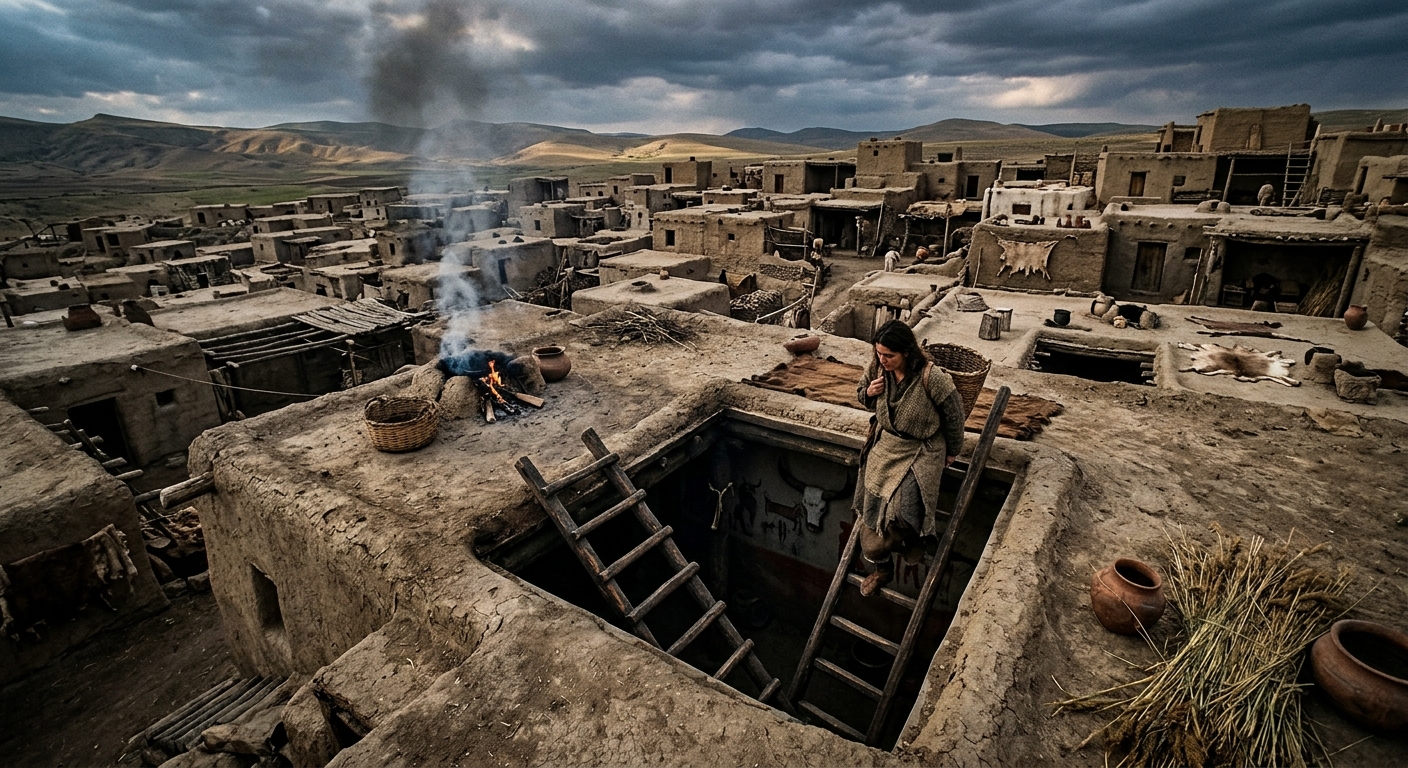
Imagine living in a city where there are no roads, no front doors, and the only way to enter your home is by climbing down a ladder through a hole in your roof. Sound like science fiction? Welcome to Catalhoyuk, one of the world’s most extraordinary ancient settlements that completely reimagines how humans can organize their communities.
A City Like No Other
Located in modern-day Turkey, Catalhoyuk flourished between 7500 and 5700 BCE, making it one of the world’s earliest urban settlements. What makes this Neolithic city absolutely mind-blowing isn’t just its age, but its radical approach to urban planning that defies everything we think we know about how cities should work.
Picture this: thousands of rectangular mud-brick houses packed so tightly together that their walls actually touched, creating a massive honeycomb-like structure. There were no spaces between buildings, no alleys, no streets, and certainly no front doors. The entire settlement was essentially one enormous, interconnected building complex where people moved around by walking across rooftops.
Rooftop Highways and Ladder Doorways
The rooftops of Catalhoyuk served as the city’s transportation network. These flat, sturdy surfaces were where daily life played out: people socialized, conducted business, and moved from house to house. Children played on rooftops while adults gathered to share news and trade goods. It was a three-dimensional city where the “ground level” was actually several stories up.
To enter their homes, residents climbed down wooden ladders through holes cut into their roofs. These openings served multiple purposes:
- Primary entrance and exit
- Source of natural light
- Ventilation system
- Smoke outlet from indoor hearths
The ladders could be pulled up when needed, effectively turning each home into a fortress. This wasn’t just architectural innovation; it was brilliant defensive strategy.
The Psychology of Vertical Living
Living in Catalhoyuk required a completely different mindset about privacy, community, and personal space. Without traditional streets or front doors, the concept of “public” versus “private” space was radically different. Your roof was simultaneously your front yard, your neighbor’s walkway, and the community’s highway.
This design forced unprecedented cooperation. Maintenance of the rooftop network required community effort. If one person’s roof collapsed or was poorly maintained, it affected everyone’s ability to move through the settlement. The architecture literally built interdependence into daily life.
Inside the Mysterious Houses
The interiors of Catalhoyuk homes were just as fascinating as their unusual entrances. These weren’t just simple dwellings; they were complex spaces that served as homes, workshops, storage areas, and sacred spaces all rolled into one.
Most homes consisted of a main room with raised platforms along the walls that served as beds, work surfaces, and seating areas. Storage areas were built into the walls, and many homes featured elaborate hearths for cooking and warmth. But perhaps most remarkably, many houses contained burials beneath their floors.
A City of Artists and Innovators
The walls of Catalhoyuk houses were covered with some of humanity’s earliest known murals, depicting everything from hunting scenes to geometric patterns to mysterious human figures. Some homes featured elaborate bull’s head sculptures and other artistic elements that suggest this wasn’t just a practical settlement but a place where creativity and spiritual expression flourished.
Archaeological evidence shows that residents were skilled craftspeople who produced pottery, textiles, tools, and jewelry. The unique architecture may have actually facilitated trade and craft production by creating intimate workshop spaces while maintaining easy access to the broader community network via the rooftops.
Why Build a City Without Streets?
The streetless design of Catalhoyuk wasn’t accidental; it was a sophisticated response to the challenges of Neolithic life. This architectural approach offered several crucial advantages:
Defense: Without streets or ground-level entrances, the settlement was incredibly difficult to attack. Enemies couldn’t march through the city or easily break into homes. The entire community could quickly become an impenetrable fortress.
Climate control: The tightly packed buildings provided excellent insulation. Shared walls helped homes stay warm in winter and cool in summer, while the roof access allowed for natural ventilation.
Space efficiency: By eliminating streets, residents maximized living space. Every square meter could be used for housing, storage, or workshops rather than being “wasted” on transportation corridors.
Social cohesion: The rooftop highway system naturally encouraged community interaction and cooperation. It was nearly impossible to be a hermit in Catalhoyuk.
The End of an Era
After nearly 2,000 years of continuous occupation, Catalhoyuk was eventually abandoned around 5700 BCE. Climate change, soil depletion, and changing trade routes likely contributed to its decline. But the innovative urban planning concepts pioneered at Catalhoyuk influenced settlement design throughout the ancient world.
Today, Catalhoyuk stands as a UNESCO World Heritage site and continues to challenge our assumptions about urban living. In an age of urban overcrowding and housing shortages, perhaps there’s something to learn from this ancient city that dared to imagine streets in the sky and doorways in the ceiling.
Lessons from the Rooftop City
Catalhoyuk reminds us that there’s no single “right” way to organize human settlements. For nearly two millennia, thousands of people thrived in a city that would seem utterly alien to us today. Their success challenges us to think creatively about urban planning, community design, and the relationship between architecture and social organization.
The next time you walk down a street or open your front door, take a moment to imagine life in Catalhoyuk, where neighbors literally walked over your house and coming home meant climbing down from the sky. It’s a fascinating reminder that human ingenuity and adaptability know no bounds.






Interesting parallel with ecological systems, Steve, though I’d be curious how you see the analogy playing out beyond the basic density angle. I spend a lot of time thinking about how organisms (and yeah, humans too) organize themselves in tight quarters, and in my experience with frog populations, high density without proper resource distribution usually leads to stress and disease rather than mutualism. Wonder if Catalhoyuk’s tight architecture required some specific social or practical mechanisms to keep things from breaking down the way overcrowded amphibian breeding pools do.
Log in or register to replyThis is such a cool lens for thinking about human habitat design! I’m actually reminded of how native plant communities work, too – when you pack species densely but with the right relationships, everyone thrives and nothing needs extra inputs. I wonder if Catalhoyuk’s rooftop commons worked similarly, where shared spaces created natural feedback loops that kept the whole system running smoothly. Makes me think about our modern obsession with isolated single-family homes and how much we lost when we abandoned this kind of interdependence, even if I’m not quite ready to live in a communal ladder-access situation myself!
Log in or register to replyThis is such a perfect example of mutualism shaping infrastructure, honestly. Just like cleaner shrimp don’t just benefit the fish they clean but actually become essential to the whole reef ecosystem, these densely packed neighborhoods created conditions where cooperation literally had to be the default – you can’t live that close together without developing these intricate social contracts. I wonder if the roof-as-street setup actually reinforced community cohesion in ways that traditional street cities never could achieve, since you couldn’t just isolate yourself in your home the way we do now.
Log in or register to reply