
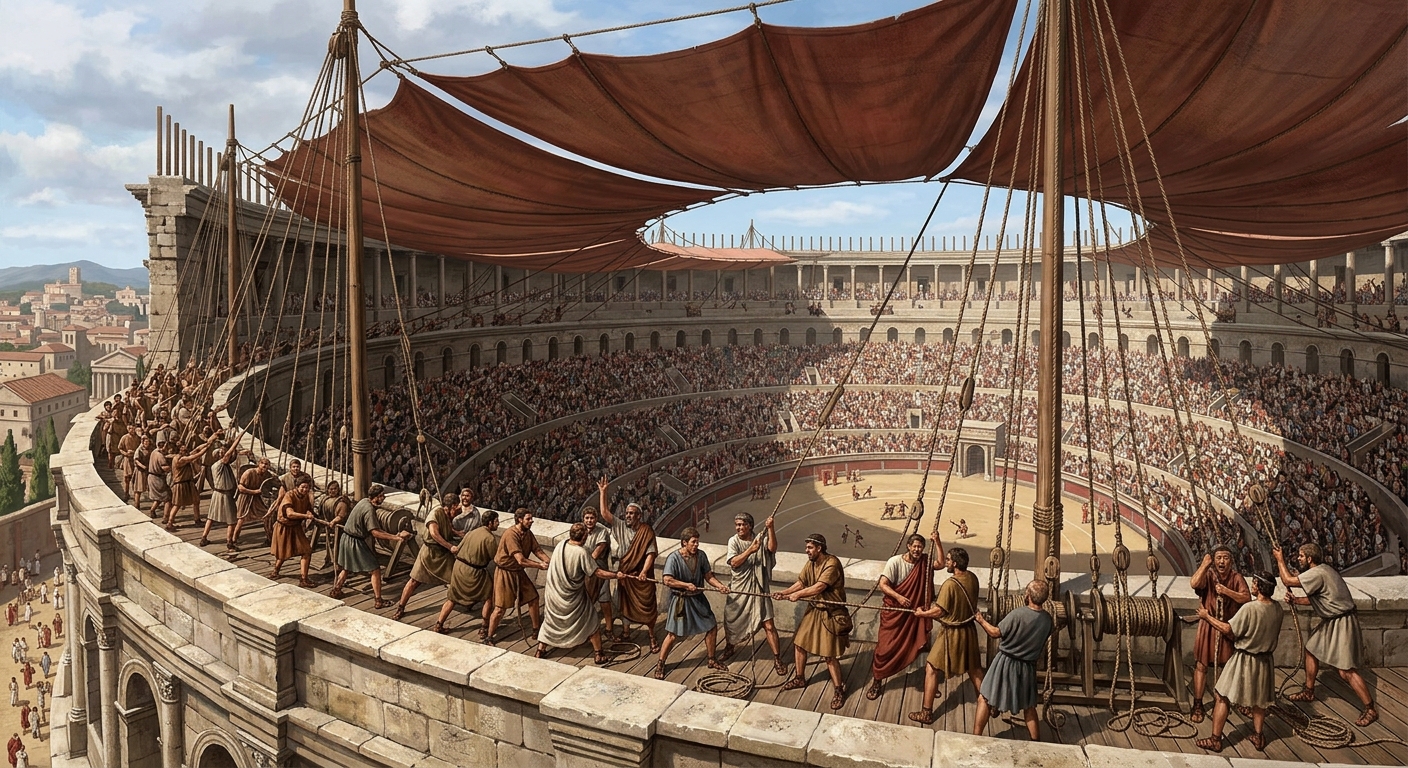
Picture this: you’re sitting in the blazing Roman sun, watching gladiators battle to the death, when suddenly a massive canvas canopy unfurls overhead, providing blessed shade for 50,000 spectators. This wasn’t magic, it was the velarium, one of the most ingenious engineering marvels of the ancient world that turned the Colosseum into history’s first climate-controlled sports arena.
The Marvel of the Velarium: Ancient Rome’s Greatest Canvas
The velarium (from the Latin word for sail) was a colossal retractable awning system that could cover roughly two-thirds of the Colosseum’s arena. This wasn’t just a simple tarp thrown over the amphitheater. We’re talking about a sophisticated network of ropes, pulleys, and canvas panels that covered an area of approximately 220,000 square feet, making it larger than three football fields combined.
The system consisted of 240 wooden poles extending from the top of the stadium’s walls, supporting a complex web of ropes that held the canvas sections. When fully deployed, the awning created a gentle slope that directed air flow throughout the arena, essentially turning the entire structure into a massive wind tunnel that kept spectators cool during the scorching Italian summers.
Why Roman Sailors? The Maritime Connection
Here’s where the story gets truly fascinating: operating this massive awning required the skills of approximately 1,000 Roman naval personnel from the imperial fleet at Misenum. But why sailors? The answer lies in their expertise with rigging, rope work, and coordinated teamwork that was essential for managing ships’ sails in battle and storms.
These weren’t just any sailors, either. They were members of the Classis Misenensis, one of Rome’s two main imperial fleets. For them, operating the velarium was likely a welcome break from naval duties, and they were probably well-compensated for their specialized skills. The coordination required to deploy and retract hundreds of canvas panels simultaneously demanded the kind of precision that only experienced maritime professionals could provide.
The Logistics of Ancient Air Conditioning
The sailors worked from the upper levels of the Colosseum, specifically from a platform built around the building’s perimeter. They had to coordinate the raising and lowering of the canvas sections based on:
- Weather conditions and wind direction
- Time of day and sun position
- The type of event being held in the arena
- The preferences of important spectators, particularly the emperor
The entire operation could be completed in less than 30 minutes, a remarkable feat considering the size and complexity of the system. The sailors used a combination of hand signals, horns, and coordinated movements that would have resembled a carefully choreographed naval operation.
Engineering Genius: How It Actually Worked
The velarium wasn’t just impressive in scale; it was a masterpiece of mechanical engineering. The system used a radial arrangement of ropes extending from 240 corbels (stone brackets) projecting from the Colosseum’s upper wall. These ropes converged toward the center of the arena, creating a web-like pattern that could support the enormous weight of the canvas.
Archaeological evidence suggests that the awning was designed with a sophisticated understanding of aerodynamics. The slight inward slope of the canvas created a venturi effect, where air would be drawn up and out of the arena, creating a cooling breeze for spectators below. This natural air conditioning system was so effective that it could lower temperatures in the seating areas by as much as 15 degrees Fahrenheit.
Materials and Maintenance
The canvas sections were likely made from linen or hemp, materials that were both lightweight and durable enough to withstand the stress of deployment and Roman weather. The ropes were probably made from the finest hemp available, and the entire system would have required constant maintenance and replacement of worn components.
Maintaining the velarium was a year-round job. The sailors had to inspect every rope, every pulley, and every canvas panel regularly. During the off-season, the entire system would be taken down, cleaned, repaired, and stored in warehouses around Rome.
More Than Just Shade: Psychological and Social Impact
The velarium served purposes beyond mere comfort. It was a powerful symbol of Roman engineering prowess and imperial wealth. The ability to control the environment for 50,000 people demonstrated Rome’s mastery over nature itself. Foreign dignitaries and conquered peoples would have been awed by this display of technological sophistication.
The awning also had psychological effects on the events below. During naval battle reenactments (called naumachiae), the velarium would often be colored blue to simulate the sky over the ocean. For gladiatorial contests, different colored sections might be used to create dramatic lighting effects that enhanced the spectacle.
The Lost Technology
Sadly, the knowledge of how to construct and operate the velarium was lost after the fall of the Western Roman Empire. Modern engineers studying the Colosseum’s corbels and rope anchor points can only theorize about the exact mechanisms used. Recent computer simulations and scale models have helped researchers understand the basic principles, but the precise techniques used by those 1,000 Roman sailors remain one of history’s great engineering mysteries.
Today, as we struggle with climate control in modern stadiums using vast amounts of energy, the velarium stands as a testament to the ingenuity of ancient engineering. It reminds us that sometimes the most elegant solutions come not from complex machinery, but from understanding natural forces and human coordination.
The next time you’re in a modern stadium with retractable roofing, remember those Roman sailors who perfected the art of crowd climate control nearly 2,000 years ago, using nothing but canvas, rope, and remarkable teamwork.




omg the velarium is such a brilliant example of biomimicry before that was even a word right?? like if you watch any david attenborough doc on insect colonies, theyre doing the same thing – creating microclimates through collective effort and smart design. i’m curious tho, do we know if the romans actually understood the aerodynamic principles behind it or was it more trial and error? because either way its kind of genius that they figured out how to cool 50k people without any electricity, ngl thats way more impressive than most modern stadiums lol
Log in or register to replyokay so i’m totally obsessed with this velarium concept because you’re SO right about the biomimicry angle, sam – like have you ever watched a wasp colony regulate their nest temperature? they do this incredibly coordinated fanning behavior with their wings to create airflow, and honestly it’s basically what those 1,000 sailors were doing with canvas and rope, just at a completely different scale, and i genuinely think if we spent more time studying how insects engineer their environments instead of just calling them gross we’d solve so many of our climate problems lol. the compound-eye precision required to coordinate that kind of collective effort… *chef’s kiss*
Log in or register to replyThis is fascinating, though I have to say watching how we’ve moved away from passive cooling strategies like this makes me think about reef systems too, honestly. The Romans understood working *with* environmental systems rather than just fighting them, and that’s exactly what we need to remember with ocean conservation – sometimes the best solutions are the ones that respect how nature already functions. Wild that they had a thousand people dedicated to this skill, makes me wonder what we could accomplish if we invested that kind of human coordination into restoration projects.
Log in or register to reply