Imagine a world where the sun never rises, where temperatures hover just above freezing year-round, and where bizarre creatures drift through endless darkness like living nightmares. This isn’t science fiction or a distant planet. This alien realm exists right here on Earth, covering more surface area than all continents combined. Welcome to the midnight zone, the ocean’s most mysterious and forbidding frontier.
What Is the Midnight Zone?
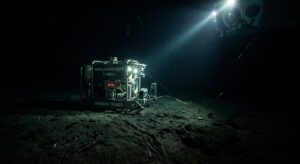
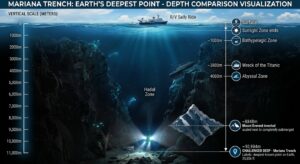
The midnight zone, scientifically known as the bathypelagic zone, stretches from 1,000 to 4,000 meters below the ocean’s surface. At these crushing depths, sunlight becomes nothing more than a memory. The last faint traces of solar radiation fade completely around 1,000 meters, leaving behind a world of absolute darkness that has persisted unchanged for millions of years.
This zone represents one of Earth’s most extreme environments, yet it covers an astounding 50% of our planet’s surface area. To put this in perspective, the midnight zone is larger than all of Earth’s landmasses combined. Despite its vast size and proximity, we know less about this underwater realm than we do about the surface of Mars.
A World Frozen in Time
Temperature in the midnight zone remains remarkably stable, hovering between 2-4°C (36-39°F) throughout the year. This perpetual near-freezing state creates one of the most thermally stable environments on Earth. Unlike surface waters that fluctuate with seasons and weather patterns, the midnight zone maintains its icy grip with unwavering consistency.
The water pressure at these depths is equally extreme, ranging from 100 to 400 times greater than atmospheric pressure at sea level. For every 10 meters of depth, pressure increases by approximately one atmosphere. At 4,000 meters deep, the pressure would instantly crush any surface-dwelling creature, including humans, into a space smaller than a marble.
The Physics of Perpetual Darkness
The complete absence of light in the midnight zone creates unique physical conditions. Without photosynthesis, the entire ecosystem depends on a constant rain of organic matter falling from the sunlit zones above. This “marine snow” consists of dead plankton, fish waste, and decomposing organisms that drift downward like an endless blizzard of nutrients.
Water density increases significantly at these depths due to the extreme pressure and cold temperatures. This creates distinct water layers that rarely mix, essentially trapping the midnight zone in its own isolated environment. These conditions have remained virtually unchanged for geological time periods, creating evolutionary pressures unlike anywhere else on Earth.
Alien Life Forms of the Abyss
The creatures inhabiting the midnight zone have evolved into forms so bizarre they seem pulled from science fiction. Cut off from the sun’s energy, life here has adapted remarkable strategies for survival in this hostile environment.
Masters of Bioluminescence
Over 90% of midnight zone creatures produce their own light through bioluminescence. This biological light show serves multiple purposes:
- Hunting: Anglerfish dangle glowing lures to attract unsuspecting prey
- Communication: Jellyfish flash intricate light patterns to communicate with potential mates
- Defense: Some species create brilliant light bursts to confuse predators
- Camouflage: Certain fish match the faint light filtering from above to become invisible from below
The vampire squid, despite its terrifying name, exemplifies midnight zone adaptation. When threatened, it turns itself inside out, revealing spines and bioluminescent photophores that create a spectacular light display. This creature can survive in oxygen levels so low they would be lethal to most other animals.
Extreme Adaptations
Midnight zone creatures have evolved extraordinary features to survive in their harsh environment. Many species have enormous mouths and expandable stomachs, allowing them to consume prey much larger than themselves. In a food-scarce environment, the ability to eat whatever becomes available, regardless of size, provides a crucial survival advantage.
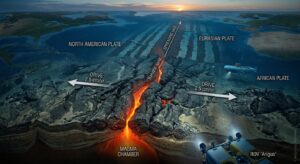
The giant tube worms found near hydrothermal vents in the midnight zone have no digestive system at all. Instead, they rely on symbiotic bacteria that convert chemicals from the vents into energy. These remarkable creatures can grow over 8 feet long and live for centuries in their chemically-rich oases.
Earth’s Last Frontier
Despite covering half of Earth’s surface, less than 5% of the midnight zone has been explored. The technical challenges of reaching these depths mean that we’ve mapped more of the Moon’s surface than we have of our own deep ocean floors. Each expedition to these depths reveals new species and ecosystems that challenge our understanding of life’s limits.
Recent discoveries have revealed entire ecosystems thriving around underwater mountains, deep-sea coral gardens that exist without sunlight, and massive migrations of creatures moving between the midnight zone and upper waters. These findings suggest that the midnight zone plays a crucial role in global ocean circulation and climate regulation.
The Carbon Connection
The midnight zone serves as one of Earth’s largest carbon storage systems. The constant rain of organic matter from above gets trapped in these deep, cold waters, effectively removing carbon dioxide from the atmosphere for hundreds or thousands of years. This process, known as the biological pump, significantly impacts global climate patterns.
Scientists estimate that the midnight zone stores more carbon than all terrestrial ecosystems combined. Understanding this process becomes increasingly important as we face climate change challenges and search for natural carbon sequestration solutions.
Mysteries Yet to Unfold
The midnight zone continues to reveal surprises that reshape our understanding of life on Earth. Recent discoveries of plastic pollution even at these extreme depths highlight humanity’s far-reaching impact. Conversely, studies of extremophile bacteria in the midnight zone provide insights into potential life on other planets and moons.
As technology advances, we’re only beginning to scratch the surface of this vast underwater realm. The midnight zone represents our planet’s final frontier, a world of perpetual winter and darkness that covers more of Earth than any other environment. In exploring these depths, we’re not just discovering new species, we’re uncovering the hidden processes that make our planet habitable.
The next time you gaze across the ocean’s surface, remember that beneath those waves lies a world more alien and mysterious than anything in our solar system. The midnight zone reminds us that even on our own planet, there are still vast realms waiting to be explored, understood, and protected.