Imagine a horseshoe-shaped zone of destruction that wraps around the Pacific Ocean like a fiery necklace, where three-quarters of all volcanic eruptions and earthquakes on Earth happen. Welcome to the Pacific Ring of Fire, a 25,000-mile arc of geological violence that makes the rest of our planet look positively peaceful by comparison.
What Exactly Is the Pacific Ring of Fire?
The Pacific Ring of Fire isn’t actually made of fire, despite its ominous name. This geological phenomenon is a massive horseshoe-shaped region that encircles the Pacific Ocean, stretching from the southern tip of South America, up the west coast of North and South America, across the Aleutian Islands, down through Japan, the Philippines, and Indonesia, and finally ending in New Zealand.
This region contains approximately 452 volcanoes, representing about 75 percent of all active and dormant volcanoes on Earth. But volcanoes are just part of the story. The Ring of Fire is also responsible for roughly 90 percent of all earthquakes worldwide, making it the most seismically active region on our planet.
The Science Behind the Chaos
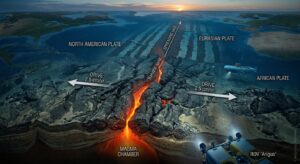
The Ring of Fire exists because of plate tectonics, the geological process that shapes our planet’s surface. The Pacific Ocean sits on the Pacific Plate, which is constantly moving and colliding with surrounding tectonic plates. These collisions create subduction zones, where one plate slides beneath another, generating enormous pressure and heat.
Subduction Zones: Earth’s Pressure Cookers
When oceanic plates slide beneath continental plates, they carry water and sediments deep into the Earth’s mantle. This process creates magma, which eventually rises to the surface as volcanic eruptions. The immense friction and pressure at these boundaries also trigger earthquakes, creating a double threat of geological instability.
Some of the most significant subduction zones in the Ring of Fire include:
- The Cascadia Subduction Zone along the Pacific Northwest
- The Japan Trench, which produced the devastating 2011 tsunami
- The Peru-Chile Trench along South America’s west coast
- The Philippine Sea Plate boundaries
Famous Volcanic Residents of the Ring of Fire
The Ring of Fire hosts some of the most famous and destructive volcanoes in human history. These geological giants have shaped civilizations, altered climates, and captured human imagination for millennia.
Mount Vesuvius: The City Killer
While technically outside the Pacific Ring of Fire, Vesuvius serves as a stark reminder of volcanic power. However, the Ring of Fire has its own legendary destroyers, including Mount Tambora in Indonesia, whose 1815 eruption caused global climate change and crop failures worldwide.
Mount Fuji: Japan’s Sleeping Giant
Japan’s iconic Mount Fuji is actually an active volcano that last erupted in 1707. Despite its peaceful appearance, scientists continuously monitor this perfectly shaped stratovolcano, as its location near Tokyo makes it one of the world’s most dangerous volcanic threats.
The Alaskan Arc
Alaska’s Aleutian Islands chain represents one of the most volcanically active regions in the Ring of Fire, with over 130 volcanoes and volcanic fields. The remote location of many Alaskan volcanoes means their eruptions often go unnoticed by the general public, but they pose significant threats to aviation routes between North America and Asia.
Living on the Edge: Cities in the Danger Zone
Despite the obvious risks, millions of people call the Ring of Fire home. Major cities situated within this geological danger zone include:
- Tokyo, Japan (population: 37 million)
- Jakarta, Indonesia (population: 10 million)
- Manila, Philippines (population: 13 million)
- San Francisco, USA (population: 875,000 in city proper)
- Santiago, Chile (population: 6 million)
These cities exist in constant awareness of potential volcanic and seismic activity. Advanced monitoring systems, building codes designed for earthquake resistance, and emergency preparedness protocols are essential elements of daily life in Ring of Fire communities.
The Ring of Fire’s Role in Earth’s Climate
Volcanic eruptions along the Ring of Fire don’t just affect local areas; they can alter global climate patterns. Large eruptions inject massive amounts of ash and sulfur dioxide into the atmosphere, creating a cooling effect that can last for years.
The 1991 eruption of Mount Pinatubo in the Philippines, for example, lowered global temperatures by approximately 0.5 degrees Celsius for two years. This cooling effect demonstrates how the Ring of Fire’s volcanic activity serves as a natural climate regulator, albeit an unpredictable and often destructive one.
Modern Monitoring and Prediction
Today’s scientists use sophisticated technology to monitor Ring of Fire activity. Seismographs detect earthquake patterns that might signal impending eruptions, while satellite imagery tracks gas emissions and ground deformation around volcanic sites.
Ground-penetrating radar, thermal imaging, and gas analysis help researchers understand what’s happening beneath the surface. However, predicting exactly when and where the next major eruption will occur remains one of geology’s greatest challenges.
The Future of the Ring of Fire
The Ring of Fire will continue its destructive dance for millions of years to come. As tectonic plates continue their slow but relentless movement, new volcanic threats will emerge while others become dormant. Understanding this geological powerhouse remains crucial for the hundreds of millions of people who live within its fiery embrace.
The Pacific Ring of Fire stands as a humbling reminder of our planet’s raw power and the dynamic forces that continue to shape our world. While we cannot control these geological giants, our growing understanding of their behavior helps us coexist with Earth’s most spectacular and dangerous natural phenomenon.