
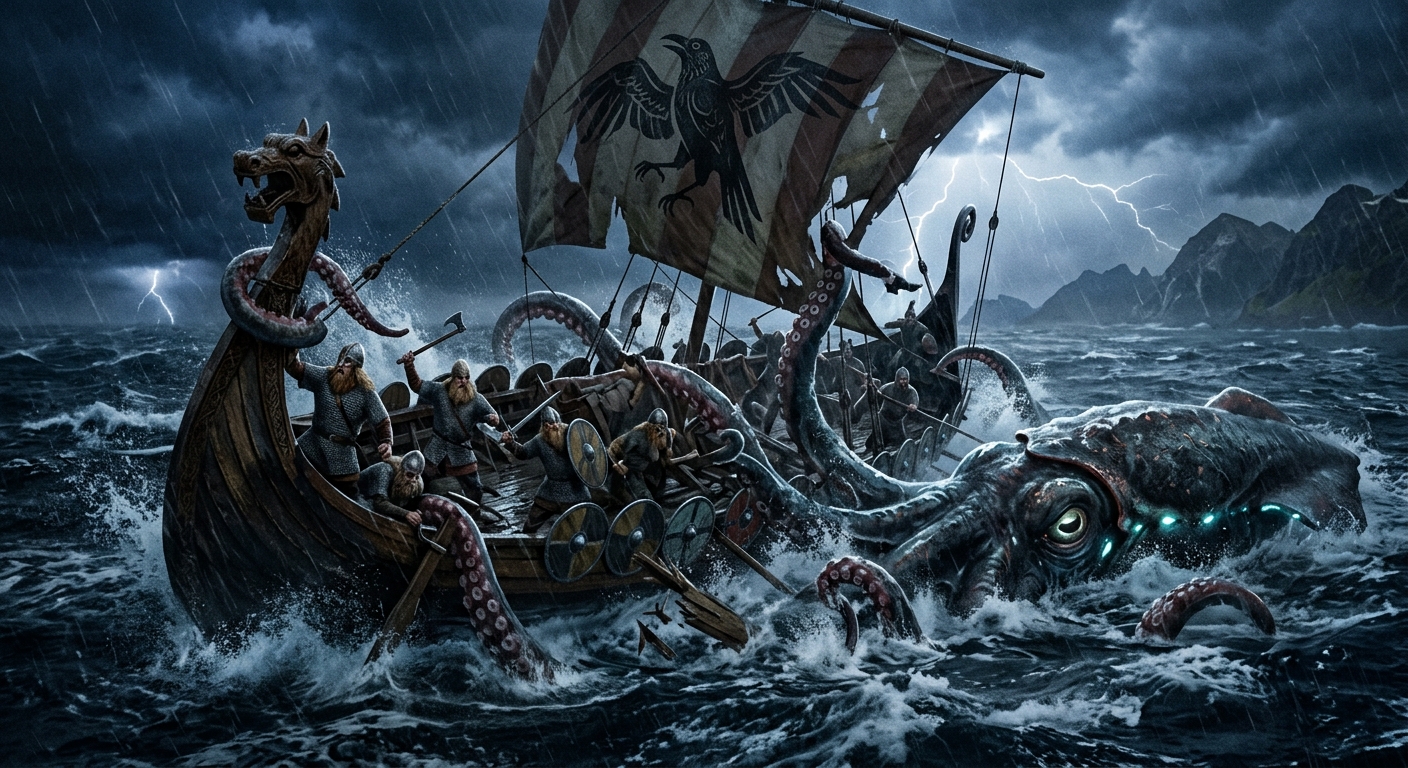
Deep beneath the frigid waters of the North Atlantic, something enormous lurks in the abyss. For over a thousand years, Norse sailors returned from their voyages with tales of a creature so massive it could be mistaken for an island. They called it the Kraken, a beast capable of creating whirlpools with its movements and destroying entire ships with its writhing tentacles. What these ancient mariners didn’t realize was that their terrifying sea monster wasn’t born from imagination, but from very real encounters with one of the ocean’s most mysterious giants.
The Birth of a Legend in Norse Waters
The earliest recorded mentions of the Kraken appear in 13th-century Icelandic texts, where it was described as a colossal sea creature dwelling off the coasts of Norway and Greenland. According to the Örvar-Odds saga, the beast was so enormous that sailors often mistook it for an island, complete with what appeared to be beaches and vegetation on its back.
Bishop Erik Pontoppidan of Norway, writing in 1753, provided one of the most detailed historical accounts of the creature. He described the Kraken as being the size of a floating island, approximately 1.5 miles across. When it submerged, it created dangerous whirlpools that could drag ships to their doom. Most tellingly, Pontoppidan noted the creature’s “many arms or branches” that “project from the water as high and as large as the masts of medium-sized vessels.”
Giant Squid: The Science Behind the Myth
Modern marine biology has revealed that the waters where Kraken sightings were most common are precisely where giant squid (Architeuthis dux) populations thrive. These remarkable cephalopods are among the largest invertebrates on Earth, with confirmed specimens reaching lengths of up to 43 feet, including their feeding tentacles.
Anatomy of a Sea Monster
Giant squid possess several characteristics that would have seemed supernatural to medieval observers:
- Massive tentacles: Eight arms and two longer feeding tentacles, each lined with powerful suction cups rimmed with sharp hooks
- Enormous eyes: The largest eyes in the animal kingdom, reaching up to 10 inches in diameter
- Powerful beak: A razor-sharp, parrot-like beak capable of cutting through flesh and bone
- Jet propulsion: The ability to rapidly expel water for quick movement, potentially creating surface disturbances
- Color-changing skin: Chromatophores that allow rapid color and pattern changes
Behavioral Clues
Giant squid typically inhabit depths between 1,000 and 3,000 feet, but they do occasionally venture to the surface, especially when injured, dying, or during feeding. These rare surface appearances would have been shocking encounters for sailors navigating the same waters. The squid’s massive tentacles breaking the surface could easily be interpreted as sea serpents or the arms of a massive sea demon.
Historical Evidence Meets Modern Science
The geographical correlation between Kraken sightings and known giant squid habitat is striking. The deep, cold waters off Norway, Iceland, and Greenland provide ideal conditions for these creatures. The continental shelf in these regions creates upwelling currents that bring nutrient-rich water to the surface, supporting the complex food webs that giant squid depend upon.
Historical accounts become even more compelling when examined alongside what we now know about giant squid behavior. Many Kraken stories describe the creature surfacing near fishing grounds where there were abundant schools of fish. Giant squid are known to follow their prey, particularly deep-water fish and other squid species, toward the surface during feeding migrations.
The Colossal Squid: An Even More Terrifying Reality
As if giant squid weren’t impressive enough, science has revealed an even more formidable cephalopod: the colossal squid (Mesonychoteuthis hamiltoni). Found primarily in Antarctic waters, these creatures may grow even larger than giant squid and possess rotating hooks on their tentacles instead of suction cups, making them far more dangerous to potential prey, or curious humans.
While colossal squid don’t inhabit Norse waters, their discovery has reinforced the possibility that historical “sea monster” accounts were based on real encounters with massive cephalopods that we’re only beginning to understand.
When Myth Meets Reality in the Modern Era
The first photographs of a living giant squid weren’t captured until 2004, and the first video footage was recorded in 2012. For over a millennium, these creatures existed in a realm between myth and reality, occasionally washing ashore or being found in the stomachs of sperm whales, but never observed alive in their natural habitat.
This modern confirmation of giant squid existence has led marine biologists to reconsider other “mythical” sea creatures. The scientific community now takes historical accounts of sea monsters more seriously, recognizing that many may have been accurate descriptions of real animals that we simply hadn’t yet catalogued or understood.
The Sperm Whale Connection
One of the most convincing pieces of evidence linking giant squid to Kraken mythology comes from sperm whale behavior. These whales are the primary predators of giant squid, and their hunting grounds overlap perfectly with historical Kraken sighting locations. Sailors may have witnessed the aftermath of these epic underwater battles, seeing massive tentacles at the surface without understanding the context of predator-prey relationships occurring in the depths below.
Legacy of the Kraken
The transformation of the Kraken from mythological terror to biological reality represents one of the most fascinating intersections of folklore and science. Rather than diminishing the wonder of these creatures, scientific understanding has only enhanced their mystique. Giant squid remain among the most elusive animals on Earth, spending their lives in the deep ocean’s perpetual darkness, occasionally rising from the abyss like living embodiments of humanity’s oldest fears and fascinations.
The Norse sailors who first spoke of the Kraken couldn’t have imagined that their sea monster would eventually be validated by science, or that the reality would prove almost as extraordinary as their myths. In the deepest parts of our oceans, where sunlight never penetrates and pressure would crush any surface dweller, creatures that inspired humanity’s greatest legends continue to thrive, reminding us that sometimes the most unbelievable stories contain kernels of profound truth.






This is such a perfect example of why I drag people to the cephalopod exhibits, honestly – a real animal MORE alien and bizarre than the myth, yet somehow less terrifying once you understand what you’re actually looking at. The thing that gets me is how those sailors were describing genuine behavior (the feeding arms, the intelligence) but through a lens of pure terror, when really they were witnessing one of nature’s greatest puzzles trying to survive in the deep. Makes you wonder what we’re missing about the ocean right now that future generations will laugh we didn’t understand.
Log in or register to replyYou two are making me think about how this is exactly what needs to happen with bats, honestly! People are SO quick to imagine the worst (hello, vampire bat obsession) when the reality is actually way more fascinating – like, did you know most bats eat insects or fruit and are basically tiny acrobats? The fear usually comes from not understanding them, same as your giant squid situation. Anyway, great thread, this is the kind of science communication that actually shifts perspectives.
Log in or register to replyYeah, the giant squid thing is wild because the actual animal is somehow *more* unsettling when you learn the details, like those suckers can leave scars on sperm whales or how we barely understand their behavior even now. Nick’s right that understanding makes it less scary but somehow more fascinating, which I think says something about how our brains work with deep time and creatures we can barely observe.
Log in or register to reply