
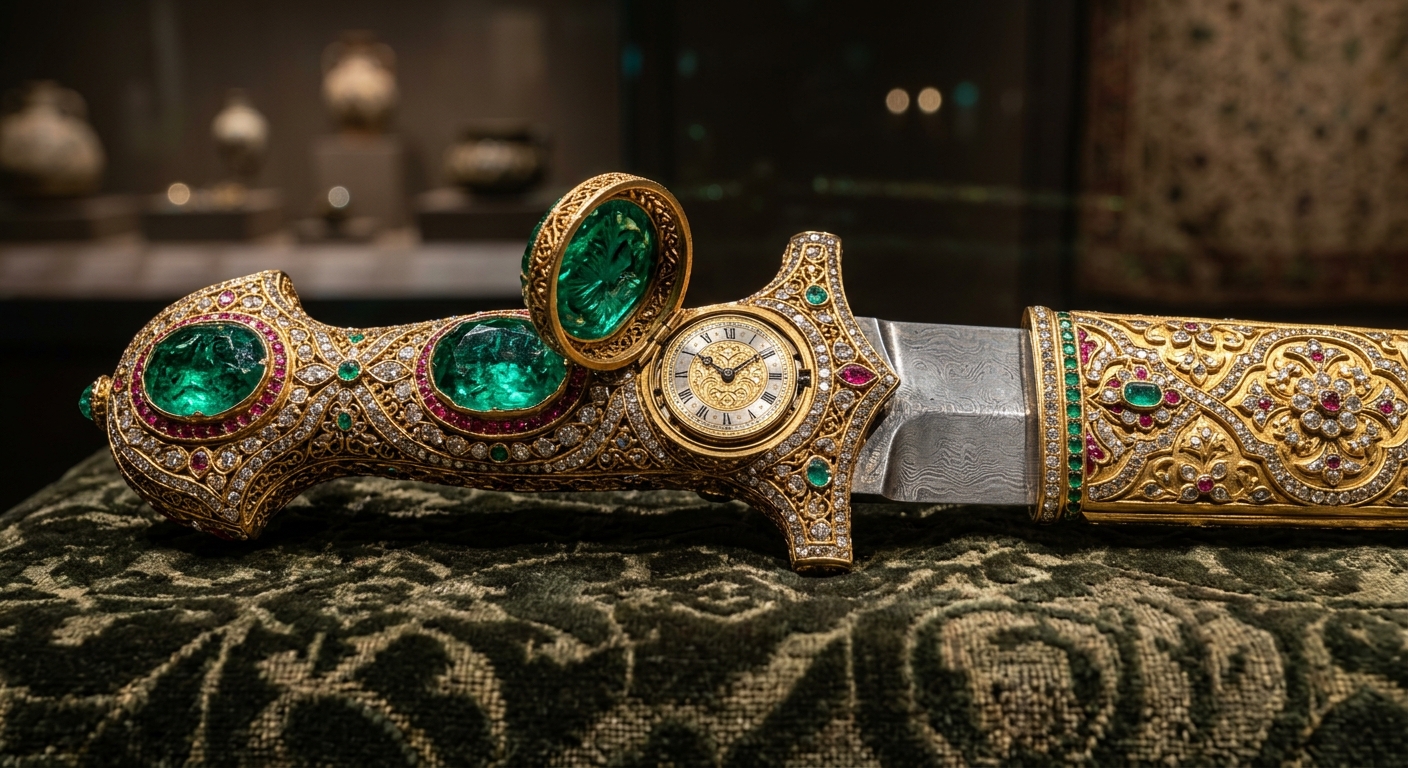
A Jeweled Weapon That Tells Time: The Topkapi Dagger’s Incredible Secret
In the depths of Istanbul’s Topkapi Palace Museum lies one of the most extraordinary artifacts in human history: a ceremonial dagger that doubles as a timepiece. The famous Topkapi Dagger doesn’t just dazzle with its three enormous emeralds and diamond-studded surface. Hidden within its ornate hilt is a fully functional watch, making this 18th-century masterpiece a marvel of both artistry and engineering that continues to astound visitors and historians alike.
The Dagger That Almost Changed History
The Topkapi Dagger was originally crafted as a diplomatic gift from Ottoman Sultan Mahmud I to Persian ruler Nadir Shah in 1747. However, fate intervened when Nadir Shah was assassinated before the precious gift could reach him. The Ottoman emissaries, carrying this priceless treasure, turned around and brought it back to Istanbul, where it found its permanent home in the imperial treasury.
This twist of fate preserved one of the most remarkable examples of Ottoman craftsmanship for posterity. Had the dagger reached its intended recipient, it might have been lost to history, dissolved into private collections, or destroyed in the countless conflicts that swept through Persia in subsequent centuries.
Engineering Marvel in Miniature
What makes the Topkapi Dagger truly extraordinary isn’t just its stunning appearance, but the incredible feat of miniaturization hidden within. The watch mechanism, tucked away in the dagger’s hilt, represents cutting-edge 18th-century technology. Creating a timepiece small enough to fit inside a weapon’s handle while maintaining accuracy required master craftsmen working at the absolute limits of their abilities.
The watch features:
- A spring-driven mechanism that was revolutionary for its time
- Intricate gears and escapements crafted to microscopic precision
- A winding mechanism accessible through the dagger’s design
- Remarkable durability that has allowed it to survive nearly three centuries
The Crown Jewels of Earth: Those Magnificent Emeralds
The three emeralds adorning the dagger aren’t merely decorative accessories. They are geological marvels in their own right, each weighing several carats and displaying the deep, vivid green that makes emeralds among the most prized gemstones on Earth. These particular stones likely originated from the famous mines of Colombia or possibly from deposits in what is now Afghanistan, regions that produced the finest emeralds of the medieval and early modern periods.
Emeralds form under extremely specific geological conditions, requiring the rare combination of beryllium, aluminum, silicon, oxygen, and chromium or vanadium to create their distinctive color. The process takes millions of years and occurs only in very particular rock formations, making large, high-quality specimens like those on the Topkapi Dagger extraordinarily rare.
A Canvas of Diamonds and Gold
Beyond the three prominent emeralds, the dagger sparkles with dozens of diamonds set in gold. The craftsmanship demonstrates the Ottoman Empire’s access to global trade networks that brought precious stones from India, South America, and Africa to the workshops of Constantinople. Each diamond was hand-cut using techniques that maximized brilliance within the constraints of 18th-century technology.
The Science Behind the Spectacle
The integration of a timepiece into a ceremonial weapon represents a fascinating intersection of metallurgy, geology, and precision engineering. The Ottoman craftsmen had to solve several complex problems: how to protect delicate clockwork from the vibrations and impacts a weapon might endure, how to seal the mechanism against moisture and dust, and how to create a design that was both functional and aesthetically magnificent.
The dagger’s creators used techniques that wouldn’t be out of place in modern luxury watchmaking. They employed shock-absorbing mountings for the movement, created precise fits between metal components, and designed the entire piece to be both durable and maintainable. The fact that the watch mechanism remains functional after nearly three centuries speaks to the incredible skill of these anonymous masters.
Cultural and Technological Significance
The Topkapi Dagger represents the height of Ottoman material culture during the empire’s classical period. It demonstrates several important historical realities:
- The Ottoman Empire’s vast wealth and access to global luxury goods
- Advanced metalworking and jeweling techniques that rivaled anything in Europe
- The integration of practical technology with ceremonial objects
- The importance of gift-giving in 18th-century diplomacy
Modern Fame and Enduring Mystery
The dagger gained worldwide recognition through the 1964 film “Topkapi,” which centered around a fictional heist attempting to steal this very artifact. While the movie took considerable liberties with the facts, it introduced millions of people to this remarkable object and helped cement its status as one of the world’s most famous historical artifacts.
Today, visitors to the Topkapi Palace Museum can see the dagger displayed in climate-controlled cases, where its emeralds continue to capture light and imagination. The hidden watch, while no longer kept running due to conservation concerns, remains a testament to human ingenuity and the endless human desire to create objects that are simultaneously beautiful and functional.
The Topkapi Dagger stands as proof that our ancestors were capable of achieving remarkable feats of engineering and artistry, creating objects that continue to inspire wonder centuries after their creation. In an age where we carry computers in our pockets, there’s something profoundly moving about a weapon that secretly kept time, bridging the gap between the practical and the magnificent in ways that still seem almost magical today.






That’s genuinely amazing craftsmanship, but now I’m stuck wondering: did Ottoman artisans apply that same precision to studying the incredible echolocation abilities of their native bat species? Because bats have been doing biological “precision timekeeping” with their sonar for millions of years, yet they’re still stuck with the vampire reputation while humans get all the credit for a hidden clock in a dagger, lol. Nature’s engineering is wild!
Log in or register to replyomg this is such a cool thought! honestly makes me think about how plants do something similar with their circadian rhythms – like my Nepenthes (pitcher plants) have these internal clocks that regulate when theyre most “ready” to digest, and its basically precision timing built into their biology over millions of years. i wonder if ottoman craftsmen were inspired by observing natural cycles and animal behavior more than we realize, because that kind of biomimicry probably happened way more than historical records show. nature really did invent everything first, we just get fancy with metals and jewels lol
Log in or register to replyThat’s such a cool connection you’re making! Though I gotta admit, my brain immediately went to cetaceans instead of bats, haha – like, imagine if those Ottoman craftsmen could’ve observed how sperm whales use echolocation to navigate the deep ocean with pinpoint accuracy, or how humpbacks coordinate their movements through sound in ways that still baffle modern researchers. The precision in that hidden clock is genuinely astounding, but nature’s been perfecting these biological timing systems for so much longer. Makes you wonder what we’re missing by not listening closely enough to the whales singing all around us.
Log in or register to reply