
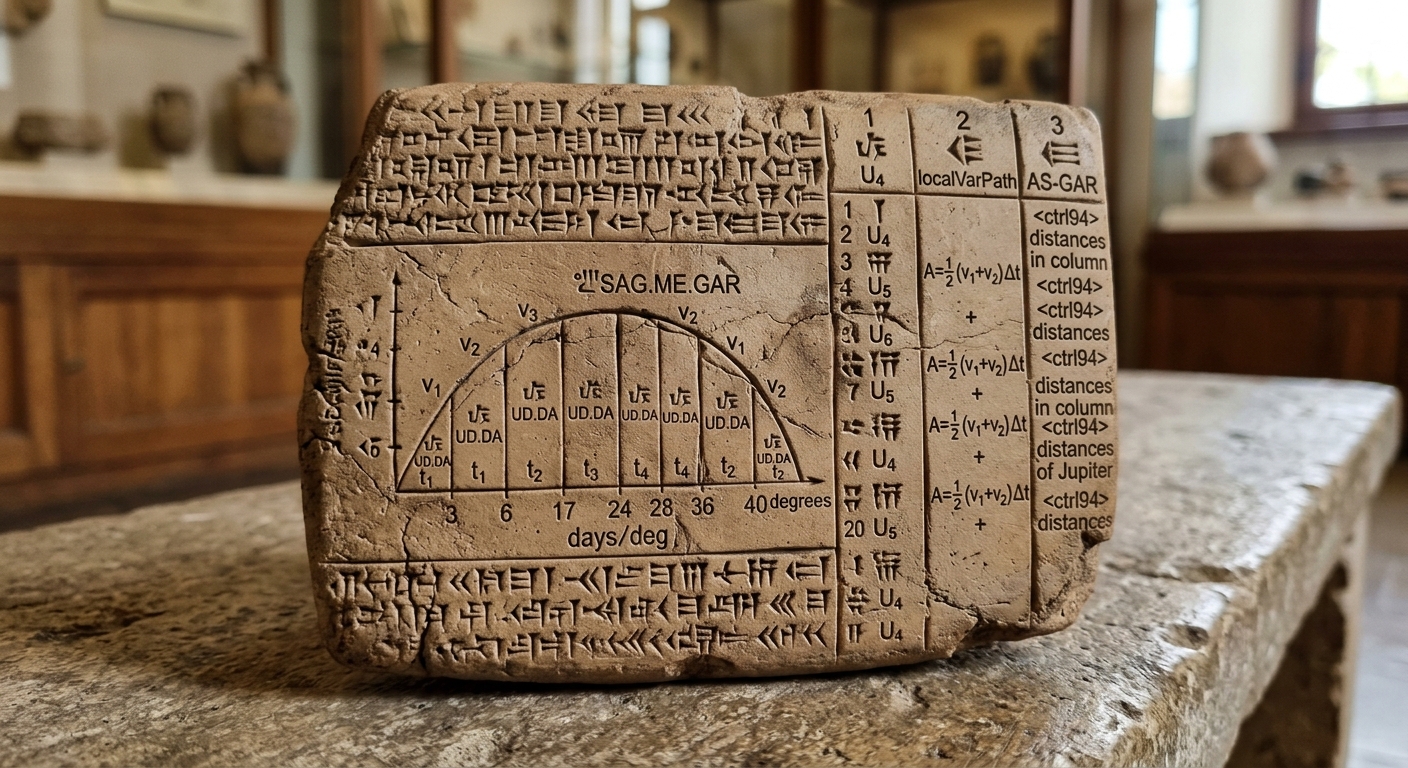
In the dusty archives of ancient Babylon, hidden within cuneiform tablets that survived millennia, archaeologists uncovered one of history’s most mind-blowing mathematical revelations. The Babylonians, master astronomers of the ancient world, didn’t just observe the heavens, they cracked the mathematical code of planetary motion using techniques that wouldn’t be “officially” invented until the Renaissance.
The Mathematical Revolution Hidden in Clay
Between 350 and 50 BCE, Babylonian astronomers were solving complex geometric problems that required what we now recognize as fundamental calculus principles. These ancient mathematicians calculated Jupiter’s position in the sky by determining the area under a velocity-time curve, a technique that European scholars wouldn’t develop until the 14th century CE.
The discovery came to light when Cambridge University professor Mathieu Ossendrijver decoded four cuneiform tablets housed in the British Museum. What he found shattered our understanding of mathematical history: detailed calculations showing how Babylonian astronomers used geometric methods to track Jupiter’s complex orbital dance across the zodiac.
Cracking the Cuneiform Code of Celestial Motion
The Babylonians faced a fascinating astronomical puzzle. Jupiter doesn’t move at constant speed across the sky, instead, it appears to slow down and speed up as Earth’s orbital position changes relative to the gas giant. This created what ancient astronomers called “zones” where Jupiter’s apparent velocity varied dramatically.
To solve this problem, the Babylonians developed an ingenious approach:
- They calculated Jupiter’s velocity at different points in its 60-day journey through specific zodiacal zones
- They determined the total distance traveled by computing the area under a velocity curve
- They found the time when Jupiter reached the halfway point of its journey using geometric principles identical to the mean value theorem
- They applied these calculations to predict Jupiter’s future positions with remarkable accuracy
This geometric approach to astronomy represents one of humanity’s earliest examples of using abstract mathematical concepts to model physical reality.
The Trapezoid That Changed Mathematical History
The key breakthrough lay in how the Babylonians visualized Jupiter’s motion. They created what modern mathematicians recognize as a velocity-time graph, where Jupiter’s changing speed formed a trapezoid shape. By calculating the area of this trapezoid, they determined the total distance Jupiter traveled during its journey through each zodiacal zone.
Even more remarkably, they solved for the precise moment when Jupiter completed exactly half its journey. This required dividing the trapezoid into two equal areas, a process that’s mathematically identical to finding the mean value of a function, a fundamental concept in integral calculus.
Why Jupiter Captured Babylonian Imagination
Jupiter held special significance in Babylonian culture and astronomy. Named Marduk after their chief deity, this bright wandering star was associated with kingship, justice, and divine will. Accurately predicting Jupiter’s position wasn’t just scientific curiosity, it was essential for making astrological predictions that guided royal decisions and religious ceremonies.
The planet’s 12-year orbital period made it particularly important for Babylonian calendar systems. Jupiter spends approximately one year in each zodiacal constellation, creating a celestial timekeeper that ancient astronomers could use to track longer cycles and make long-term predictions.
Advanced Mathematics in Ancient Mesopotamia
This discovery reveals the sophistication of Babylonian mathematical thinking. Their achievements include:
Numerical Innovation
The Babylonians used a base-60 number system that allowed for precise fractional calculations. This system survives today in our measurement of time (60 minutes, 60 seconds) and angles (360 degrees).
Astronomical Precision
Their observations of planetary motions were accurate to within minutes of arc. They compiled centuries of astronomical data, creating the foundation for predictive astronomy.
Abstract Mathematical Thinking
The Jupiter calculations demonstrate their ability to translate physical phenomena into abstract geometric relationships, a crucial step in the development of theoretical mathematics.
Rewriting the History of Calculus
This discovery forces us to reconsider how mathematical knowledge develops and spreads across cultures and centuries. The techniques found in these Babylonian tablets suggest that the conceptual foundations of calculus emerged independently in different civilizations, separated by vast distances in both space and time.
The Babylonian approach differs from modern calculus in important ways. While Newton and Leibniz developed calculus as a general mathematical tool applicable to many problems, the Babylonians applied these geometric principles specifically to astronomical calculations. Their work was deeply practical, focused on solving real observational challenges rather than developing abstract mathematical theory.
The Legacy of Ancient Mathematical Genius
The Babylonian calculation of Jupiter’s orbital period represents more than just an impressive mathematical achievement. It demonstrates humanity’s deep, ancient drive to understand and predict natural phenomena using logical, systematic approaches. These clay tablets preserve evidence of minds grappling with complex problems using whatever tools they could develop or adapt.
Today, as we send spacecraft to Jupiter and map its moons in extraordinary detail, we’re building upon mathematical foundations laid by astronomers who watched the same bright point of light move across desert skies over two millennia ago. Their geometric insights into planetary motion helped establish the mathematical tradition that would eventually enable us to launch Juno to orbit Jupiter and capture stunning images of its swirling clouds.
The next time you spot Jupiter shining in the night sky, remember that ancient Babylonian astronomers were using proto-calculus to track its celestial dance, proving once again that human curiosity and ingenuity know no boundaries of time or culture.






This is absolutely mind-blowing, honestly. I’ve spent countless nights tracking Jupiter myself with telescopes and cameras, and knowing the Babylonians were doing this naked-eye and getting it *right* makes me appreciate how much darker their skies were, and how that darkness shaped their entire understanding of celestial mechanics. It makes me wonder what other ecological and astronomical connections we’ve lost to light pollution, because you can’t develop that kind of intimate knowledge of planetary motion if you can’t actually see the stars clearly. The fact that they essentially invented calculus just to understand what they were watching in the night sky is such a perfect example of why everyone honestly needs to experience genuine darkness at least once.
Log in or register to replyThis is such a fascinating discovery, and it really does show how keen observation and mathematical creativity can flourish when you’re studying something that matters to survival and culture. It reminds me of how Jane Goodall revolutionized primatology not just through fancy equipment but through patient, meticulous observation of chimp behavior over decades, the same way those Babylonian astronomers must have tracked Jupiter’s movements so carefully. It makes you wonder what other sophisticated knowledge systems existed before we had “modern” tools, and honestly it’s humbling to realize humans have always been capable of this kind of complex thinking.
Log in or register to replyThis is genuinely cool stuff, though “calculus” is doing some heavy lifting here – they developed sophisticated geometric methods for astronomical prediction, which is amazing on its own without needing to call it calculus proper. What gets me is that they were doing this naked-eye observation for centuries, which is wild when you think about how much pattern recognition and record-keeping across generations that required, especially over the roughly 12-year orbital period of Jupiter.
Log in or register to reply