The Impossible Journey That Still Baffles Archaeologists
Standing silent on Salisbury Plain in southern England, Stonehenge continues to mystify visitors and scientists alike. While its purpose remains hotly debated, one aspect of this ancient monument is particularly mind-boggling: the incredible journey of its bluestones. These 80 massive stones, each weighing between 2 and 5 tons, were somehow transported over 200 miles from the Preseli Hills in Wales to their current location around 2600 BCE. To put this in perspective, that’s like moving the equivalent of 320 cars across the distance from New York to Boston, using only Neolithic technology.
This achievement becomes even more astounding when you consider that the wheel hadn’t been invented in Britain yet, and these ancient builders had no domesticated horses, pulleys, or any of the mechanical advantages we take for granted today. So how did they do it? The answer reveals an incredible story of human ingenuity, determination, and perhaps the most ambitious construction project of the Stone Age.
The Bluestones: Not Your Average Building Material
The bluestones of Stonehenge aren’t actually blue, they just appear so when wet or freshly broken. These rocks are primarily composed of spotted dolerite, rhyolite, and volcanic ash, materials that are geologically unique to the Preseli Hills in Pembrokeshire, Wales. Recent archaeological research has pinpointed their origin to specific outcrops, particularly at Carn Goedog and Craig Rhos-y-felin.
What makes this discovery even more remarkable is that these weren’t the only stones available. The much larger sarsen stones that form Stonehenge’s outer circle were sourced locally from the Marlborough Downs, just 20 miles away. Yet for some inexplicable reason, the Neolithic builders decided that these specific Welsh stones were worth an epic 200-mile journey.
The Sacred Significance Theory
Why would ancient people go to such extraordinary lengths to transport these particular stones? Archaeologists believe the bluestones held special significance for Neolithic communities. Some theories suggest:
- Acoustic properties: The bluestones produce distinct musical tones when struck, leading some researchers to call Stonehenge a “prehistoric concert hall”
- Healing powers: Medieval legends speak of Stonehenge’s healing properties, and recent studies show high levels of acoustic resonance that may have been perceived as magical
- Ancestral connections: The stones may have come from already-sacred sites in Wales, carrying spiritual significance with them
- Geological uniqueness: The specific mineral composition of these stones was seen as special or otherworldly
The Great Transportation Challenge: How They Did the Impossible
Moving 80 multi-ton stones across 200 miles of challenging terrain would be difficult today with modern equipment. For Neolithic builders working around 2600 BCE, this represented one of the most ambitious logistical undertakings in human history. Archaeological evidence and experimental archaeology have revealed several possible methods:
The Overland Route Theory
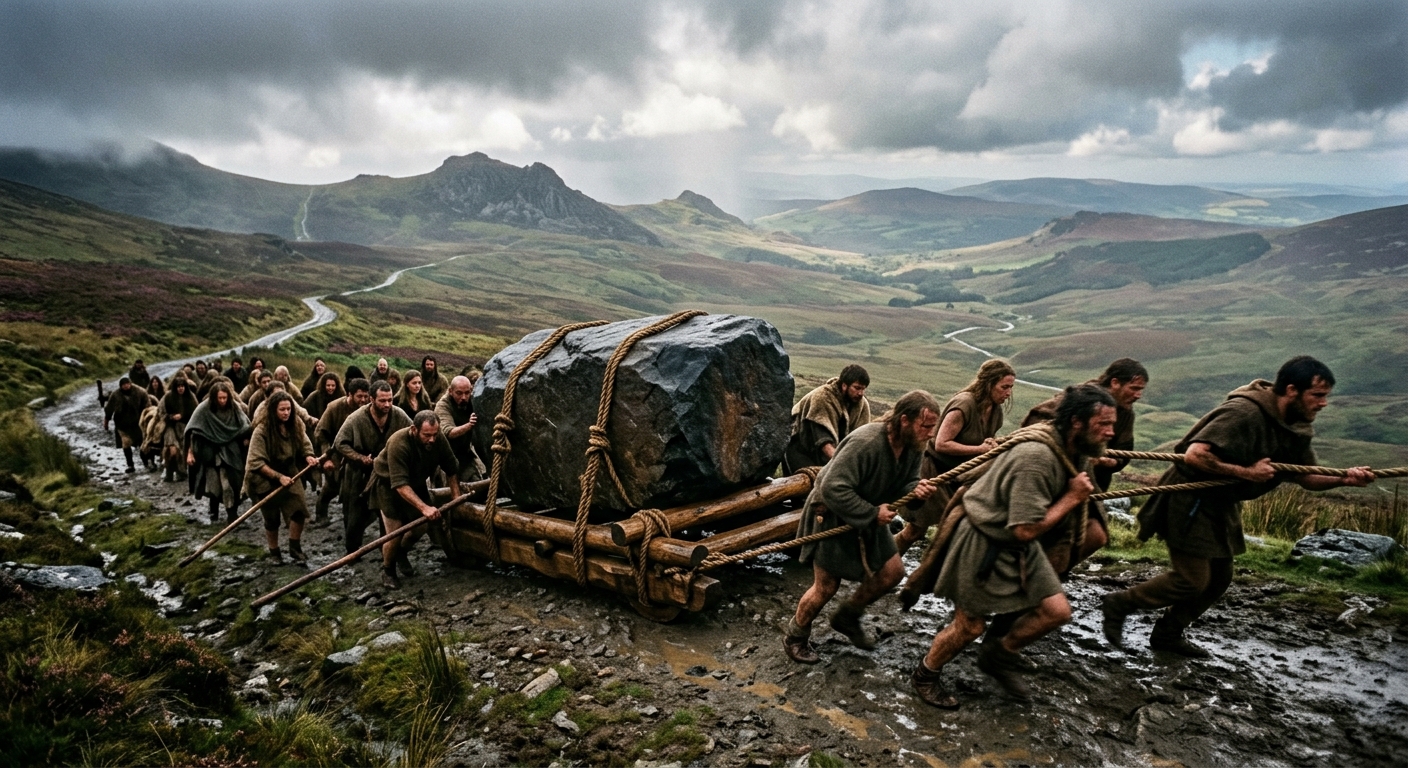
Some researchers propose that the stones were moved entirely over land using wooden rollers, ropes, and human power. Experimental reconstructions suggest that moving a 2-ton bluestone would require approximately 100 people working together. The route would have taken them across challenging terrain including rivers, hills, and dense forests.
This theory is supported by the discovery of wooden trackways and ancient paths that align with a potential overland route from Wales to Stonehenge. However, the sheer physical difficulty of this approach, especially crossing major rivers like the Severn, makes many archaeologists skeptical.
The Glacial Transport Theory (Largely Debunked)
For decades, some geologists argued that glaciers during the last Ice Age naturally transported these stones from Wales to the Stonehenge area. This would have made the builders’ job much easier, as they would have simply collected the stones from local deposits left behind by retreating ice.
However, recent geological surveys have found no evidence of glacial deposits containing Welsh rocks in the Stonehenge area. The lack of other Welsh rock types in the region strongly suggests human, not glacial, transport.
The Water Route: The Most Likely Solution
The current leading theory involves a combination of land and water transport, taking advantage of Britain’s rivers and coastline. This route would have involved:
- Moving stones from quarry to coast: Rolling the bluestones approximately 30 miles from the Preseli Hills to Milford Haven on the Welsh coast
- Sea transport: Loading stones onto rafts or early boats and sailing around the Welsh coast, then up the Bristol Channel
- River transport: Navigating up the River Avon and other waterways to get within a few miles of Stonehenge
- Final overland journey: The last stretch would still require moving stones over land, but this would be much shorter than a fully overland route
Experimental archaeology has shown that Neolithic-era technology could indeed support this approach. Researchers have successfully moved multi-ton stones using replica Bronze Age boats and simple raft systems.
The Human Cost: A Massive Community Effort
Regardless of the exact method used, transporting the bluestones would have required unprecedented cooperation between different communities across Bronze Age Britain. Archaeological evidence suggests this wasn’t a single journey but potentially multiple expeditions over several decades or even centuries.
The project would have demanded:
- Hundreds of workers coordinating their efforts
- Sophisticated planning and route-finding
- Seasonal timing to take advantage of favorable weather and water conditions
- Massive resource allocation, including food, tools, and materials
- Cooperation between tribes and communities along the entire route
The Social Implications
The bluestone transport project reveals sophisticated social organization among Neolithic British communities. This wasn’t just an engineering achievement, it was a social one. The project required a level of coordination and shared purpose that suggests these ancient societies were far more complex and organized than previously believed.
Modern Mysteries: Questions That Remain
Despite decades of research, many questions about the bluestone transport remain unanswered:
Why these specific stones? While we know the bluestones came from particular outcrops in Wales, we still don’t fully understand why these exact stones were chosen over others with similar properties.
How long did it take? Estimates range from a single massive undertaking lasting several years to a gradual process spanning centuries, with stones moved individually or in small groups.
Who organized it? The level of coordination required suggests a powerful authority or shared religious purpose, but we have no direct evidence of who or what motivated this massive project.
Were there failures? Some researchers speculate that stones may have been lost during transport, potentially lying at the bottom of rivers or the Bristol Channel, but none have been definitively identified.
A Testament to Human Determination
The transport of Stonehenge’s bluestones represents one of humanity’s earliest mega-engineering projects. It demonstrates that our Neolithic ancestors were capable of incredible feats of planning, coordination, and sheer determination. They moved mountains, literally, to create something they believed was important enough to justify an almost unimaginable effort.
Today, as we marvel at modern engineering achievements, it’s humbling to remember that 5,000 years ago, our ancestors accomplished something that still leaves us scratching our heads. They didn’t have cranes, trucks, or GPS, but they had something perhaps more powerful: an unshakeable belief that some things are worth the impossible journey.
The next time you see Stonehenge, whether in person or in photographs, remember that those distinctive inner stones carry with them the sweat, ingenuity, and dreams of countless ancient workers who refused to accept that 200 miles was too far to transport their sacred stones. In an age before motorways and modern transport, they literally moved heaven and earth to build something that would outlast empires and continue to inspire wonder five millennia later.


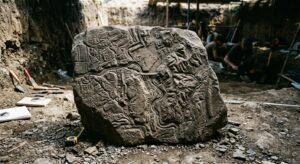

ok but like honestly the logistics of this are way more impressive than any cryptid mystery lol. ancient humans figuring out how to move massive stones over that distance without modern tech is basically real-world evidence that our ancestors werent just randomly placing rocks – theres actual strategy here. i wonder if theyre finding any evidence of the routes they used or tools they left behind? the engineering problem solving is so much cooler than it gets credit for tbh
Log in or register to replyI mean, you’re touching on something real here – the logistics problem is genuinely wild and worth taking seriously on its own terms. But I’d gently push back on the framing that figuring out clever solutions to physical problems proves something about overall human capability, because honestly we still don’t fully know HOW they did it (water transport? Sleds on greased tracks? Some combination?). The mystery isn’t that ancient humans were dumb, it’s that we’ve lost the specific knowledge and context. What’s actually impressive is reconstructing enough of their problem-solving to figure out what was even possible at all.
Log in or register to replyThis is fascinating stuff, but I can’t help thinking about how much we could learn by studying the actual *routes* these stones traveled – I’ve explored enough cave systems in Wales to know the landscape has hidden passages and water systems that could’ve made transport way easier than we assume. The underground geology of that region is seriously underexplored and might hold clues about how they navigated or even stored resources during the journey. Has anyone looked into whether cave systems along the hypothetical transport routes could explain some of the logistics puzzle?
Log in or register to reply