
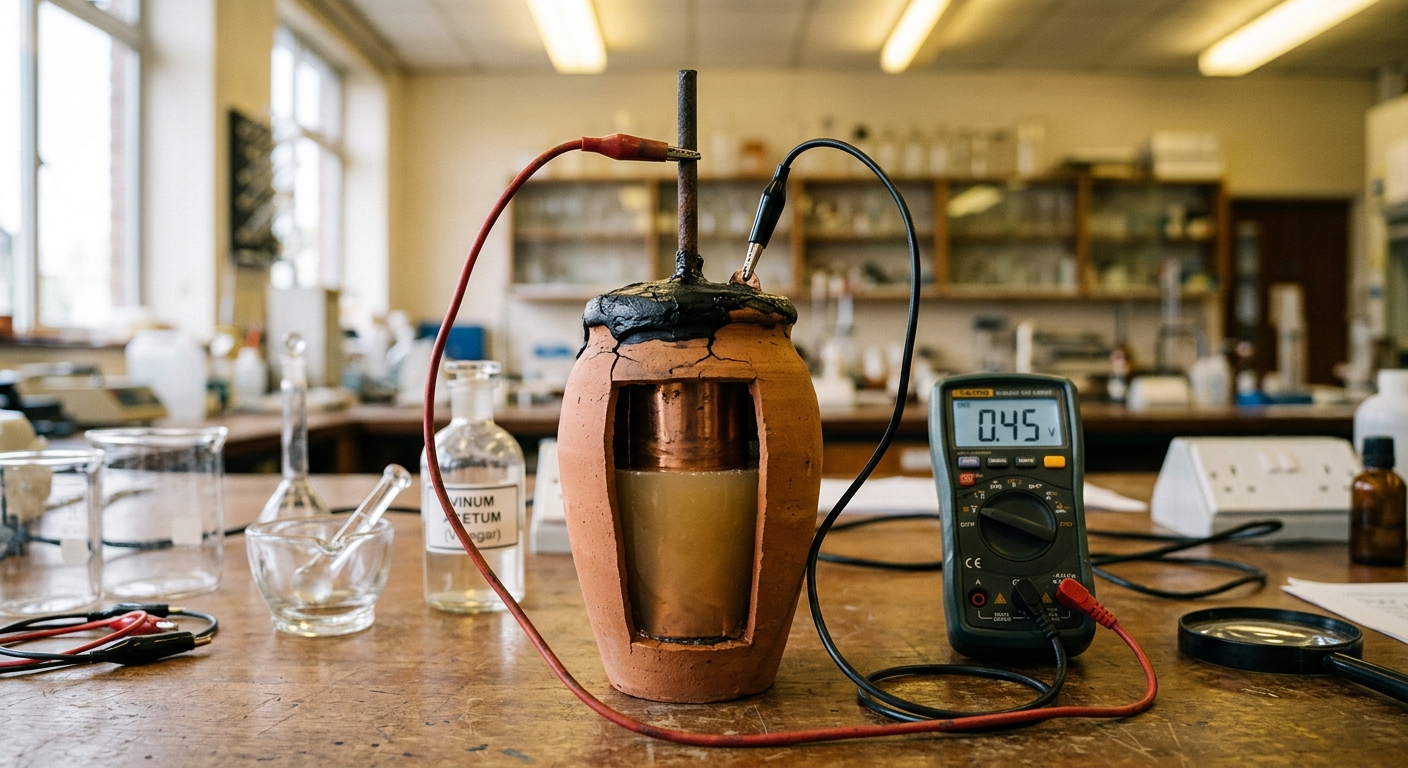
Deep in the basement of the National Museum of Iraq sits an object that challenges everything we think we know about ancient technology. Found in 1936 near Baghdad, this unassuming clay jar might be the world’s oldest battery, predating Alessandro Volta’s famous invention by more than 2,000 years. But the real mystery isn’t just that it works: it’s what ancient craftsmen might have used it for.
The Discovery That Changed Everything
German archaeologist Wilhelm König was cataloging artifacts in the Iraq Museum when he stumbled upon something extraordinary. Among pottery shards and ancient coins was a 5.5-inch tall clay jar containing a copper cylinder wrapped around an iron rod. At first glance, it looked like debris. But König, who had a background in electrical engineering, recognized something others had missed: this arrangement could generate electricity.
The jar, dating to approximately 250 BCE during the Parthian period, contained all the basic components of a galvanic cell. The copper cylinder served as the cathode, the iron rod as the anode, and when filled with an acidic solution, the entire apparatus could produce a measurable electrical current.
Testing the Impossible
Skeptics dismissed König’s theory for decades until television producer and engineer Arne Eggebrecht decided to put it to the test in 1978. Using an exact replica of the Baghdad Battery filled with grape juice (a mildly acidic solution that would have been available to ancient peoples), Eggebrecht successfully generated 0.87 volts of electricity.
The voltage was modest but consistent. More importantly, it proved that the ancient device could indeed function as a battery. Subsequent experiments by other researchers have generated between 0.8 and 2 volts using various acidic solutions including:
- Vinegar
- Wine
- Lemon juice
- Copper sulfate solution
The Golden Connection
The most compelling evidence for the battery’s practical use comes from its archaeological context. The Baghdad Battery wasn’t found in isolation: it was discovered alongside numerous objects that showed evidence of gold plating. This detail transforms the artifact from a curious anomaly into a potentially revolutionary piece of ancient technology.
Electroplating, the process of using electrical current to deposit thin layers of metal onto objects, requires a steady source of electricity. Modern experiments have demonstrated that replicas of the Baghdad Battery can indeed deposit gold onto silver jewelry and other metal objects, creating a thin but durable golden coating.
Dr. Marjorie Senechal, a mathematician and historian at Smith College, points out that ancient texts describe objects with impossibly thin layers of gold: coatings so fine they seemed almost magical. “We always assumed they used fire gilding or gold leaf,” she explains, “but electroplating would explain how they achieved such uniform, thin layers.”
Evidence in the Artifacts
Archaeological evidence supports this electroplating theory. Several Parthian-era artifacts show gold plating that’s remarkably uniform and thin, characteristics that are difficult to achieve without electrical assistance. Traditional fire gilding, which involves heating gold amalgam, typically produces thicker, more uneven coatings.
Furthermore, some ancient gold-plated objects show no evidence of the mercury residue typically left behind by fire gilding processes. This absence suggests an alternative method was used, one that could have involved electrical current.
Alternative Theories and Skepticism
Not everyone accepts the battery theory. Some archaeologists argue that the object might have served entirely different purposes:
- Storage vessel: The jar might have simply held scrolls or other documents, with the metal components serving as structural support
- Religious artifact: Some suggest it was used in rituals, possibly to create mild electrical sensations interpreted as divine touch
- Medical device: Ancient texts describe using metal objects for pain relief, possibly through mild electrical stimulation
Dr. Paul Craddock of the British Museum remains skeptical about the electroplating theory. “While the device can generate electricity, we have no contemporary written evidence that ancient peoples understood electrical phenomena in this way,” he argues. “The archaeological context, while suggestive, isn’t conclusive proof of intentional electrical use.”
The Broader Implications
If the Baghdad Battery was indeed used for electroplating, it would revolutionize our understanding of ancient technological capabilities. The implications extend far beyond a single artifact:
Lost Knowledge
The technology might represent lost knowledge that disappeared during periods of political upheaval. The Parthian Empire faced constant warfare with Rome, and much technological knowledge could have been lost when craftsmen died or fled without passing on their secrets.
Trade Networks
Electroplating would have given ancient craftsmen a significant competitive advantage, allowing them to produce gold-plated items more efficiently and with less gold. This could have influenced ancient trade networks and economic systems in ways we’re only beginning to understand.
Scientific Understanding
The battery suggests that ancient peoples might have had empirical knowledge of electrical phenomena, even without modern scientific frameworks to explain them. This challenges assumptions about the linear progression of scientific knowledge.
Modern Mysteries
Perhaps the most frustrating aspect of the Baghdad Battery mystery is that we may never have definitive answers. The original artifact disappeared during the 2003 invasion of Iraq, along with thousands of other irreplaceable archaeological treasures. What remains are photographs, detailed measurements, and the tantalizing possibility that our ancestors were more technologically sophisticated than we ever imagined.
Recent archaeological work in the region has uncovered similar jars with metal components, suggesting the Baghdad Battery wasn’t unique. However, political instability has limited comprehensive study of these finds.
The Verdict
While we may never know with certainty whether ancient peoples intentionally created electrical batteries, the Baghdad Battery remains a fascinating glimpse into technological possibilities that conventional archaeology never considered. Whether it powered ancient workshops or served some other purpose, this humble clay jar reminds us that innovation and ingenuity are as old as civilization itself.
The next time you plug in your phone to charge, remember that the basic principles powering your device might have been discovered not in a modern laboratory, but in an ancient workshop along the banks of the Tigris River, where craftsmen created golden treasures that still shimmer today.




This is fascinating from a historical perspective, but it honestly makes me think about how we tend to underestimate ancient intelligence while simultaneously overestimating our own understanding of animal cognition, which is wild because humpback whales have been using complex sonar and song patterns for millennia too and we’re still just scratching the surface of what they’re communicating. I’d love to know more about whether these batteries were actually functional or if that’s still debated among experts, because the gap between “could theoretically work” and “was actually used” is huge!
Log in or register to replytbh quinn is totally right here, the voltage generated would be so smol compared to what you’d actually need for anything practical. like its definitely a cool proof of concept thing but calling it a “battery” feels generous when it coudnt power much more than a tiny led. i always think about how ppl want ancient tech mysteries to be way more sophisticated than they probably were, kinda like how every lake monster legend is either a giant squid (which is real and genuinely terrifying btw) or a plesiosaur (which… isnt gonna work in freshwater lol). what real animal or natural phenomenon do you think inspired the electroplating idea?
Log in or register to replyThis is such a cool artifact to think about, but I gently push back on the “rewriting history” framing – the Baghdad Battery probably generated *some* voltage (imagine a lemon battery scaled up with vinegar or citric acid), but nowhere near enough to be practical for electroplating, which requires pretty specific conditions and consistent current. The gold plating might’ve just been decorative work done the old fashioned way. What I find more interesting is the question of *why* someone made it – was it intentional electrical experimentation, religious ritual, or just accidental discovery? That’s the real mystery worth pondering.
Log in or register to reply