
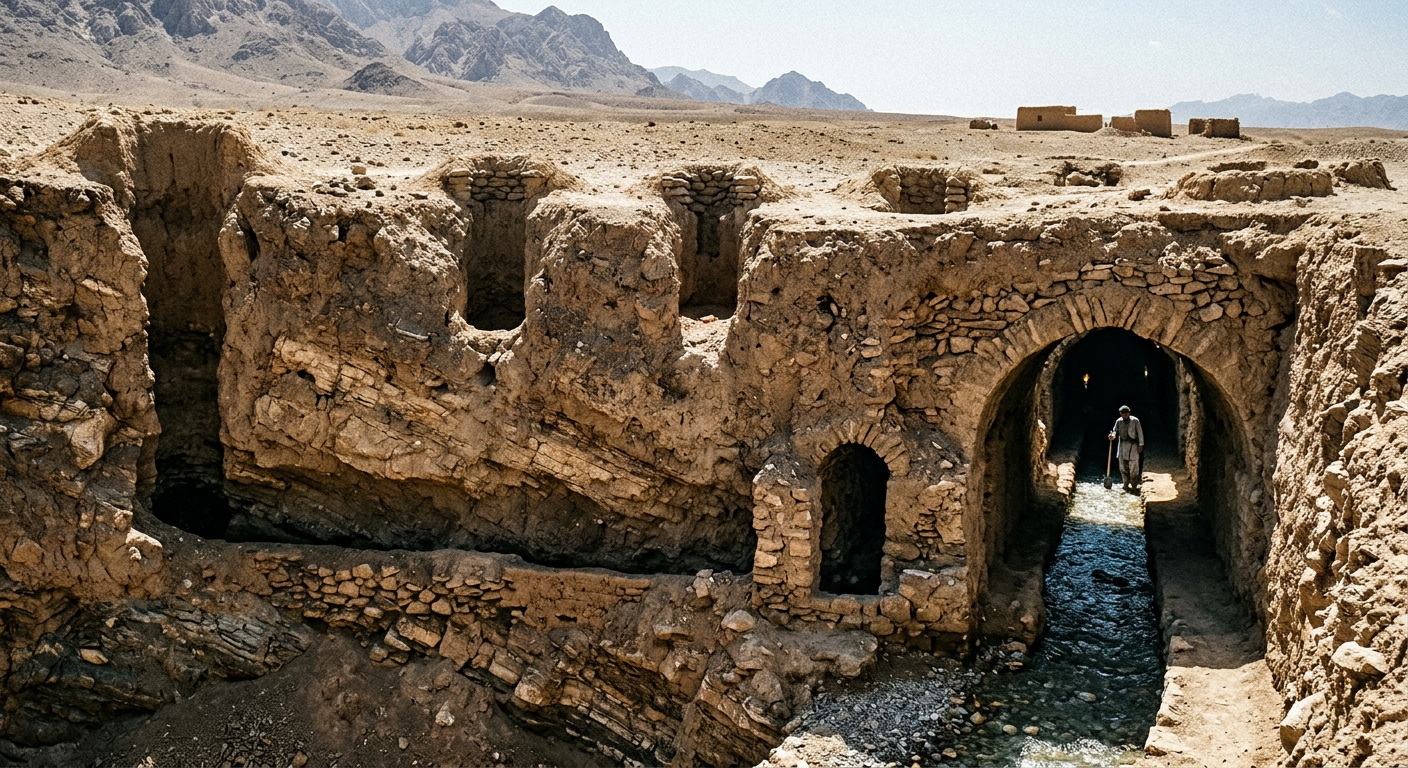
Imagine digging a tunnel longer than the distance from New York to Boston, entirely by hand, using only basic tools and ancient engineering knowledge. Now imagine doing this not just once, but thousands of times across desert landscapes where water means the difference between life and death. This is exactly what Persian engineers accomplished over 2,500 years ago with their revolutionary qanat system.
What Exactly Is a Qanat?
A qanat is an ingenious underground aqueduct system that transports water from highland aquifers to arid lowland areas through gravity-fed tunnels. The word “qanat” comes from the Persian word meaning “to dig,” and these remarkable structures represent one of humanity’s greatest engineering achievements that most people have never heard of.
Unlike surface canals that lose massive amounts of water to evaporation in desert climates, qanats flow entirely underground, preserving every precious drop as it travels from source to destination. The system works by tapping into water tables at higher elevations and channeling that water through gently sloping tunnels that can extend for hundreds of kilometers.
The Mind-Blowing Scale of Ancient Engineering
The numbers behind qanat systems are staggering. Iran alone contains over 37,000 active qanats with a combined length exceeding 270,000 kilometers. To put this in perspective, that’s enough tunnel length to circle the Earth nearly seven times. Some individual qanats stretch for more than 300 kilometers, making them longer than many major rivers.
The longest known qanat runs for an incredible 427 kilometers in Iran’s Kerman province. Construction of such massive undertakings often took decades or even centuries to complete, with multiple generations of workers dedicating their entire lives to a single project.
Vertical Shafts: The Ancient Elevator System
What makes qanats even more remarkable are the vertical access shafts spaced every 20-200 meters along their length. These shafts, some reaching depths of over 200 meters, served multiple purposes:
- Removing excavated soil and rock during construction
- Providing ventilation for workers deep underground
- Allowing access for maintenance and repairs
- Creating precise surveying points to maintain proper tunnel gradient
From the surface, these shaft openings create distinctive dotted lines across desert landscapes that can be seen from space, marking the underground rivers flowing beneath.
The Master Craftsmen: Muqannis
The construction and maintenance of qanats required highly specialized workers called muqannis. These master tunnel diggers possessed an almost supernatural understanding of underground hydrology, soil composition, and structural engineering. Working in cramped, dangerous conditions with minimal lighting, muqannis could somehow maintain precise gradients over enormous distances using only simple tools like picks, shovels, and oil lamps.
The knowledge of qanat construction was closely guarded and passed down through generations within specialist families. A master muqanni could determine the optimal route for a qanat by reading subtle surface clues about underground water sources and geological conditions.
Dangerous Work in the Depths
Building qanats was incredibly perilous work. Cave-ins, toxic gases, flooding, and oxygen deprivation claimed countless lives. Workers faced the constant threat of tunnel collapse, especially when excavating through unstable soil layers. Many qanats became tombs for the brave individuals who built them, with their remains still entombed in collapsed sections.
A Global Water Revolution
While qanats originated in ancient Persia around 500 BCE, the technology spread throughout the ancient world wherever Persian influence extended. Today, qanat systems can be found across:
- The Middle East and Central Asia
- North Africa, particularly in Morocco and Algeria
- Spain, introduced during Islamic rule
- Parts of South America, brought by Spanish colonizers
- Afghanistan, where they’re called “karez”
- Oman, where they’re known as “aflaj”
Each region adapted the basic qanat concept to local conditions, creating variations in construction techniques and maintenance practices while preserving the core engineering principles.
Modern Marvels Still Flowing
Perhaps most incredibly, many ancient qanats continue operating today exactly as they did thousands of years ago. In Iran, these ancient waterways still provide about 10% of the country’s total water supply, irrigating over 75,000 hectares of farmland and supplying drinking water to millions of people.
Some qanats have flowed continuously for over two millennia, representing the longest-running engineering projects in human history. Their sustainability far exceeds any modern infrastructure, as they require no external power source and minimal maintenance when properly constructed.
Recognition at Last
In 2016, UNESCO recognized the Persian Qanat as a World Heritage Site, finally giving these engineering marvels the global recognition they deserve. The designation highlights not just their technical achievement, but their crucial role in enabling civilization to flourish in some of Earth’s most challenging environments.
Today, as water scarcity becomes an increasingly urgent global issue, engineers and hydrologists are studying ancient qanat systems for insights into sustainable water management. These 2,500-year-old solutions may hold keys to addressing modern water challenges in arid regions worldwide.
The Persian qanat system stands as a testament to human ingenuity, persistence, and the incredible achievements possible when necessity drives innovation. These underground highways of life continue flowing beneath desert sands, carrying not just water, but the legacy of ancient engineers whose vision literally moved mountains to bring life to the desert.




the qanats are genuinely incredible from a hydrology perspective too, not just engineering, because those guys understood groundwater flow and slope gradient without any of our modern tools or gauges. what fascinates me is how they worked WITH the landscape instead of against it like we do with dams, and honestly the ecological impact was probably way lighter since they weren’t impounding whole river systems. i’d love to know if anyone’s done water quality monitoring on active qanats compared to modern piped systems, because i suspect there’s something about that slow, filtered movement through soil that keeps the water cleaner than our industrial methods.
Log in or register to replyyeah rachel youre hitting on something i think about a lot actually, like the qanats are basically a perfect example of working within existing systems instead of trying to dominate them, which is exactly what ant colonies do right, they map the environment and move through it intelligently rather than reshaping everything. and your point about the ecological filtering is huge because thats basically what happens in a foraging network too, the pressure naturally distributes itself and self corrects, so i wouldnt be surprised if those older methods actually maintain better water quality through just letting physics and biology do the work rather than forcing everything through industrial pipes. the fact that theyre still functioning after 2500 years is kind of the ultimate proof that working with
Log in or register to replydude this is honestly the perfect example of what i mean when i talk about ant colonies as a model for human achievement, like these engineers created this decentralized network of workers all following pretty simple rules and guidelines, and it resulted in something that literally lasted 2500 years and still works today. thats the kind of emergent complexity you see when a colony coordinates without some centralized “brain” telling everyone exactly what to do, and its wild that we built stuff this resilient before we had computers or project management software. i wonder if the knowledge transfer between workers was as sophisticated as how ants communicate via pheromones, because that kind of information flow seems crucial to keeping such massive projects organized over generations
Log in or register to reply