
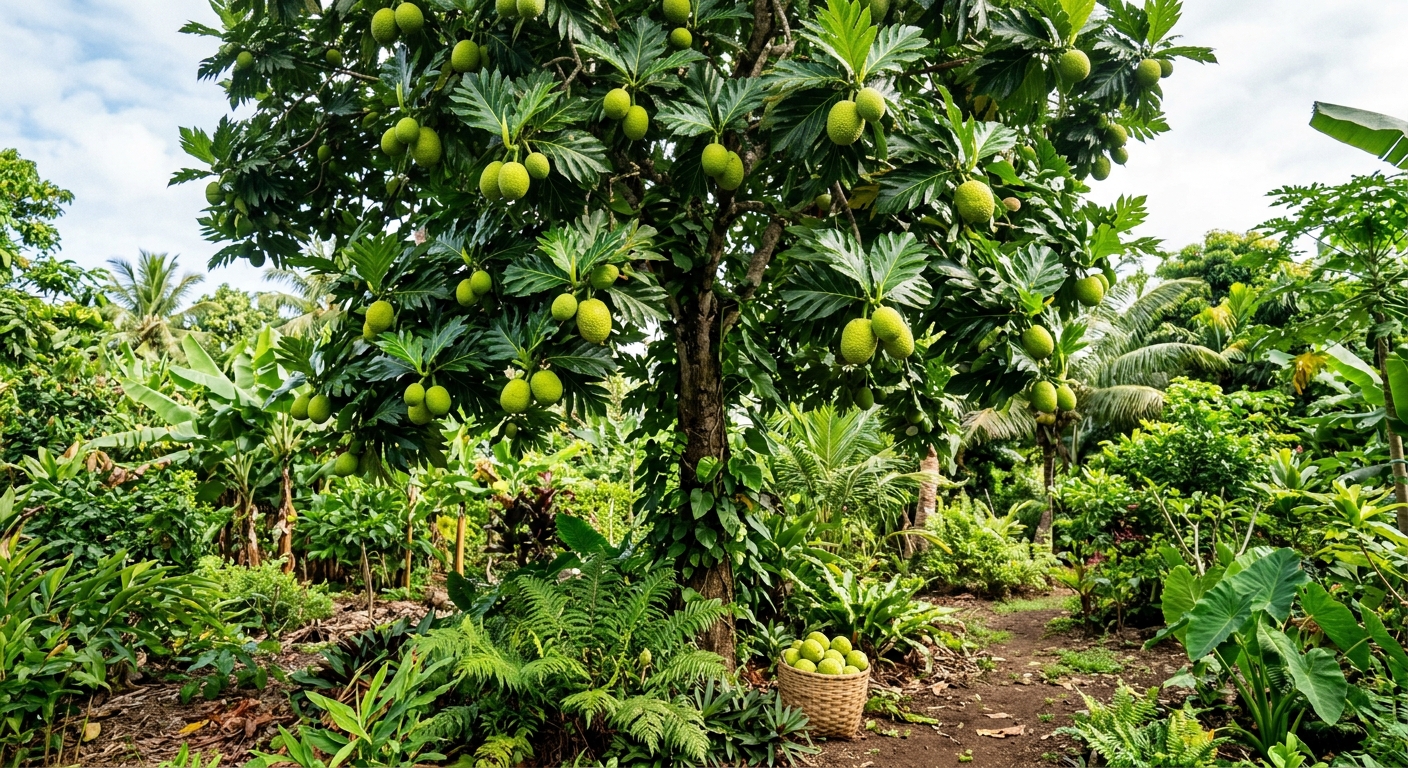
Imagine a tree that could feed your entire family for decades without requiring a single day of farming, planting, or harvesting. No fertilizers, no pesticides, no backbreaking labor under the scorching sun. It sounds like something out of a fantasy novel, but this agricultural miracle exists right now on our planet.
Meet the breadfruit tree (Artocarpus altilis), nature’s most generous gift to humanity. This remarkable plant produces an astounding 200 pounds of nutritious food every single year for up to 80 years, all while asking for absolutely nothing in return except a patch of tropical soil and some rainfall.
The Ultimate Survival Tree That Sustained Civilizations
For over 3,000 years, Pacific Islander communities have relied on breadfruit trees as their primary food source. These trees didn’t just supplement their diet; they formed the backbone of entire civilizations. On islands where traditional farming was challenging due to volcanic soil or limited space, breadfruit trees allowed populations to thrive without the constant struggle of agriculture.
The tree’s reputation was so legendary that it sparked one of history’s most famous maritime adventures. Captain William Bligh’s infamous voyage on the HMS Bounty wasn’t just a casual exploration trip. The British Navy specifically tasked him with collecting breadfruit trees from Tahiti to transplant them to Caribbean colonies, hoping to create a cheap, reliable food source for enslaved populations. The mission was considered so valuable that it led to the famous mutiny when crew members refused to prioritize the trees over their own survival.
A Nutritional Powerhouse Disguised as a Simple Fruit
Don’t let the name fool you. Despite being called “breadfruit,” this incredible produce is actually more nutritionally complete than most staple foods we consider essential today. A single breadfruit contains:
- High levels of complex carbohydrates that provide sustained energy
- Significant amounts of vitamin C (more than oranges)
- Potassium levels that rival bananas
- Fiber content that supports digestive health
- Essential amino acids that contribute to protein synthesis
- Calcium, iron, and magnesium for bone and blood health
The fruit can be eaten at various stages of ripeness, each offering different nutritional profiles and flavors. Young breadfruit tastes remarkably similar to potatoes and can be boiled, baked, or fried. Mature fruit becomes sweeter and can be eaten raw or turned into flour for baking. This versatility means a single tree can provide diverse meal options throughout the year.
The Science Behind Nature’s Most Efficient Food Factory
What makes breadfruit trees so incredibly productive? The secret lies in their evolutionary adaptation to tropical climates and their unique reproductive strategy.
Photosynthetic Efficiency
Breadfruit trees have developed an extremely efficient photosynthetic system. Their large, distinctively shaped leaves maximize sunlight absorption while their extensive root system efficiently extracts nutrients and water from the soil. This combination allows them to convert solar energy into edible calories at a rate that puts most agricultural crops to shame.
Continuous Production Cycle
Unlike seasonal crops that require replanting, breadfruit trees produce food year-round in tropical climates. They typically have two main harvesting seasons per year, with some varieties producing fruit continuously. This means families can count on regular food supplies without the anxiety of crop failure or seasonal shortages.
Minimal Resource Requirements
Perhaps most impressively, breadfruit trees thrive with minimal human intervention. They’re naturally resistant to most pests and diseases, rarely require fertilization, and can tolerate various soil conditions. Once established, they essentially become autonomous food production systems.
Global Impact: Could Breadfruit Solve World Hunger?
Modern researchers and humanitarian organizations are taking a fresh look at breadfruit trees as a potential solution to global food security challenges. The math is compelling: a single tree can feed a family of four for decades, requires minimal water compared to traditional crops, and produces more calories per acre than rice, wheat, or corn.
The National Tropical Botanical Garden has launched the Breadfruit Institute, dedicated to promoting breadfruit cultivation worldwide. Their research suggests that strategic planting of breadfruit trees in tropical and subtropical regions could significantly reduce hunger while requiring minimal agricultural investment.
Climate Change Resilience
As climate change threatens traditional agriculture, breadfruit trees offer remarkable resilience. They can withstand hurricanes, drought conditions, and saltwater intrusion that would destroy conventional crops. Their deep root systems help prevent soil erosion, while their large canopies provide shade and cooling effects that benefit local ecosystems.
The Incredible Varieties You’ve Never Heard Of
Not all breadfruit trees are created equal. There are over 120 known varieties, each adapted to specific climates and offering unique characteristics:
- Polynesian varieties: Produce the largest fruits, some weighing up to 10 pounds each
- Caribbean types: Adapted to hurricane-prone regions with flexible trunks
- Hawaiian cultivars: Bred for continuous year-round production
- African varieties: Drought-resistant types that thrive in semi-arid conditions
Some varieties produce seedless fruit, while others generate seeds that can be roasted and eaten like chestnuts, adding even more nutritional value to the tree’s output.
Why Isn’t Everyone Growing These Miracle Trees?
Given their incredible productivity and low maintenance requirements, you might wonder why breadfruit trees aren’t cultivated everywhere. The answer lies in geography and cultural familiarity. Breadfruit trees require tropical or subtropical climates and can’t survive freezing temperatures.
Additionally, many cultures outside of Pacific Island communities simply aren’t familiar with how to prepare and eat breadfruit. Unlike rice or wheat, breadfruit hasn’t been globally marketed or integrated into international cuisine. This cultural barrier has limited its adoption despite its obvious benefits.
However, this is changing rapidly. Agricultural researchers are developing cold-resistant varieties, while chefs worldwide are discovering breadfruit’s culinary versatility. From breadfruit flour to fermented breadfruit products, innovation is making this ancient superfood accessible to modern global markets.
The breadfruit tree stands as a testament to nature’s incredible generosity and efficiency. In a world where we often assume that feeding people requires complex technology and intensive labor, this remarkable plant quietly produces abundance with almost no human effort required. Perhaps the most mind-blowing fact isn’t just that breadfruit trees can feed families for decades, but that this solution to hunger has been hiding in plain sight for thousands of years.


You and Beatrice are both hitting on something important here, and I’d add that the “zero-effort” angle, while tempting, actually undersells what makes breadfruit so genuinely remarkable. Yes, it needs some care – pruning, pest management, soil considerations – but what’s really astounding is the *caloric return on that modest effort* compared to staple crops like corn or wheat, which demand constant attention. After 30 years of teaching, I noticed students got more excited about a plant that genuinely solves problems than one that sounds like magic, so I’m curious whether you’ve found breadfruit actually catching on in regions where food security is real, or if cultural food preferences and infrastructure
Log in or register to replyI love the enthusiasm here, but I’d gently push back on the “zero-effort” framing, since even breadfruit needs *some* tending to thrive and produce reliably. That said, what really gets me is thinking about breadfruit in the context of habitat restoration, especially in tropical regions where we’ve torn out so much native vegetation, because these food forests could actually create shelter for fireflies and other bioluminescent creatures we’ve been losing to monoculture and light pollution. Imagine restoring both food security AND the magic of tropical night skies flickering with life again.
Log in or register to replyoh this is such a good point about the habitat angle, beatrice! i was just watching a david attenborough doc on tropical ecosystems and honestly the way monoculture just erases entire niches is devastating. breadfruit polyculture systems could genuinely be a game changer for biodiversity while also feeding people – like you’re creating microclimates that could support fireflies and who knows what else just by letting these food forests develop? have you looked into wether the bioluminescent diversity actually bounces back quickly once you start restoring that kind of canopy coverage, or is it a slower process?
Log in or register to reply