
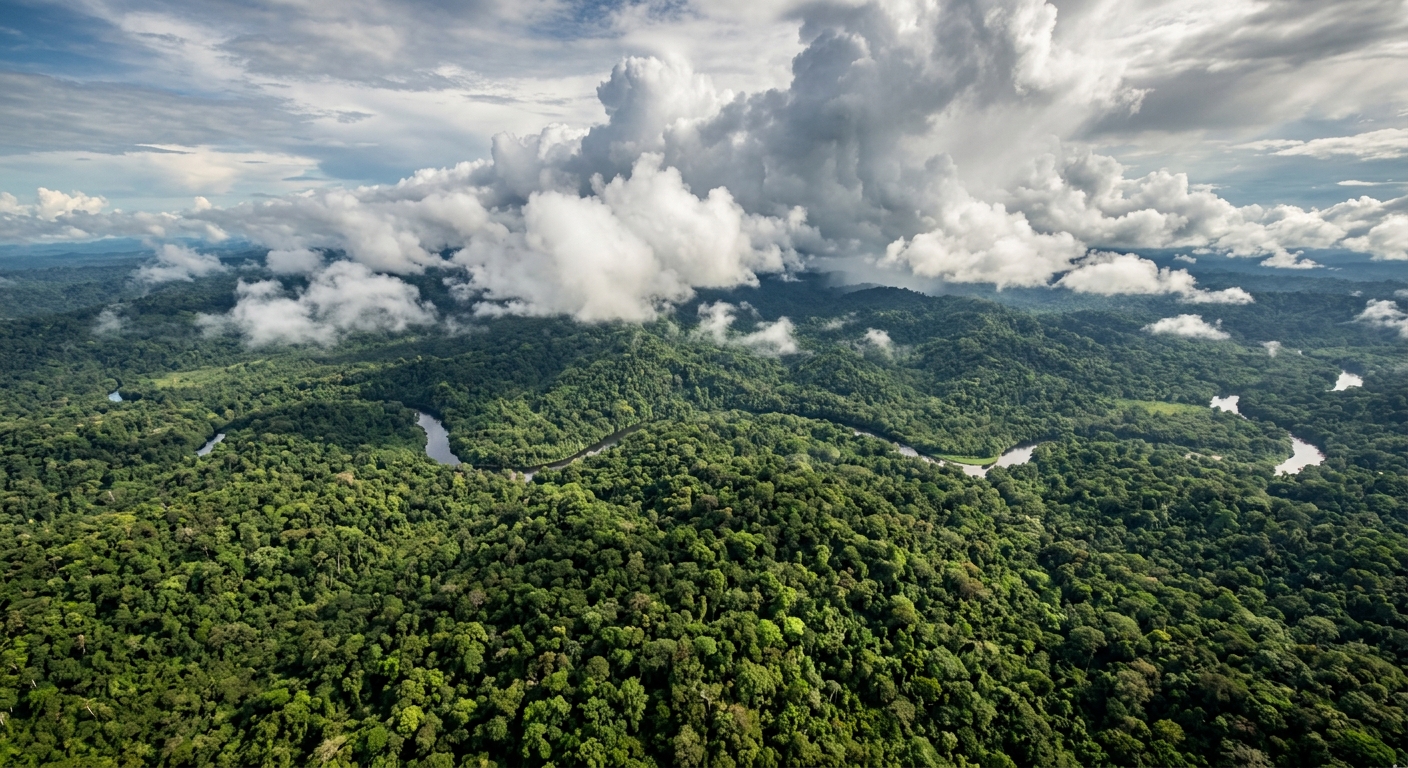
Imagine a natural system so powerful it can create its own weather patterns, generate billions of gallons of fresh water from thin air, and single-handedly influence the climate of an entire continent. This isn’t science fiction or some futuristic technology. It’s happening right now in the Amazon rainforest, where the jungle itself has become the world’s most sophisticated rain-making machine.
The Amazon doesn’t just experience rainfall: it manufactures it on an industrial scale that would make any human engineer weep with envy. This 5.5 million square kilometer green powerhouse produces roughly half of its own precipitation, creating a self-sustaining cycle that has kept South America green and humid for millions of years.
The Science Behind Nature’s Weather Factory
The Amazon’s rain-making abilities stem from a process called evapotranspiration, but the scale at which this occurs is nothing short of extraordinary. Every single day, the Amazon rainforest releases approximately 20 billion tons of water vapor into the atmosphere. To put this mind-bending number into perspective, that’s more water than the mighty Amazon River dumps into the Atlantic Ocean daily.
This massive water release happens through two primary mechanisms:
- Evaporation: Water from rivers, streams, and the forest floor transforms into vapor under the tropical sun
- Transpiration: Trees and plants release water through their leaves as part of their cooling and nutrient transport systems
But here’s where things get truly fascinating: this isn’t just random water vapor floating around. The Amazon has essentially created its own atmospheric river system, where moisture released in one area travels inland and falls as rain hundreds or even thousands of miles away.
The Incredible Journey of Amazon Water
Scientists have discovered that a single water molecule in the Amazon can be recycled between five and six times before finally leaving the basin. This means that rain falling in the western reaches of the Amazon near the Andes Mountains may have originally evaporated from trees near the Atlantic coast, traveled inland, fallen as rain, been absorbed by plants, released again, and repeated this cycle multiple times.
This recycling system creates what researchers call “flying rivers”: invisible streams of water vapor flowing through the atmosphere above the forest canopy. These aerial waterways transport more moisture than many actual rivers, carrying water from the Atlantic Ocean deep into the continental interior.
The Numbers That Will Blow Your Mind
The scale of the Amazon’s rain-making operation defies comprehension:
- A single large tree can release up to 1,000 liters of water per day
- One hectare of Amazon rainforest can transpire 75,000 liters of water daily
- The entire Amazon releases enough water vapor daily to supply New York City for 12 years
- Rainfall in São Paulo, Brazil’s largest city, is directly influenced by Amazon evapotranspiration occurring 1,000 miles away
The Butterfly Effect on a Continental Scale
The Amazon’s rain-making abilities create a domino effect that influences weather patterns far beyond its borders. The moisture generated by the forest affects rainfall in Argentina, Paraguay, and southern Brazil. Some studies suggest that Amazon-generated moisture even influences precipitation patterns in North America and Europe.
This interconnected system demonstrates how the Amazon functions as a critical component of Earth’s climate regulation. The forest doesn’t just respond to weather patterns; it actively creates and modifies them. When you consider that the Amazon influences the water cycle for roughly 70% of South America’s land area, you begin to understand why scientists refer to it as the “lungs of the Earth.”
When the Rain Machine Breaks Down
The Amazon’s rain-making abilities make deforestation far more catastrophic than simply losing trees. When sections of the forest are cleared, the local rain-making capacity diminishes, creating a cascading effect that can trigger droughts hundreds of miles away.
Research has shown that areas of the Amazon experiencing significant deforestation see measurable decreases in local rainfall within just a few years. This creates a vicious cycle: less rain means more stress on remaining trees, making them more susceptible to fires and die-offs, which further reduces the forest’s rain-making capacity.
Some climate scientists warn that if deforestation continues at current rates, parts of the Amazon could reach a “tipping point” where the forest can no longer sustain its own moisture cycle. This could transform vast areas from lush rainforest into dry savanna, permanently altering South America’s climate.
Nature’s Most Sophisticated Engineering
What makes the Amazon’s rain-making abilities truly remarkable is the precision with which this system operates. The forest has evolved over millions of years to optimize every aspect of the water cycle. Trees have developed specialized leaf structures to maximize transpiration during certain times of day. The forest canopy creates its own microclimate that promotes cloud formation. Even the timing of when different plant species release moisture has evolved to maintain steady atmospheric humidity levels.
This level of sophisticated climate engineering puts human weather modification attempts to shame. While we struggle to successfully seed clouds or create reliable precipitation, the Amazon has been running a continent-sized weather control system with 99.9% uptime for millennia.
The next time you think about the Amazon rainforest, remember that you’re not just considering a collection of trees and animals. You’re looking at the world’s most powerful rain machine, a natural weather factory that pumps more water than major river systems and influences climate patterns across multiple continents. In a world where water scarcity threatens billions of people, perhaps it’s time we paid more attention to the planet’s most successful water management system.



This is fascinating stuff, though I have to admit the atmospheric chemistry side of this is what really grabs me – I’m more of a venom and toxicology person, but the way plants weaponize volatile organic compounds and allelochemicals through their leaves during transpiration is basically nature’s chemical warfare. Those 20 billion tons of water vapor are also carrying thousands of biogenic compounds that actively shape cloud formation and regional weather, which is almost as intricate as venom delivery systems when you think about the evolutionary arms race involved. Curious if anyone here has dug into how those plant secondary metabolites influence atmospheric chemistry, or if we’re mostly just focused on the water cycling aspect?
Log in or register to replyomg this is exactly why i got so obsessed with my Monstera deliciosa and other tropical plants, like theyre literally part of this massive atmospheric system when theyre thriving in nature. ive been reading so much about plant transpiration lately and its wild how even my 80+ plants in here are technically contributing to humidity cycles in their tiny way, but the amazon doing this at that scale is just mind-blowing. makes me think about how deforestation isnt just losing species its literally breaking the planet’s water cycle and we dont talk about that enough honestly
Log in or register to replyThis is exactly the kind of system I’ve been obsessing over in my biomimicry notebook – the Amazon’s ability to create its own moisture cycle through transpiration is basically a self-sustaining atmospheric pump, and I keep wondering why we can’t apply similar principles to our water management infrastructure in arid regions. Like, if we could engineer landscapes that mimic how rainforests move water vapor the way trees do, we might actually solve some of our drought problems instead of just throwing more concrete at them. Your point about Monsteras is spot on too – even houseplants are doing tiny versions of this climate work, which is honestly wild when you think about it.
Log in or register to reply