
When an Entire Village Falls Under Nature’s Spell
Deep in the volcanic islands of the South Pacific, there exists a ritual so profound that it transforms entire communities into a collective trance state. The ceremony doesn’t involve modern pharmaceuticals or synthetic compounds. Instead, it relies on a humble-looking plant with heart-shaped leaves that has been quietly altering human consciousness for over 3,000 years.
This is the story of Piper methysticum, better known as kava, a plant so powerful that when consumed ceremonially, it can put dozens of people simultaneously into a deeply relaxed, euphoric state that anthropologists describe as “wakeful dreaming.” Unlike anything else in the botanical world, kava creates a unique form of conscious sedation that has shaped entire cultures across Polynesia, Melanesia, and Micronesia.
The Science Behind the Sacred Stupor
What makes kava so extraordinary isn’t just its cultural significance, but the remarkable way it affects the human brain. The plant’s roots contain a cocktail of compounds called kavalactones, with six primary varieties that work together to create effects unlike any other naturally occurring substance.
When consumed, these kavalactones target the brain’s limbic system, particularly affecting GABA receptors that control anxiety and stress. But here’s where it gets truly fascinating: unlike alcohol or other sedatives, kava produces profound relaxation while keeping the mind crystal clear. Participants in kava ceremonies report feeling deeply peaceful yet mentally sharp, creating what researchers call “lucid tranquility.”
The Neurological Mystery
Scientists are still puzzled by kava’s unique neurological profile. The plant somehow manages to:
- Reduce anxiety without impairing cognitive function
- Create muscle relaxation while maintaining coordination
- Induce euphoria without the typical “high” associated with other psychoactive plants
- Promote social bonding and emotional openness
- Generate vivid, peaceful dreams when sleep finally comes
Dr. Jerome Sarris, a leading researcher in psychopharmacology, describes kava as “nature’s perfect anxiolytic,” noting that its effects are so specific and beneficial that modern medicine has struggled to replicate them synthetically.
Ritual Transformation: When Villages Become One Mind
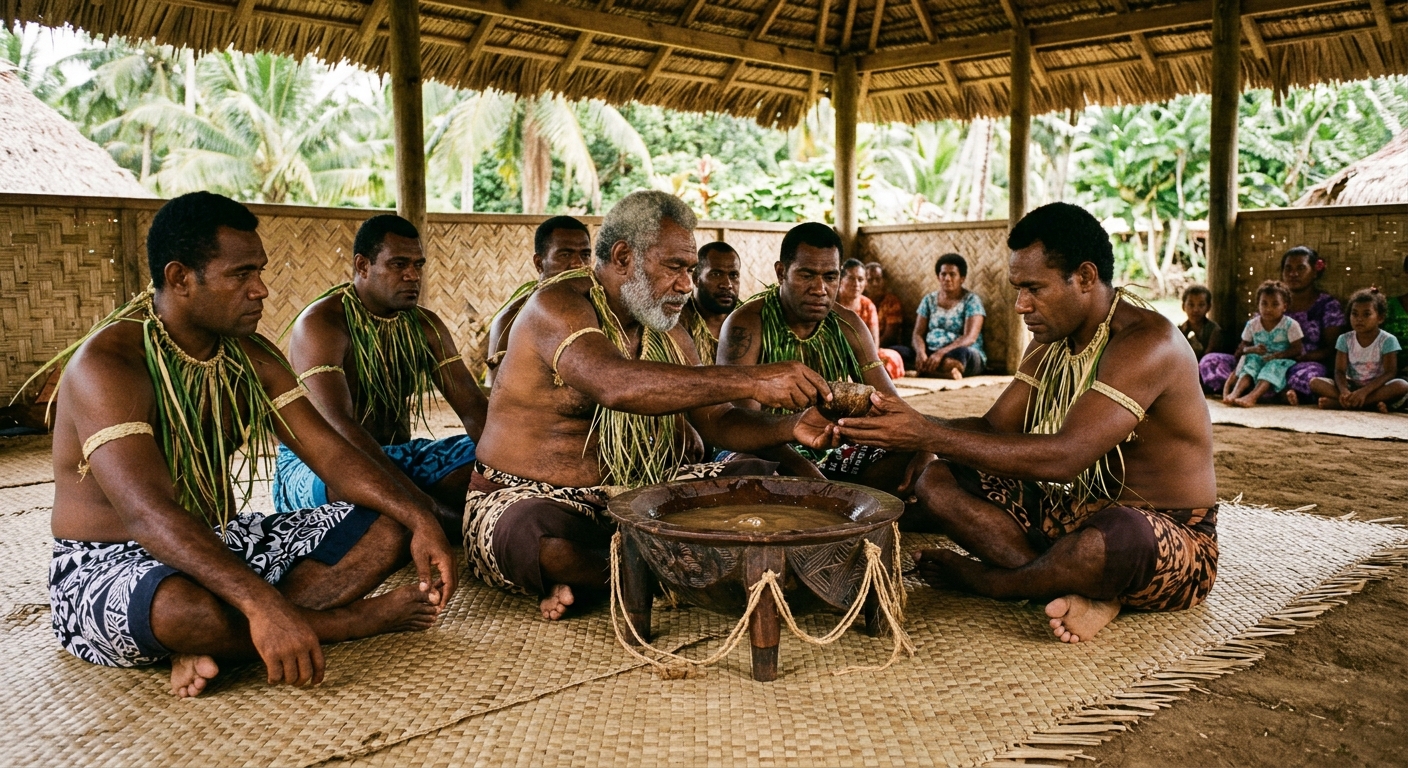
The true magic of kava reveals itself during traditional ceremonies. As the sun sets over Pacific islands, entire villages gather in a sacred circle around a large wooden bowl called a tanoa. The kava root has been ceremonially ground and mixed with water, creating a muddy-looking liquid that belies its profound power.
The ceremony begins with the village chief or elder receiving the first cup. As the bitter, slightly numbing liquid is consumed, participants feel their tongues and lips tingle, the first sign of kava’s active compounds taking effect. Within 20 to 30 minutes, a remarkable transformation begins to sweep through the gathering.
The Collective Consciousness Effect
What happens next is something anthropologists struggle to describe adequately. As the kavalactones take hold, individual anxieties and social barriers seem to dissolve. Participants report feeling deeply connected not just to each other, but to their ancestors, their land, and the spiritual realm their cultures recognize.
Dr. Lamont Lindstrom, who has studied kava ceremonies in Vanuatu for decades, explains: “It’s not simply intoxication. The entire social dynamic of the village shifts. People speak more openly, conflicts are resolved more easily, and there’s a palpable sense of unity that extends beyond the ceremony itself.”
Ancient Wisdom Meets Modern Science
Recent research has validated what Pacific Islander cultures have known for millennia: kava is remarkably effective for treating anxiety, insomnia, and stress-related disorders. Clinical trials have shown that kava extract can be as effective as prescription anti-anxiety medications, but without the side effects of dependency or cognitive impairment.
The World Health Organization has recognized kava’s therapeutic potential, leading to its legalization as a natural supplement in many countries. However, researchers emphasize that the ceremonial context is crucial to understanding kava’s full effects.
The Entourage Effect
Scientists believe that kava’s power is amplified by what’s called the “entourage effect.” The various kavalactones work synergistically, and the social, spiritual, and cultural context of traditional ceremonies may actually enhance the plant’s neurological impact. This explains why isolated kava consumption rarely produces the profound experiences reported in traditional village settings.
Cultural Preservation in a Modern World
Today, as globalization threatens traditional ways of life, kava ceremonies represent something precious: an unbroken link to ancient wisdom about consciousness, community, and healing. In Fiji, Vanuatu, Tonga, and other Pacific nations, these rituals continue to serve as the social and spiritual glue that holds communities together.
The plant that can put entire villages into a ceremonial trance offers modern society a glimpse into alternative ways of understanding mental health, social cohesion, and our relationship with the natural world. As we face rising levels of anxiety and social disconnection, perhaps there’s something profound to learn from a humble plant that has been bringing people together in peace for thousands of years.
Respecting the Sacred
For those intrigued by kava’s potential, researchers and cultural experts emphasize the importance of approaching this plant with respect for its cultural origins. The casual consumption of kava outside its traditional context may provide some relaxation benefits, but it misses the deeper lessons about community, ritual, and the profound ways that plants and humans can interact to create something greater than the sum of their parts.
This is fascinating, though I’d gently push back on the “dreamwalker” framing – kava (Piper methysticum) creates a really distinct state that’s more about grounded relaxation than the dissociative visions the headline suggests. What intrigues me is how this compares to other plant medicines that actually reshape neural processing. I keep wondering if the communal aspect and ritual structure shape the experience as much as the kavalactones themselves, similar to how mycelial networks create entirely different communication patterns depending on what’s connected to them. Have you come across research on whether individual versus group consumption produces measurably different effects?
Log in or register to replyoh the mycelial network comparison is SO good, ive been thinking about this exact thing with my carnivorous plants lately – like how Nepenthes pitcher plants seem to “respond” differently when theyre near other plants versus alone, its probably mostly chemical signaling but it makes you wonder if theres something about proximity that shifts the whole dynamic. and yeah i totally agree the “dreamwalker” thing is kind of sensationalizing it, kava ceremonies are way more about that grounded communal state youre describing than actual visionary stuff. id be really curious to know if theres research comparing solo kava use versus ceremonial, because ritual and expectation are honestly huge parts of how plants affect us –
Log in or register to replyhonestly the collective aspect is what gets me most about this, like how kava ceremonies create this synchronized state across an entire group is kind of like how ant colonies achieve coordination without a central command structure, they’re just all responding to the same chemical signals and environmental context. ants have pheromone trails that sync up thousands of individuals into coherent foraging patterns, and it seems like kava does something similar but through a shared pharmacological experience instead? would be curious if theres any research on how the ritual structure itself reinforces that group synchronization beyond just the plant chemistry
Log in or register to reply