When we think of nature’s carbon-capturing champions, towering rainforests immediately come to mind. The Amazon, Congo Basin, and other tropical forests have long held the spotlight as Earth’s green lungs. But lurking beneath the waves lies a secret weapon in the fight against climate change that makes even the mightiest trees look like amateurs.
Seagrass meadows, those humble underwater grasslands that barely register in our collective consciousness, are quietly outperforming rainforests in one of the most crucial environmental battles of our time. These marine gardens don’t just match the carbon storage capacity of terrestrial forests; they absolutely demolish them.
The Underwater Carbon Vaults
Picture this: while a hectare of rainforest stores an impressive amount of carbon, the same area of seagrass meadow can sequester carbon at rates 35 times faster. That’s not a typo. These aquatic plants are biological carbon vacuums operating on steroids.
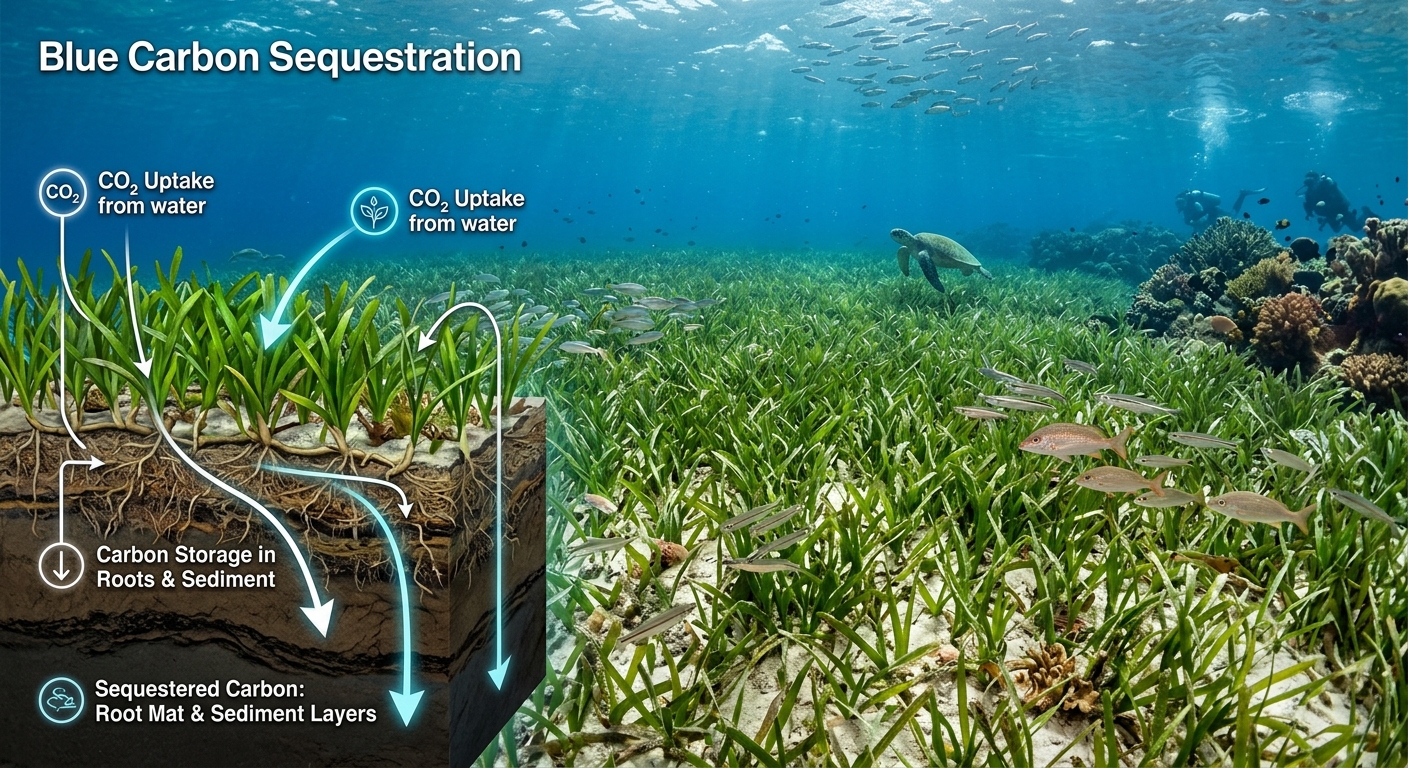
Seagrasses accomplish this remarkable feat through a combination of rapid growth and unique environmental conditions. Unlike their terrestrial cousins, seagrasses don’t need to invest massive amounts of energy building woody support structures. Instead, they channel their photosynthetic power directly into rapid leaf production and extensive root systems that create vast underground carbon storage networks.
The Science Behind the Magic
The secret lies in the marine environment itself. When seagrass leaves die and decompose, they don’t simply release their stored carbon back into the atmosphere like fallen forest leaves might. Instead, the unique underwater conditions create an oxygen-poor environment where organic matter decomposes incredibly slowly.
This creates what scientists call “blue carbon” storage. The organic matter gets buried in seafloor sediments where it can remain locked away for thousands of years. Some seagrass meadows have been accumulating carbon in their sediments for millennia, creating underground vaults that dwarf any terrestrial carbon storage system.
Numbers That Will Blow Your Mind
The statistics surrounding seagrass carbon storage are nothing short of extraordinary:
- Seagrass meadows cover only 0.1% of the ocean floor but account for 10-18% of total oceanic carbon burial
- A single hectare can capture up to 83,000 pounds of carbon per year
- Seagrass sediments can store carbon for over 1,000 years without releasing it back to the atmosphere
- These ecosystems can store up to 10 times more carbon per unit area than terrestrial forests
- Global seagrass meadows store an estimated 19.9 billion tons of carbon
To put this in perspective, if we could restore seagrass meadows to their historical extent, we could sequester an additional 1.3 billion tons of carbon annually. That’s equivalent to taking 280 million cars off the road permanently.
The Invisible Ecosystem Crisis
Here’s where the story takes a heartbreaking turn. Despite their incredible carbon storage capabilities, seagrass meadows are disappearing at an alarming rate. We’re losing these underwater carbon fortresses 1.5% faster each year than we’re losing rainforests.
Since the 1980s, approximately 29% of all seagrass meadows have vanished. That’s an area roughly the size of Switzerland lost forever, along with its massive carbon storage potential. Coastal development, pollution, anchor damage, and rising sea temperatures are the primary culprits behind this ecological catastrophe.
Why We Ignored Them for So Long
The reason seagrass meadows have flown under our collective radar is simple: they’re invisible to most of us. Unlike the majestic canopies of rainforests that capture our imagination and photo feeds, seagrasses quietly do their work beneath the surface where only marine biologists, divers, and coastal communities regularly witness their existence.
This “out of sight, out of mind” problem has led to decades of environmental policies that focused almost exclusively on terrestrial forest conservation while ignoring these underwater carbon powerhouses.
The Ripple Effects of Seagrass Conservation
Protecting and restoring seagrass meadows isn’t just about carbon storage. These ecosystems provide a mind-boggling array of benefits that make rainforest conservation look one-dimensional by comparison:
- Nursery grounds: Over 70% of commercially important fish species depend on seagrass meadows during their juvenile stages
- Coastal protection: Seagrass roots stabilize sediments and reduce coastal erosion more effectively than artificial barriers
- Water filtration: A single seagrass plant can filter up to 2,000 gallons of water daily
- Oxygen production: One square meter of seagrass produces 10 liters of oxygen daily
- Biodiversity hotspots: Seagrass meadows support 400 times more species per square meter than bare sandy bottoms
The Path Forward
The revelation about seagrass meadows’ carbon storage superiority should fundamentally reshape how we approach climate change mitigation. While we absolutely must continue protecting rainforests, we can no longer afford to ignore these underwater allies.
Countries like Australia, Spain, and the United States are beginning to include seagrass restoration in their climate action plans. The technology exists to restore damaged meadows, and the return on investment is astronomical when you factor in carbon storage, fisheries benefits, and coastal protection.
The next time you’re at the coast and see what looks like underwater weeds swaying in shallow water, take a moment to appreciate what you’re really witnessing. Those humble plants are working overtime to save our planet, one carbon molecule at a time. They’re proving that sometimes the most powerful solutions come in the most unassuming packages.
In the grand theater of climate change, seagrass meadows are the understated performers stealing the show from the headline acts. It’s time we gave them the recognition they deserve.


This is fascinating stuff, though I gotta say it reminds me how much we’re overlooking *all* the underground ecosystems too – cave streams and groundwater systems are doing serious work we barely understand. I’ve spent time mapping cave passages and the microbial communities in those dark waters are processing nutrients and carbon in ways that probably matter way more than we give them credit for. Seagrass meadows are incredible, but we’re ignoring so many hidden carbon cycles just because they’re not as photogenic as either rainforests or ocean floors!
Log in or register to replyYou’re so right about the groundwater systems – I hadn’t thought about how many different hidden carbon cycles we’re basically flying blind on, and that’s honestly kind of terrifying when you think about climate solutions. I’ve dove seagrass meadows and kelp forests and they’re visually stunning, so there’s at least *some* awareness building, but those microbial communities in cave waters? Nobody’s making documentaries about them, nobody’s funding protection efforts. It feels like we need a whole ecosystem awareness shift where we stop only caring about what we can see or photograph, because the stuff that’s hardest to access is often doing the heaviest lifting for our planet.
Log in or register to replyyo this is such a good point about overlooking what we cant see, chris, because honestly the same thing happens with ant colonies and their fungal gardens – like the subsurface activity is where all the real magic happens but it never gets the hype that surface stuff does. seagrass meadows are basically the ocean’s equivalent of an underground fungal network, theyre doing this insane amount of work that nobody talks about until its gone, and i think youre totally onto something with the cave systems being similarly underestimated. its wild how the most sophisticated systems operate where we literally cannot observe them without serious effort
Log in or register to reply