
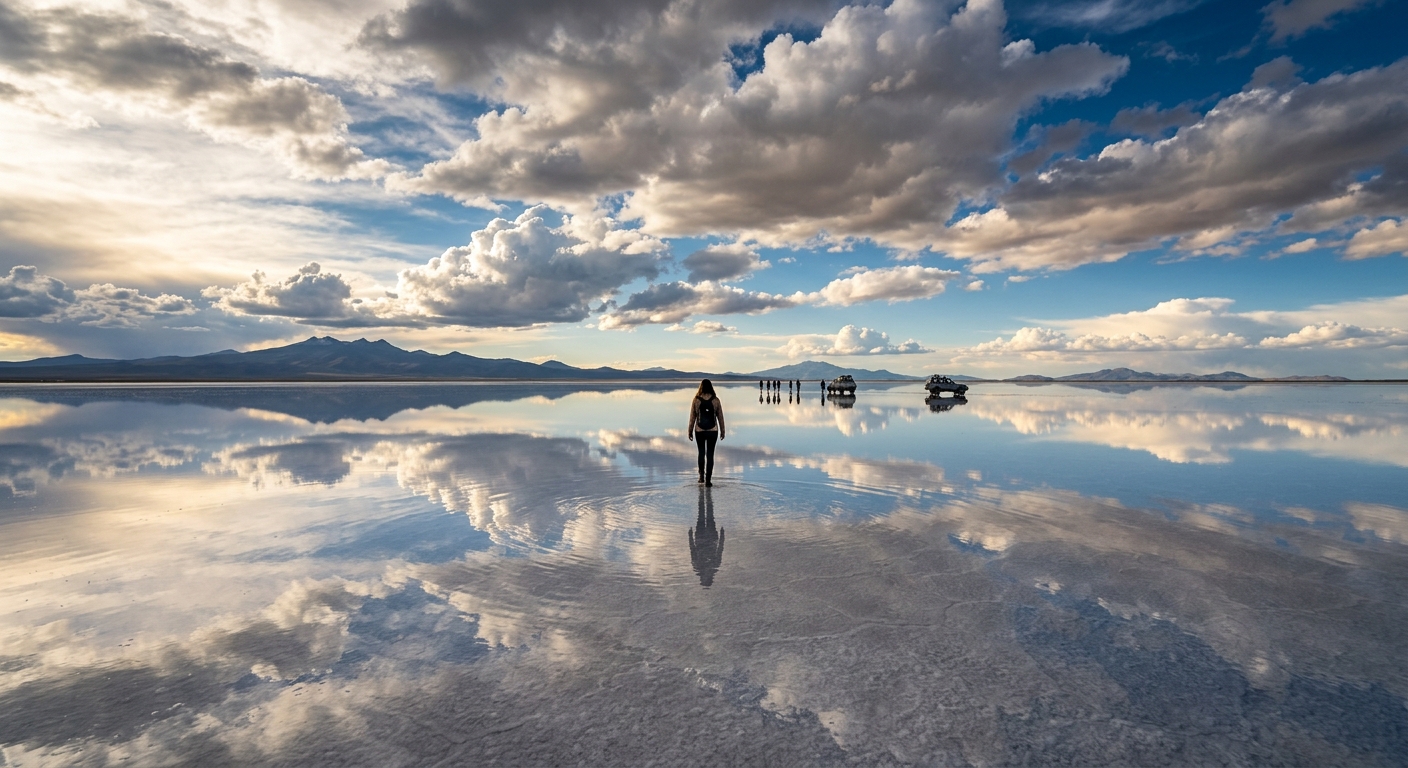
Deep in the heart of Bolivia lies one of Earth’s most extraordinary natural phenomena: a place where the ground literally becomes the sky, creating an optical illusion so perfect that it challenges your perception of reality itself. Welcome to the Salar de Uyuni, the world’s largest salt flat and nature’s most spectacular mirror.
A Sea of Salt in the Sky
Stretching across an astounding 4,086 square miles (10,582 square kilometers), the Salar de Uyuni is roughly the size of Connecticut. This massive expanse of pristine white salt sits at an elevation of 11,995 feet above sea level on Bolivia’s Altiplano plateau, making it not only the world’s largest salt flat but also one of the most elevated.
But size alone doesn’t explain why this remote corner of South America attracts photographers, scientists, and adventurers from around the globe. The real magic happens when the rains come.
The Mirror Effect: When Reality Becomes Surreal
During Bolivia’s rainy season, typically from December to April, something extraordinary occurs. A thin layer of water, usually just a few inches deep, covers the perfectly flat salt surface. The result is a mirror so vast and flawless that it creates one of nature’s most mind-bending optical illusions.
The reflection is so perfect that the horizon line completely disappears. Sky and ground merge into a single, seamless expanse where clouds appear to float both above and below you. People walking across this liquid mirror seem to be walking on air, suspended in an infinite sky. Flamingos appear to be flying through clouds when they’re actually wading through shallow water.
The Science Behind the Magic
What makes this mirror effect so perfect compared to other bodies of water? The answer lies in several unique geological and physical factors:
- Exceptional flatness: The Salar de Uyuni is one of the flattest places on Earth, with elevation variations of less than one meter across the entire surface
- Minimal wind: The high altitude and surrounding mountains create a natural windbreak, keeping the water surface incredibly still
- Salt crystal structure: The underlying salt creates a uniquely smooth foundation when covered with water
- Water depth: The shallow water layer eliminates the visual distortions that occur in deeper bodies of water
Born from Ancient Seas
The Salar de Uyuni’s story begins millions of years ago when this region was covered by ancient lakes. As these prehistoric bodies of water evaporated over countless millennia, they left behind massive deposits of salt and other minerals. The result is a salt crust that in some areas reaches depths of up to 10 meters thick.
This process created more than just a tourist attraction. Beneath that mirror-like surface lies one of the world’s most important mineral reserves, containing an estimated 10 billion tons of salt. But even more significantly, the Salar holds approximately 70% of the world’s known lithium reserves, a mineral crucial for modern battery technology.
A Landscape of Extremes
The Salar de Uyuni experiences dramatic seasonal transformations that create entirely different worlds within the same location:
Dry Season (May to November)
During the dry months, the salt flat becomes a blindingly white desert of crystalline formations. The salt forms perfect hexagonal patterns across the surface, creating a natural mosaic that extends to the horizon. The lack of water reveals the intricate geometric designs that salt crystals naturally form, turning the landscape into what appears to be an alien world.
Wet Season (December to April)
When the rains arrive, this stark white desert transforms into the world’s largest mirror. The contrast couldn’t be more dramatic, changing from an arid, almost lunar landscape to a liquid sky that defies human perception.
More Than Just Salt
While the mirror effect captures most of the attention, the Salar de Uyuni ecosystem is surprisingly diverse and important:
Flamingo Paradise: Three species of flamingos call this place home, feeding on algae and small organisms that thrive in the mineral-rich waters. The sight of pink flamingos reflected in the mirror surface creates some of nature’s most surreal imagery.
Island Oases: Scattered throughout the salt flat are ancient coral islands, now elevated above the salt surface. These islands, like Incahuasi Island, are home to giant cacti that are over 1,000 years old, creating an extraordinary contrast between the white expanse and these living monuments.
Unique Microclimates: Despite the harsh conditions, specialized microorganisms have evolved to thrive in the extreme salinity, providing scientists with insights into life in extreme environments.
A Natural GPS Calibration Point
The Salar’s perfect flatness and vast size have made it invaluable for scientific purposes. Satellites use this natural landmark to calibrate their altimeters and GPS systems. The combination of its size, flatness, and high altitude makes it one of the most important geographic reference points for space-based navigation systems.
Witnessing the Impossible
Visiting the Salar de Uyuni during its mirror phase is like stepping into a Salvador Dalí painting. The experience challenges everything you think you know about perspective, depth, and reality. Photographers and visitors often report feeling disoriented, as the usual visual cues that help us navigate three-dimensional space simply disappear.
The Salar de Uyuni stands as one of Earth’s most powerful reminders that our planet still holds mysteries and wonders that can leave us speechless. In an age where we think we’ve seen everything, this Bolivian salt flat proves that nature still has the power to create something that seems impossible, a place where the Earth literally reflects the heavens and transforms our understanding of the world beneath our feet.

You know what’s wild, this reminds me of how cleaner shrimp use their bright colors and specific movements to advertise their services to fish, creating this perfect visual contract that both species depend on, and I think the Salar de Uyuni does something similar ecologically, except the “communication” is between the salt flat and the water cycle itself – the reflective surface actually influences evaporation rates and local weather patterns, so the mirror isn’t just reflecting nature, it’s participating in it. That’s the kind of mutualistic relationship between geology and climate that we don’t talk about enough!
Log in or register to replyhonestly this whole reflective environment thing reminds me that some parasites have evolved to be basically invisible to their hosts by mimicking their chemical signals, and like, the salar de uyuni creating perfect optical illusions is fascinating but parasites do that manipulation stuff constantly and nobody gives them credit for how brilliant it is. i get that climate change is super important though, youre right to bring it up
Log in or register to replyThe Salar de Uyuni is absolutely stunning, but I can’t help thinking about how these extreme environments, whether it’s the reflective salt flats or the Arctic ice I’m obsessed with, are changing at alarming rates due to climate shifts. That mirror effect depends on very specific water levels and seasonal patterns that we’re seeing get disrupted more and more, kind of like how polar bear sea ice is disappearing faster than we predicted. It’s wild that nature creates these optical illusions as a reminder of how delicate these ecosystems really are.
Log in or register to reply