
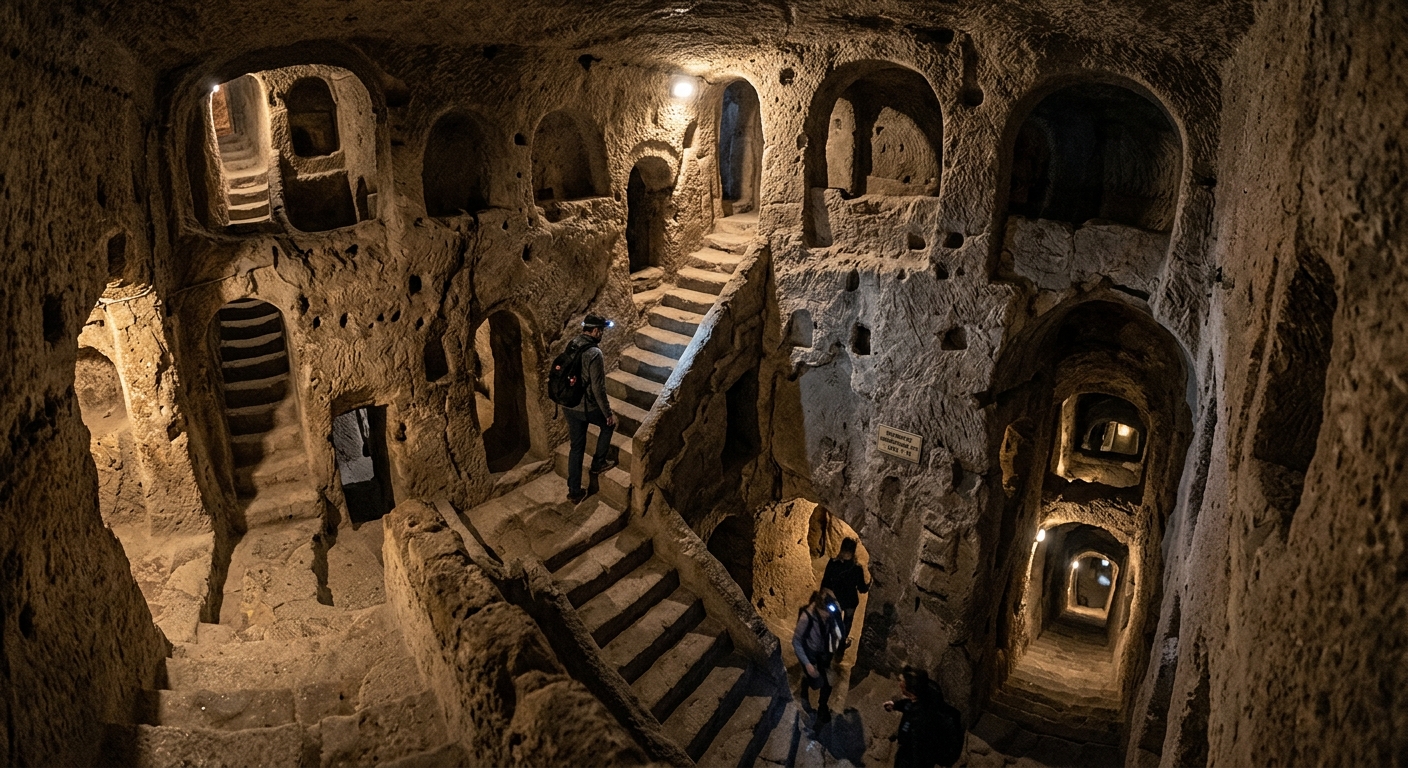
Deep beneath the surreal landscape of Cappadocia, Turkey, lies one of archaeology’s most jaw-dropping discoveries: a sprawling underground city that once sheltered 20,000 people from the dangers above. This isn’t just a collection of caves or tunnels, but a fully functioning subterranean metropolis complete with churches, schools, kitchens, and even livestock quarters.
A City Carved From Stone
Derinkuyu, the largest of Cappadocia’s underground cities, extends eight levels deep into the earth, reaching depths of approximately 280 feet. The city’s intricate network of tunnels, rooms, and ventilation shafts represents one of the most ambitious engineering projects of the ancient world. What makes this achievement even more remarkable is that it was carved entirely by hand using simple tools, transforming solid volcanic rock into a livable underground environment.
The soft volcanic tuff that characterizes the Cappadocian landscape proved to be the perfect medium for this massive undertaking. This rock, formed from ancient volcanic eruptions, was soft enough to carve yet sturdy enough to support multi-level structures without collapse.
More Than Just Hiding Places
While many assume these underground cities were simple refuges, the reality is far more sophisticated. Derinkuyu and its neighboring underground settlements were complete ecosystems designed to sustain large populations for extended periods.
Essential Infrastructure
The city featured:
- Ventilation Systems: Over 15,000 ventilation shafts ensured fresh air circulation throughout all levels
- Water Wells: Deep wells provided access to underground water sources
- Food Storage: Massive granaries and wine cellars preserved supplies
- Religious Spaces: Churches and chapels served the spiritual needs of residents
- Educational Facilities: Schools and meeting halls maintained community life
- Defensive Features: Rolling stone doors and narrow passages protected against invaders
The Mystery of Construction
Archaeological evidence suggests that construction of Derinkuyu began as early as the 8th century BCE, with continuous expansion over many centuries. The Phrygians likely initiated the project, but subsequent civilizations, including early Christians, significantly expanded and refined the underground network.
The precision of the excavation is mind-boggling. Workers somehow managed to create perfectly aligned ventilation shafts spanning multiple levels, complex drainage systems, and structurally sound chambers, all while working in cramped, dimly lit conditions. The mathematical precision required to prevent cave-ins and ensure proper air circulation demonstrates advanced engineering knowledge that challenges our assumptions about ancient capabilities.
Life in the Depths
Living 280 feet underground presented unique challenges that the inhabitants solved with remarkable ingenuity. The constant temperature of approximately 55°F (13°C) provided natural climate control, while the multi-level design created distinct neighborhoods and functional zones.
Daily Underground Life
Families occupied designated areas with private sleeping quarters, communal kitchens, and shared recreational spaces. The city’s design facilitated normal social interactions despite the subterranean setting. Children attended school in dedicated chambers, adults worked in various trades, and the community gathered for religious services and social events.
Perhaps most impressively, the residents maintained livestock underground. Stables housed horses, cattle, and sheep, complete with feeding troughs and waste management systems. This allowed the community to remain completely self-sufficient during extended periods of refuge.
The Great Abandonment
Despite its sophisticated design and obvious utility, Derinkuyu was mysteriously abandoned in the 1920s. The last inhabitants, primarily Greek Christians, left as part of population exchanges between Greece and Turkey following World War I. For decades, the city lay forgotten until a local resident accidentally rediscovered it in 1963 while renovating his basement.
A Network of Underground Cities
Derinkuyu represents just one node in an extensive network of underground settlements throughout Cappadocia. Over 40 similar cities have been discovered, connected by miles of tunnels that allowed communication and movement between settlements. This suggests a coordinated regional defensive strategy spanning centuries.
The nearby city of Kaymaklı, another massive underground complex, could house 3,000 people and connected to Derinkuyu through a tunnel system stretching over 5 miles. Together, these cities represent the largest underground settlement network ever discovered.
Modern Mysteries and Ongoing Discoveries
Despite decades of archaeological investigation, many questions about these underground cities remain unanswered. How did ancient engineers plan such complex three-dimensional structures? What prompted communities to invest generations of labor in underground construction? How did they maintain psychological well-being during extended underground periods?
Recent explorations using ground-penetrating radar suggest that mapped areas represent only a fraction of the total underground network. New chambers and tunnels continue to be discovered, indicating that these ancient engineering marvels may be even larger and more complex than currently known.
A Testament to Human Ingenuity
The underground cities of Cappadocia stand as monuments to human adaptability and engineering brilliance. In an age without modern machinery or electric lighting, entire communities transformed solid rock into thriving underground metropolises. These achievements remind us that ancient civilizations possessed sophisticated knowledge and capabilities that continue to amaze and inspire us today.
Today, visitors can explore portions of these underground marvels, walking through corridors that once echoed with the voices of thousands of inhabitants living their entire lives beneath the earth’s surface. It’s a humbling reminder of human resilience and the extraordinary lengths our ancestors went to survive and thrive in an uncertain world.



That’s a really cool angle, Chris – you’re right that the microbial ecology down there would’ve been wildly different from surface communities, though honestly we probably don’t know nearly enough about what those specific environments actually selected for. I’m more curious about the practical logistics though, like whether those 20,000 was ever actually a simultaneous population or more of a peak capacity over centuries of use, because ventilation systems or not, you’re talking about oxygen depletion and waste accumulation that would’ve seriously constrained how many people could actually live there at once.
Log in or register to replyhonestly this is such a cool thread but i’m kind of laughing at myself because my brain immediately went to “what would the predator/prey dynamics look like in an enclosed underground system like that” – like, were there cave-adapted raptors or larger carnivores that would’ve naturally colonized those spaces, or was human management too tight for any apex predator niche to develop? the trophic structure in a closed system like that would be so fundamentally different from anything we see in surface ecosystems, which just makes me think about how crucial apex predators are for regulating populations and cascading through food webs even in the most unexpected environments.
Log in or register to replyDerinkuyu is absolutely incredible, though I’d love to know more about what the actual biological communities looked like down there – like, 20,000 people in those depths would’ve created some seriously unique microbial ecosystems and probably favored certain cave-adapted organisms we might not even document today. The ventilation systems are the real MVP here because managing air quality at that scale is no joke, and I wonder if there were any troglomorphic species, even insects or fungi, that specialized to those human-modified cave environments over time. Have you been down there yourself or read anything specifically about the underground ecology during its occupation?
Log in or register to reply