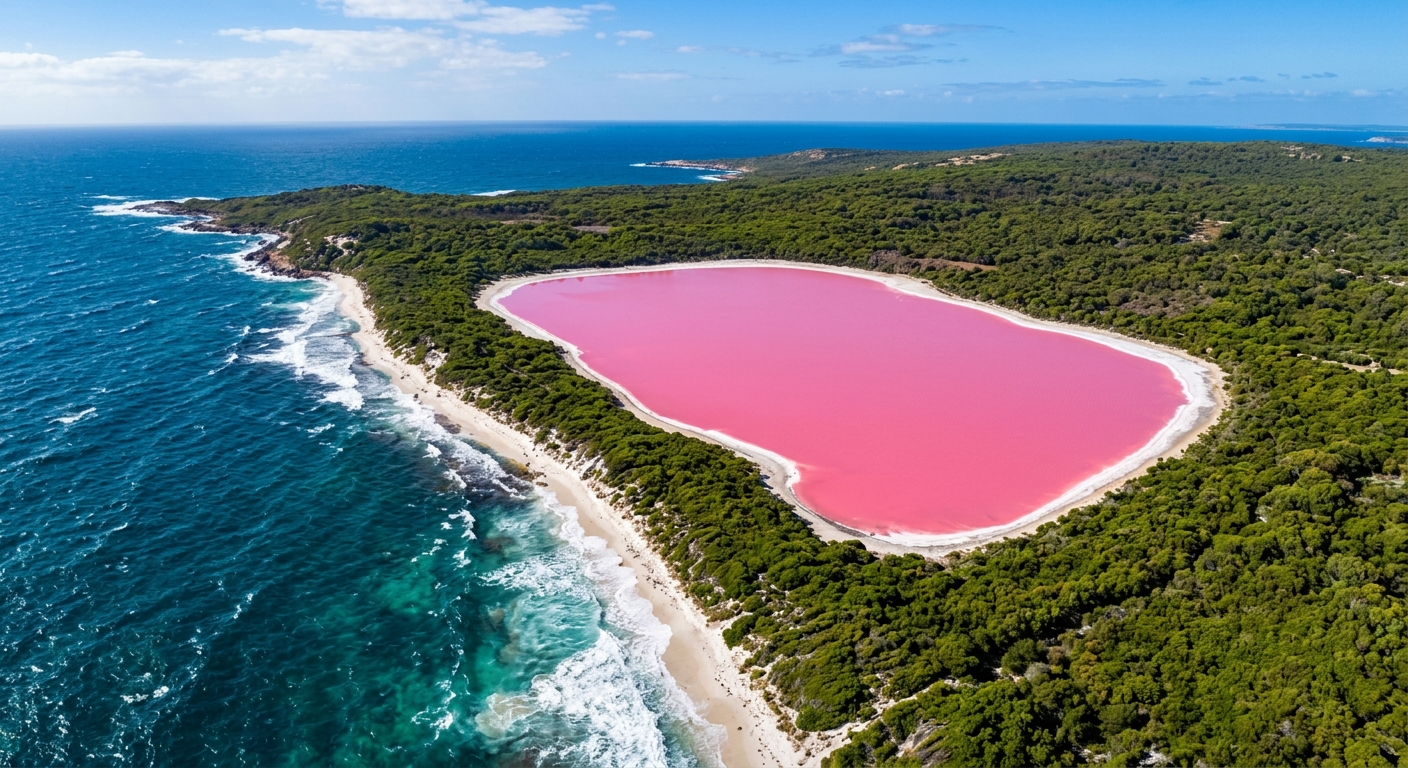
Imagine stumbling upon a lake that looks like someone poured millions of gallons of strawberry milk into a crater. That’s exactly what visitors encounter when they discover Lake Hillier, a stunning pink lake nestled on Middle Island, off the coast of Western Australia. This isn’t some Instagram filter or photo manipulation – the water is genuinely, permanently pink, and for decades, scientists were completely baffled by this natural phenomenon.
A Pink Paradise in the Middle of Nowhere
Lake Hillier measures about 2,000 feet long and is surrounded by a rim of white salt and dense woodland of paperbark and eucalyptus trees. The contrast is absolutely surreal: bubble-gum pink water bordered by pristine white salt, emerald green forest, and the deep blue of the Southern Ocean just a stone’s throw away. From above, it looks like nature’s own work of abstract art.
The lake was first documented in 1802 by navigator Matthew Flinders, who stopped on the island to survey the area. His crew was reportedly stunned by the sight, and Flinders noted the unusual coloration in his journals. But what he couldn’t have imagined was that this pink wonder would puzzle scientists for over two centuries.
The Great Pink Mystery: Theories That Didn’t Hold Water
For years, researchers proposed various theories to explain Lake Hillier’s distinctive color. The most popular early hypothesis pointed to red algae, specifically Dunaliella salina, which is known to produce pink and red pigments in high-salt environments. This algae creates the pink hue in other salt lakes around the world, so it seemed like the obvious culprit.
However, when scientists actually tested Lake Hillier’s waters, they found very low levels of Dunaliella salina – nowhere near enough to account for the intense pink coloration. Other theories included:
- Mineral deposits from the surrounding rock formations
- Unique chemical reactions between salt and organic matter
- Seasonal blooms of specific microorganisms
- Underground mineral springs feeding into the lake
None of these explanations fully satisfied the scientific community. The lake’s pink color remained consistent year-round, regardless of weather conditions, temperature changes, or seasonal variations that typically affect other colored lakes worldwide.
The Breakthrough: It’s All About the Microbes
The real answer finally emerged in 2015 when researchers from Flinders University conducted extensive genetic analysis of the lake’s water. What they discovered was far more fascinating than anyone had imagined. Lake Hillier’s pink color comes from a diverse community of microorganisms, primarily halophilic (salt-loving) bacteria and archaea.
The key players in this pink phenomenon include:
Halobacterium and Halococcus
These ancient microorganisms belong to a group called archaea, some of Earth’s oldest life forms. They thrive in extremely salty conditions and produce pink and red pigments called carotenoids to protect themselves from intense sunlight and UV radiation.
Salinibacter ruber
This bacteria species is specifically adapted to hypersaline environments and contributes significantly to the pink coloration through its production of bacterioruberin, a red carotenoid pigment.
Dunaliella salina (in smaller quantities)
While not the primary cause as originally thought, this red algae does contribute to the overall color palette of the lake.
Why These Microbes Turn Pink
The pink and red pigments produced by these microorganisms aren’t just for show – they serve crucial survival functions. In the harsh environment of Lake Hillier, where salt concentrations can reach up to 10 times that of seawater, these pigments act as natural sunscreen. They protect the microbes’ cellular machinery from damaging UV radiation while helping them maintain proper osmotic balance in the extremely salty water.
The combination of multiple pigment-producing species creates Lake Hillier’s distinctive bubble-gum pink hue. It’s essentially a massive community of microorganisms working together, each contributing their own colorful compounds to create this natural masterpiece.
What Makes Lake Hillier Special Among Pink Lakes
While Lake Hillier isn’t the only pink lake in the world, it has several unique characteristics that set it apart:
- Permanent coloration: Unlike other pink lakes that change color seasonally, Lake Hillier maintains its pink hue year-round
- Stable ecosystem: The microbial community remains remarkably consistent
- Isolation: Its location on a remote island has preserved its pristine condition
- Intensity: The pink color is more vibrant and consistent than most other colored lakes
Visiting Lake Hillier: A Protected Wonder
Due to its location on Middle Island in the Recherche Archipelago, Lake Hillier is not easily accessible to casual tourists. The island is protected, and visiting requires special permits. Most people experience this natural wonder through scenic helicopter or plane flights that offer breathtaking aerial views of the pink phenomenon.
The water is safe to swim in – the microorganisms that create the pink color are harmless to humans. However, the extreme saltiness makes swimming quite buoyant but potentially uncomfortable for extended periods.
A Living Laboratory
Today, Lake Hillier continues to fascinate researchers who study extremophile organisms and astrobiology. These salt-loving microbes provide insights into how life might exist in harsh environments on other planets. The lake serves as a natural laboratory for understanding how life adapts to extreme conditions, potentially offering clues about extraterrestrial life possibilities.
The mystery of Lake Hillier’s pink waters reminds us that our planet still holds countless secrets waiting to be discovered. What appeared to be a simple case of colored water turned out to be a complex ecosystem of ancient life forms, working together to create one of nature’s most stunning visual spectacles.



This is such a cool example of extremophiles thriving where most life can’t survive, and it makes me think about how organisms in extreme environments like this are basically the same as polar creatures in terms of their survival strategies, just different challenges. The pigments those halophiles produce to handle UV and salinity remind me of how Arctic animals developed their own biochemical toolkits, like how polar bears have special hemoglobin adaptations and seals produce antifreeze proteins, and it really shows how life finds a way in places we thought impossible. I wonder if studying these pigment-producing microorganisms could help us understand how species might adapt as climate change pushes conditions to more extreme ranges everywhere, not just in
Log in or register to replyThat’s fascinating stuff about the halophilic microorganisms, though I have to admit my expertise is more with amphibians than extremophiles! It makes me wonder though – do lakes like this create any problems for amphibians in the surrounding regions, or are there frogs that have adapted to tolerate these extreme conditions? I’ve spent two decades monitoring local wetland populations and I’m always curious about how creatures respond to unusual environmental chemistry. The genetic resilience these microbes show gives me some hope that amphibians might be more adaptable than we sometimes fear, even as we lose habitat at alarming rates.
Log in or register to replyThe halophile pigment production is honestly a perfect study in adaptive chemistry – those organisms literally evolved their own sunscreen and antioxidant system to handle extreme salinity and UV exposure. I’ve been thinking about how we could adapt similar pigment mechanisms for durable, bio-based coatings in harsh environments, like for coastal infrastructure or space applications. Does anyone know if researchers have tried culturing these microbes or isolating their pigment compounds for industrial use? That feels like such a missed opportunity from a biomimicry standpoint.
Log in or register to reply