
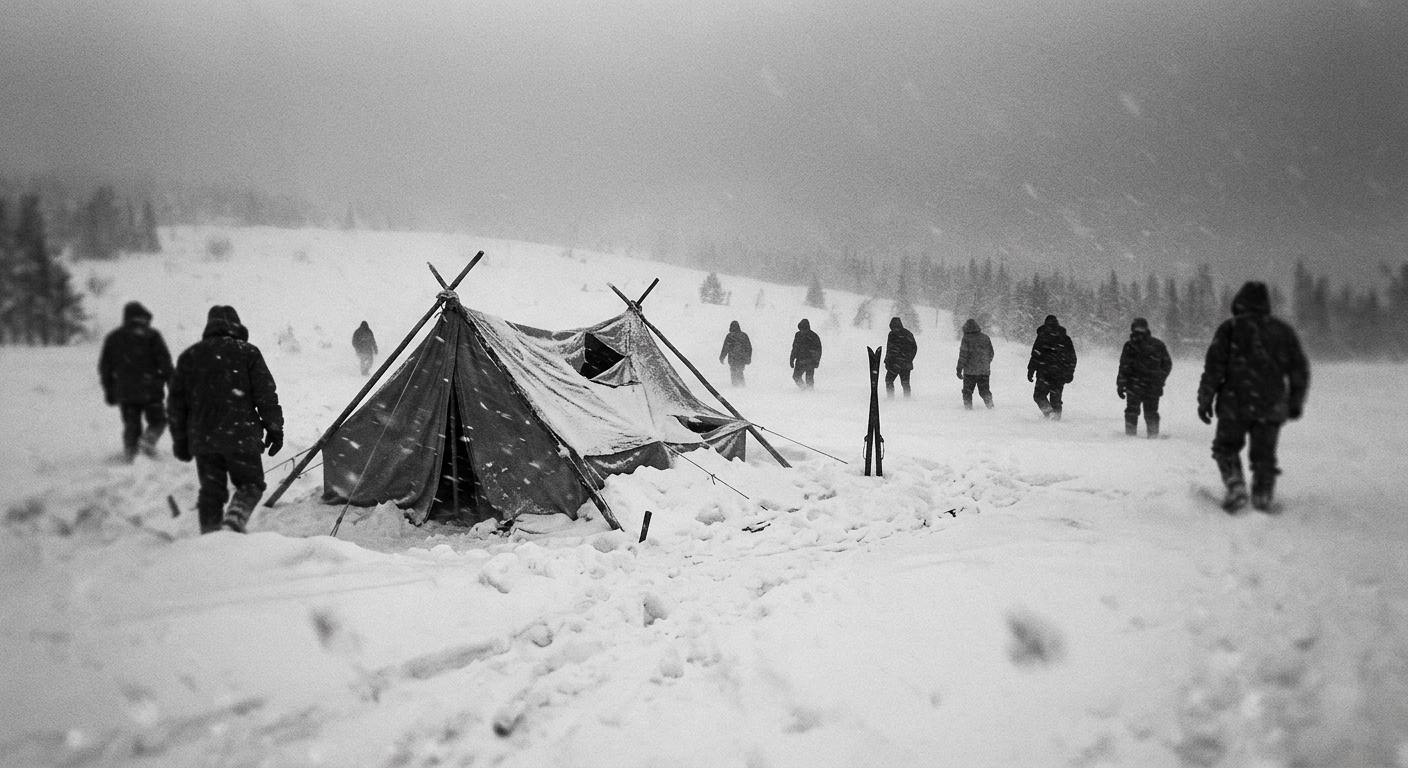
In the dead of winter 1959, nine experienced hikers embarked on what should have been a routine ski expedition through the northern Urals of Soviet Russia. What happened next defies explanation and has spawned decades of investigation, conspiracy theories, and scientific debate. The Dyatlov Pass Incident remains one of the most perplexing unsolved mysteries of the 20th century.
The Expedition That Became a Nightmare
Led by 23-year-old Igor Dyatlov, the group consisted of nine highly skilled hikers from the Ural Polytechnical Institute. These weren’t weekend warriors, they were experienced mountaineers undertaking a Category III expedition, the most difficult classification in the Soviet system. Their planned route would take them through the remote wilderness of what is now known as Dyatlov Pass.
The group included:
- Igor Dyatlov (team leader)
- Zinaida Kolmogorova
- Lyudmila Dubinina
- Alexander Kolevatov
- Rustem Slobodin
- Yuri Doroshenko
- Yuri Krivonischenko
- Nicolai Thibeaux-Brignolles
- Semyon Zolotaryov
On January 27, 1959, the team began their journey. A tenth member, Yuri Yudin, turned back due to illness, a decision that likely saved his life. The last known contact with the group was on January 31, when they were photographed setting up camp on the slopes of Kholat Syakhl, a mountain whose name ominously translates to “Dead Mountain” in the local Mansi language.
The Discovery That Shocked Investigators
When the team failed to return by February 20, search parties were dispatched. What they found on February 26 has haunted investigators for over six decades. The hikers’ tent was discovered cut open from the inside, as if the occupants had desperately slashed their way out. Even more bizarre: the tent contained all their belongings, including shoes, warm clothing, and food.
Most shocking of all, footprints in the snow showed that the hikers had fled barefoot or in socks into the deadly Siberian night, where temperatures plummeted to minus 30 degrees Fahrenheit. The footprints led downhill toward a forest nearly a mile away.
Bodies Tell a Horrifying Story
The first two bodies were found under a large cedar tree, nearly naked and showing signs of hypothermia. Branches up to 15 feet high had been broken off, suggesting someone had climbed the tree, possibly as a lookout. Between the cedar and the tent, searchers discovered three more bodies, including Dyatlov himself, apparently having died while trying to return to the tent.
The remaining four bodies weren’t found until May, buried under 12 feet of snow in a ravine. These bodies told an even more disturbing story. Three showed massive internal injuries: crushed ribs, fractured skulls, and internal bleeding. The force required to cause such injuries was compared to that of a car crash, yet there were no external wounds.
Most unsettling was Lyudmila Dubinina’s condition. She was missing her tongue, eyes, and part of her lips. Two others were missing their eyes as well.
Theories That Don’t Add Up
The Soviet investigation concluded that the deaths were caused by an “unknown compelling force,” a phrase that has fueled speculation for decades. Investigators noted several inexplicable details:
- Some clothing showed traces of radioactivity
- Witnesses reported strange orange lights in the sky that night
- The tent was found in relatively good condition, ruling out avalanche or animal attack
- No evidence of other people in the area
- Some bodies showed unusual tan coloration
Military Weapons Testing
Some researchers suggest the hikers encountered secret military testing. The area was known for missile tests, and the severe internal injuries could theoretically result from exposure to experimental weapons. The radioactivity found on clothing supports this theory, as does the government’s decision to classify the case files for decades.
Natural Phenomena
Recent scientific studies have proposed natural explanations. In 2021, researchers suggested that a rare type of avalanche called a katabatic wind avalanche could have struck the tent. However, this doesn’t explain the internal injuries or why the hikers fled so far from the tent.
Another theory involves infrasound: low-frequency sound waves that can cause panic, disorientation, and feelings of dread. Strong winds in the mountain pass might have created these frequencies, driving the hikers into irrational fear.
Ball Lightning and Atmospheric Phenomena
The orange lights reported that night might have been ball lightning or other electrical phenomena. Some scientists theorize that such events could have created the panic that drove the hikers from their tent, though this still doesn’t account for the severe injuries found on some bodies.
Modern Investigation Yields New Questions
In 2019, sixty years after the incident, Russian authorities reopened the investigation. They concluded that an avalanche was the most likely cause, but this explanation satisfies few researchers. The lack of avalanche evidence at the scene and the specific nature of the injuries continue to puzzle experts.
Computer modeling has shown that under specific conditions, a delayed avalanche could have occurred, but the models require very precise circumstances that many find unlikely.
The Enduring Mystery
What makes the Dyatlov Pass Incident so compelling isn’t just the mysterious deaths, but the combination of verified facts that seem impossible to reconcile. Experienced hikers don’t abandon their shelter in deadly cold without extreme provocation. The specific injuries found on the bodies suggest tremendous force, yet no evidence of such force exists at the scene.
The case has inspired dozens of books, documentaries, and investigation teams. Each new theory seems to explain some aspects while leaving others unsolved. The radioactivity, the missing soft tissues, the massive internal trauma, the orange lights, and the desperate flight into certain death continue to defy simple explanation.
Perhaps the most unsettling aspect is that similar incidents have occurred in remote locations worldwide, suggesting that whatever happened at Dyatlov Pass might not be unique. As our understanding of atmospheric phenomena, military technology, and human psychology advances, we may eventually solve this puzzle. Until then, the Dyatlov Pass Incident remains a stark reminder that our planet still holds secrets capable of challenging our understanding of the possible.






imagine if there’s something about extreme physiological stress, like severe hypothermia itself, that can actually flip the survival instinct on its head – the body gets so confused it starts rejecting warmth? i keep thinking about how our brains are evolved for certain threat profiles, and maybe when reality becomes so alien to what we’re wired to expect, panic just… overrides everything else. the radioactive clothing detail is wild but honestly might be a red herring (soviet era equipment was just different), whereas the injuries suggest maybe they were already injured or sick before fleeing. what gets me is how we’re still asking “what were they running from” when maybe the better question is “what broke inside them first”?
Log in or register to replySophie’s got a point that really gets at something unsettling, though I have to say my experience with survival instinct comes more from watching how animals behave under extreme stress in rainforest canopies than arctic conditions. That said, what fascinates me is how the human nervous system can override self preservation in ways that other creatures seem to resist, even when they’re fleeing into environments objectively more hostile than what they’re leaving. Makes you wonder if there’s something about the Siberian landscape specifically, or just the universality of panic overwhelming every rational calculation of survival odds.
Log in or register to replyI can’t help but think about extremophiles and how life on Earth pushes into the most hostile environments we can imagine, yet these hikers fled *toward* something they feared more than hypothermia and death itself, which is kind of the inverse of that survival instinct we see in nature. The radioactive clothing detail keeps me up at night honestly, because it makes you wonder what invisible forces or phenomena we still don’t fully understand were at play that night, and how much of our planet’s mysteries remain locked away like undiscovered exoplanets in our own backyard.
Log in or register to reply