
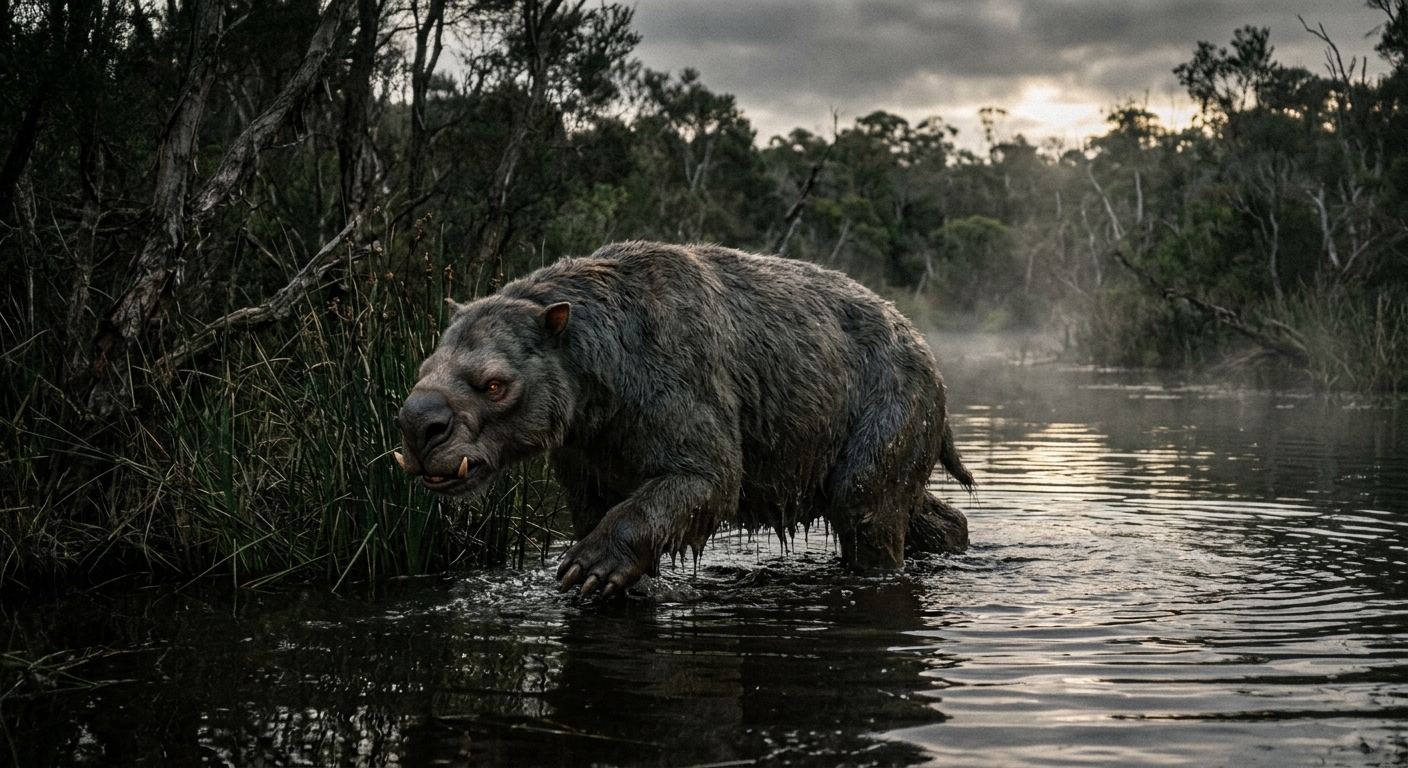
For thousands of years, Aboriginal Australians have shared stories of a mysterious creature lurking in billabongs, swamps, and rivers across the continent. The bunyip, described as a massive, fearsome water-dwelling beast, has captured imaginations and sparked debates about whether this legendary creature might have been more than just mythology. Recent scientific discoveries suggest that the bunyip legends could be deeply rooted in ancestral memories of a very real, very large extinct marsupial that once terrorized Australia’s waterways.
The Legend of the Bunyip
The word “bunyip” comes from the Wergaia language of southeastern Australia, where it means “devil” or “spirit.” But this creature appears in the oral traditions of Aboriginal groups across the continent, with over 60 different names recorded by researchers. Despite regional variations in the stories, certain characteristics remain remarkably consistent:
- A large, powerful creature that lived in or near water
- Dark fur or skin, often described as black or brown
- A loud, terrifying roar that could be heard from great distances
- Massive size, often compared to a large dog, horse, or even bigger
- Strong swimming abilities and preference for deep water
- Aggressive behavior toward humans who ventured too close to its territory
These descriptions were so widespread and consistent that early European settlers took them seriously, with several newspaper reports in the 1800s documenting supposed bunyip sightings and attacks.
Enter Diprotodon: Australia’s Largest Marsupial
In the 1960s, paleontologists made a discovery that would forever change how we view the bunyip legend. They unearthed fossils of Diprotodon optatum, a massive marsupial that lived in Australia until approximately 25,000 to 40,000 years ago. This creature was unlike anything alive today, weighing up to 2,800 kilograms (over 6,000 pounds) and measuring about 4 meters (13 feet) in length.
But here’s where it gets fascinating: Diprotodon didn’t go extinct before humans arrived in Australia. Archaeological evidence suggests that Aboriginal peoples coexisted with these giant marsupials for thousands of years before they disappeared. This overlap period is crucial because it means that ancestral memories of encounters with Diprotodon could have been passed down through generations of oral storytelling.
Physical Characteristics That Match
When paleontologists reconstructed what Diprotodon would have looked like in life, the similarities to bunyip descriptions became striking:
- Size: Diprotodon was enormous by any standard, easily matching the “larger than a horse” descriptions found in bunyip legends
- Habitat: Fossil evidence indicates Diprotodon preferred wetland environments and lake shores, exactly where bunyips were said to dwell
- Appearance: Reconstructions show a dark-furred, bulky animal with a somewhat bear-like appearance
- Behavior: As a large herbivore, Diprotodon would have been territorial around water sources, potentially aggressive when threatened
The Science Behind Ancestral Memory
The idea that cultural memories can preserve information about extinct animals isn’t as far-fetched as it might sound. Oral traditions have proven remarkably accurate in preserving historical information across millennia. Aboriginal Australian cultures, in particular, have some of the world’s oldest continuous oral traditions, with some stories accurately describing geographical events from over 10,000 years ago.
Dr. Patrick Nunn, a geographer who studies oral traditions, has documented numerous cases where Aboriginal stories contain scientifically accurate information about ancient sea level changes and volcanic activity. If these cultures could preserve memories of landscape changes over such vast timescales, preserving memories of encounters with megafauna becomes entirely plausible.
More Than Just Diprotodon
Diprotodon wasn’t the only large, potentially dangerous animal that early Aboriginal Australians would have encountered. The continent was home to an entire ecosystem of megafauna, including:
- Palorchestes: A marsupial with a trunk-like nose that some researchers call the “marsupial tapir”
- Megalania: A gigantic monitor lizard that could grow up to 7 meters long
- Thylacoleo: The “marsupial lion,” a powerful predator with bone-crushing jaws
Some researchers suggest that bunyip legends might be a composite memory, combining characteristics from multiple extinct megafauna species into a single mythological creature.
Alternative Theories and Ongoing Debates
While the Diprotodon theory is compelling, it’s not the only scientific explanation for bunyip legends. Some researchers have proposed that the stories might describe:
- Leopard seals: Occasionally found in Australian rivers, these powerful marine predators match some physical descriptions
- Large pythons: Australia’s massive snakes could account for some sightings
- Cassowaries: These large, dangerous flightless birds are known to be aggressive and could inspire fear-based legends
However, none of these alternatives explain the consistent association with extinct megafauna timeframes or the specific habitat preferences described in the legends.
What This Means for Our Understanding
The potential connection between bunyip legends and Diprotodon represents more than just an interesting coincidence. It highlights the incredible value of indigenous oral traditions as historical and scientific records. Rather than dismissing these stories as mere mythology, researchers are learning to treat them as valuable data sources that can inform our understanding of prehistoric Australia.
This research also demonstrates how human memory and storytelling can preserve information across timeframes that seem impossible. If Aboriginal Australians maintained accurate cultural memories of megafauna for tens of thousands of years, what other “mythological” creatures around the world might have similar scientific explanations?
The bunyip legend serves as a powerful reminder that the line between mythology and natural history isn’t always clear-cut. Sometimes, the monsters of our past were very real indeed, lurking not in the realm of imagination, but in the wetlands and waterways of ancient Australia, leaving behind both fossils and unforgettable memories that echo through time.



This is such a cool connection, and it actually reminds me of something I’ve noticed in my own yard here in the midwest, where native plants are starting to bring back species that haven’t been around for decades. If indigenous knowledge systems were tracking megafauna that closely for 40,000 years, they definitely understood ecological relationships we’re still trying to relearn, so I’m really curious whether that same attention to detail shows up in their plant knowledge too. Have any of the researchers looked into whether the bunyip legends also preserve info about what plants those animals ate or how they shaped the landscape?
Log in or register to replyThis is a fascinating angle on oral histories as ecological records, though I’d be curious about the specific evidence linking bunyip traditions to Diprotodon rather than other megafauna extinctions. What strikes me more is your point about native plants bringing back missing species, Gwen – that’s something I track closely with phenology data, and it’s genuinely exciting how restoration work can shift microhabitats fast enough to support species returns within a generation or two. The mechanism there is pretty different from cultural memory spanning 40,000 years, but both show how much ecological and cultural knowledge can persist in communities paying close attention.
Log in or register to replyThis is such a cool way to think about how knowledge gets passed down, especially when we’re talking about species and ecosystems that shaped entire cultures. I’m curious though, does the research suggest the bunyip stories were about actively witnessing Diprotodons, or more like cultural memory embedded in the landscape and oral traditions over thousands of years? Either way it’s a reminder that indigenous peoples were reading their environment in ways we’re only now starting to understand, which honestly makes me think about how much ecological wisdom we’ve lost by not listening closer to these knowledge systems.
Log in or register to reply