Nature’s Most Reluctant Predator
Imagine being so desperate for nutrients that you abandon millions of years of peaceful plant life to become a carnivorous killer. This isn’t science fiction – it’s the extraordinary survival story of the Venus flytrap, one of nature’s most misunderstood predators. Contrary to popular belief, these fascinating plants didn’t evolve their deadly snap traps because they love the taste of flies. They became carnivores out of sheer necessity, forced into a life of hunting by some of the most nutrient-starved soil on Earth.
The Venus flytrap (Dionaea muscipula) represents one of evolution’s most dramatic career changes. While most plants are content to photosynthesize peacefully and absorb nutrients through their roots, the Venus flytrap had to get creative when faced with soil so poor that traditional plant survival strategies simply wouldn’t work.
Trapped in a Nutritional Desert
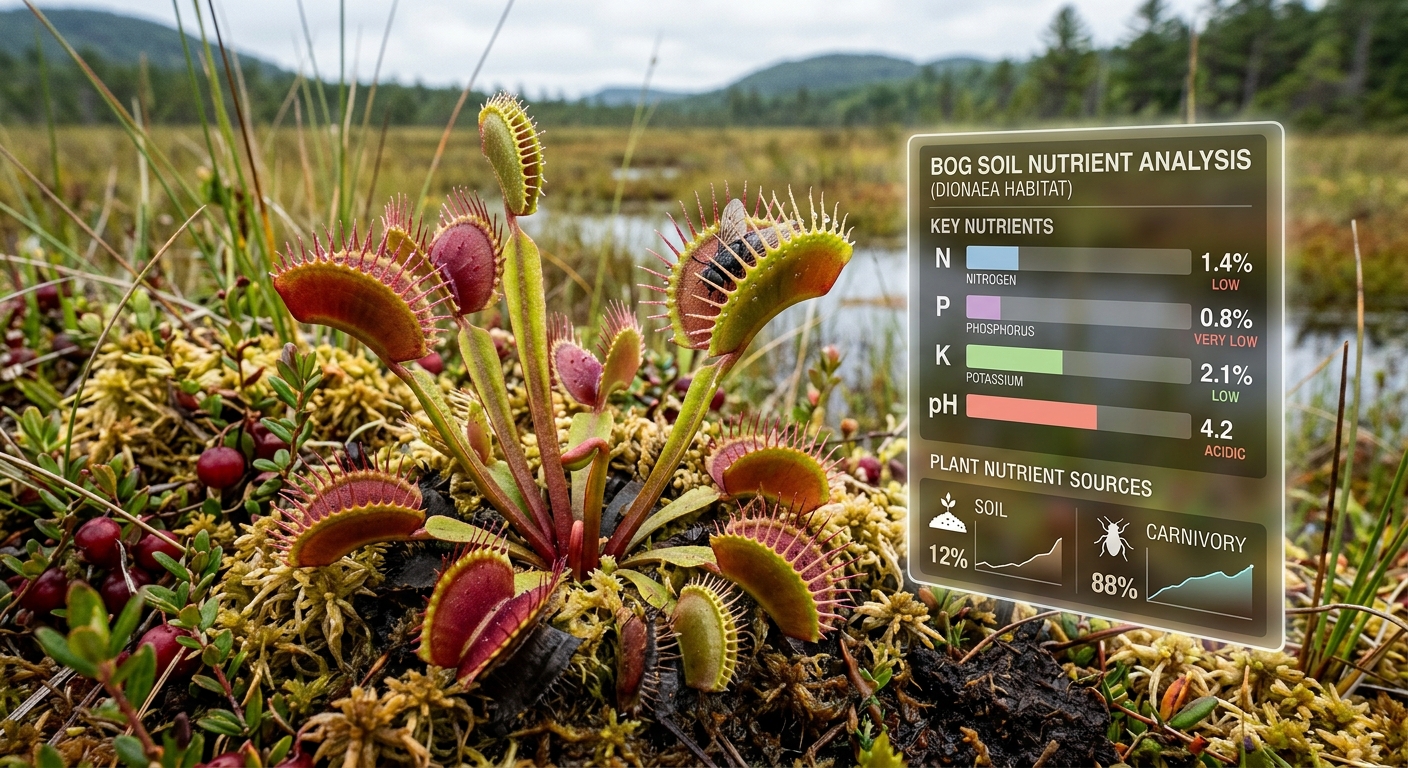
Venus flytraps are native exclusively to the coastal plains of North and South Carolina, where they inhabit some of the most challenging growing conditions on the planet. These areas, known as pocosins and Carolina bays, feature acidic, waterlogged soils with pH levels between 3.9 and 4.9 – so acidic that most plants cannot survive there at all.
The soil in these regions is essentially a nutritional wasteland. Critical nutrients that plants typically rely on, particularly nitrogen and phosphorus, exist in concentrations so low they’re barely detectable. To put this in perspective, the nitrogen content in Venus flytrap habitat is often less than 0.05% – a level that would quickly kill most garden plants.
The Nitrogen Crisis
Nitrogen is crucial for plant survival because it’s a key component of chlorophyll, amino acids, and proteins. Without adequate nitrogen, plants cannot photosynthesize efficiently, build new tissues, or reproduce successfully. Most plants obtain nitrogen from the soil through their root systems, but Venus flytraps evolved in environments where this strategy simply doesn’t provide enough nutrients to sustain life.
The waterlogged, acidic conditions in their native habitat create a perfect storm of nutrient unavailability:
- Acidic conditions: The low pH makes nutrients less available to plant roots
- Waterlogged soil: Poor drainage prevents proper nutrient cycling and root development
- Low microbial activity: Few bacteria and fungi can survive in these conditions to break down organic matter
- Nutrient leaching: Heavy rainfall washes away what few nutrients might accumulate
Evolution’s Ingenious Solution
Faced with this nutritional crisis, the ancestors of modern Venus flytraps evolved one of nature’s most sophisticated hunting mechanisms. Rather than competing with other plants for scarce soil nutrients, they learned to harvest nitrogen and phosphorus directly from insects and small animals.
This evolutionary adaptation is remarkably efficient. A single captured fly can provide a Venus flytrap with enough nitrogen to sustain it for weeks. The plant’s digestive enzymes break down insect proteins into amino acids and other compounds that would normally come from soil nutrients.
The Perfect Trap
The Venus flytrap’s iconic snap trap is a marvel of biological engineering. Each trap contains three trigger hairs, and an insect must touch at least two of these hairs within 20 seconds for the trap to close. This sophisticated mechanism prevents the plant from wasting energy on false alarms caused by raindrops or debris.
Once triggered, the trap snaps shut in less than half a second – one of the fastest movements in the plant kingdom. The trapped insect is then slowly digested over the course of 5-12 days, during which the plant extracts every possible nutrient from its prey.
Carnivory as a Last Resort
What makes the Venus flytrap’s story even more remarkable is that carnivory is energetically expensive. The plant must invest significant resources into maintaining its traps, producing digestive enzymes, and powering the rapid closure mechanism. In nutrient-rich environments, this energy expenditure simply wouldn’t be worth it.
Research has shown that Venus flytraps can actually survive without catching any insects at all, relying solely on photosynthesis and whatever minimal nutrients they can extract from their roots. However, plants that regularly capture prey grow faster, produce more flowers, and create more seeds than their hungry counterparts.
The Photosynthesis Balance
Unlike true carnivorous animals, Venus flytraps still perform photosynthesis and derive most of their energy from sunlight. Insect prey provides supplemental nutrition – particularly nitrogen and phosphorus – rather than calories. This hybrid approach allows them to thrive in environments where neither pure photosynthesis nor pure carnivory would be sufficient for survival.
Conservation Challenges
The Venus flytrap’s highly specialized adaptation to nutrient-poor soil has made it extremely vulnerable to habitat destruction. These plants cannot survive in typical garden soil, which contains far too many nutrients and lacks the specific acidic, waterlogged conditions they require.
Development, agriculture, and fire suppression have destroyed over 90% of the Venus flytrap’s original habitat. The remaining wild populations are confined to an area smaller than the state of Delaware, making this remarkable predator one of North America’s most endangered plants.
Lessons from a Reluctant Hunter
The Venus flytrap’s evolution into carnivory demonstrates nature’s incredible adaptability and resourcefulness. When faced with seemingly impossible growing conditions, these plants developed one of the most sophisticated hunting mechanisms in the natural world – not out of aggression or bloodlust, but out of simple necessity.
This remarkable adaptation reminds us that even the most extreme survival strategies often arise from the most challenging circumstances. The Venus flytrap didn’t choose to become a carnivore; it became one because that was the only path to survival in its harsh, nutrient-starved world.


Yeah, this is a great reminder that carnivory, like any adaptation, is just organisms doing what they need to do to survive in their niche. Same way people misunderstand my ball python Copernicus – he’s not “evil,” he’s just eating what his body evolved to process efficiently in his environment. It’s wild how much more interesting nature gets when you stop assigning moral judgments to survival strategies and just appreciate the mechanics of it all.
Log in or register to replyThis is such a great parallel to something I wish more people understood about bats! They get painted as these scary predators, but most bat species are actually just trying to survive in their own nutrient-poor niches, whether that’s eating insects nobody else wants or pollinating plants at night. The vampire bat thing gets ALL the attention even though they’re like 3 species out of over 1,400, kind of like how everyone fixates on Venus flytraps when there are thousands of plants we know almost nothing about. Evolution is wild when you look at what organisms actually *need* to do to survive rather than just assuming they’re being “savage.”
Log in or register to replyThis is such a cool example of how organisms adapt to survival in extreme conditions, honestly makes me think about reef ecosystems too / the corals I’ve seen bleached were basically starving in real time because their symbiotic algae couldn’t handle the heat stress. When environments get pushed to their limits, everything has to get creative or die out, which is exactly why protecting those nutrient-rich zones matters so much.
Log in or register to reply