Take a deep breath. Now imagine that every other molecule of oxygen filling your lungs didn’t come from the Amazon rainforest or the towering redwoods, but from tiny, invisible organisms floating in the ocean’s depths. This isn’t science fiction – it’s one of the most mind-blowing realities of our planet that most people never learn about.
The Hidden Heroes of Our Atmosphere
While we often credit forests and land plants for the oxygen we breathe, the truth is far more fascinating. Marine phytoplankton, microscopic algae and bacteria that drift through our oceans, are responsible for producing approximately 50-80% of all the oxygen in Earth’s atmosphere. These invisible powerhouses have been quietly keeping our planet breathable for billions of years.
Phytoplankton are so small that millions could fit in a single drop of seawater, yet collectively they outperform every rainforest on Earth. Despite their microscopic size, these organisms form the foundation of marine food webs and quite literally make complex life on our planet possible.
The Science Behind Ocean Oxygen Production
The process is elegantly simple yet absolutely crucial. Marine phytoplankton use photosynthesis just like land plants, converting carbon dioxide and water into organic compounds using sunlight as energy. The byproduct? Pure oxygen that bubbles up through the water and enters our atmosphere.
What makes oceanic oxygen production so remarkable is its sheer scale. The world’s oceans cover about 71% of Earth’s surface, providing an enormous area for these microscopic oxygen factories to operate. During peak growing seasons, the ocean’s surface waters can become supersaturated with oxygen, creating vast underwater oxygen fields that dwarf any terrestrial forest.
The Main Players in Ocean Oxygen Production
- Diatoms: Glass-like algae with intricate, beautiful shells that contribute significantly to oxygen production
- Cyanobacteria: Ancient bacteria that pioneered photosynthesis billions of years ago and continue producing oxygen today
- Dinoflagellates: Spinning, whip-like organisms that can create stunning bioluminescent displays while generating oxygen
- Coccolithophores: Tiny organisms covered in limestone plates that create massive blooms visible from space
When Microscopic Organisms Create Space-Visible Phenomena
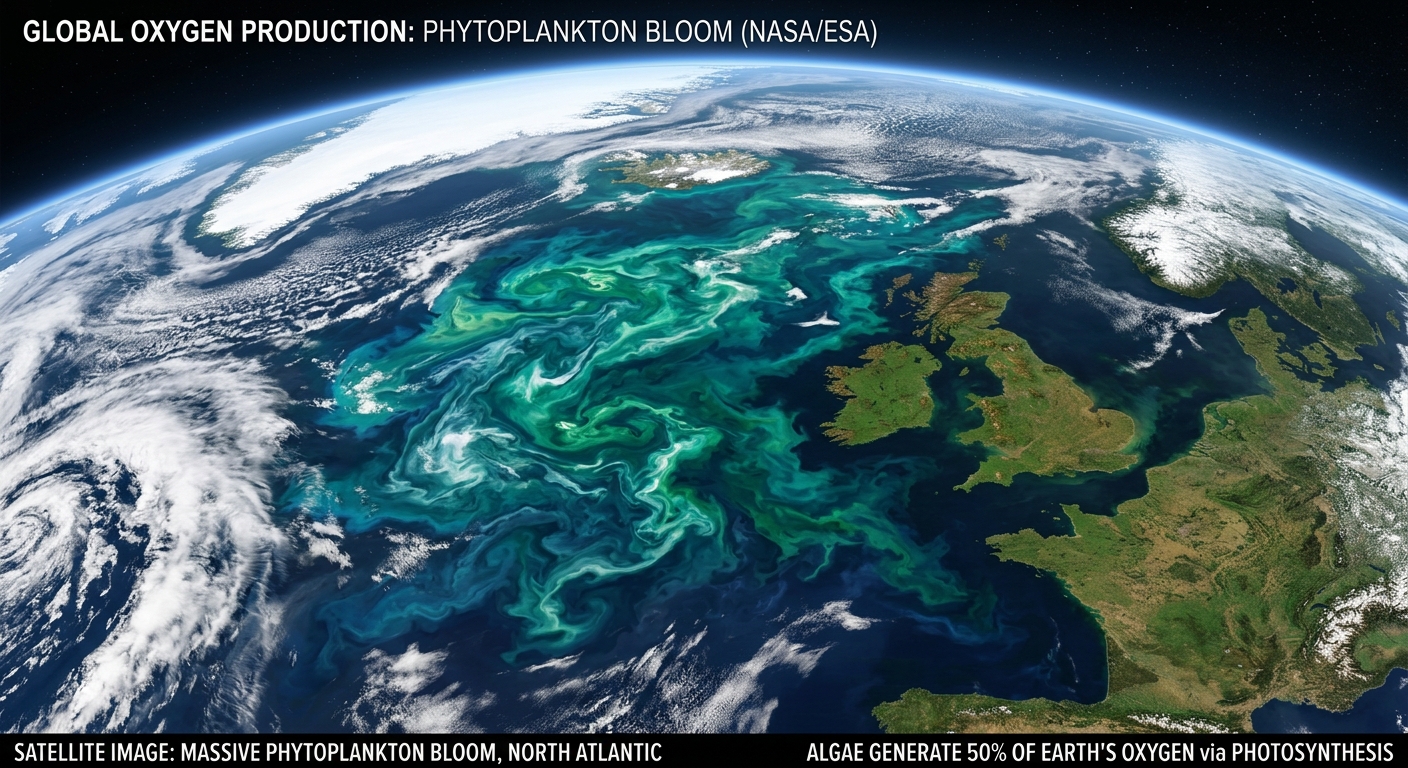
Perhaps the most incredible aspect of marine phytoplankton is how these microscopic organisms can create displays so massive they’re visible from orbit. Phytoplankton blooms can stretch across thousands of square miles, turning entire sections of ocean into swirling patterns of green, blue, and turquoise that astronauts regularly photograph from the International Space Station.
These blooms represent oxygen production on an almost incomprehensible scale. A single large bloom can produce more oxygen in a few weeks than entire countries consume in months. The satellite images of these events show nature’s invisible workforce making itself known through sheer collective power.
The Deep Sea Connection
While most marine photosynthesis occurs in the sunlit surface waters, the deep sea plays a crucial role in this oxygen cycle. Deep ocean currents transport oxygen-rich water from the surface to the ocean depths, while also bringing nutrient-rich water back to the surface to feed phytoplankton blooms.
This oceanic circulation system, sometimes called the “global conveyor belt,” ensures that oxygen production can continue year-round across different ocean regions. As surface waters cool in polar regions, they sink and carry dissolved oxygen to the deep sea, while warmer waters rise in tropical regions, bringing nutrients that fuel new phytoplankton growth.
Ancient Origins, Modern Impact
The relationship between marine organisms and atmospheric oxygen stretches back billions of years. Cyanobacteria in ancient oceans were responsible for the “Great Oxidation Event” approximately 2.4 billion years ago, when oxygen levels in Earth’s atmosphere first began to rise significantly. This event fundamentally changed our planet and made complex life forms possible.
Today, this ancient process continues with the same vital importance. Marine phytoplankton don’t just produce oxygen for current life, they actively regulate atmospheric composition and play a crucial role in climate systems worldwide.
Climate Change and Ocean Oxygen
As global temperatures rise and ocean chemistry changes, scientists are closely monitoring how these microscopic oxygen producers respond. Warmer waters hold less dissolved oxygen, and changing ocean acidity levels can affect phytoplankton growth. Some species thrive in warmer conditions, while others decline, potentially altering the delicate balance that maintains our atmospheric oxygen levels.
Understanding and protecting these invisible ocean ecosystems isn’t just about marine conservation – it’s about preserving the very air we breathe. Every breath you take connects you to vast oceanic systems and microscopic organisms working around the clock to maintain our planet’s life-supporting atmosphere.
The Next Breath You Take
The next time you find yourself by the ocean, remember that you’re looking at one of Earth’s most important oxygen factories. Those waves contain countless microscopic workers, invisible to the naked eye but absolutely essential to life as we know it. The ocean’s contribution to our breathable atmosphere represents one of nature’s most impressive examples of how the smallest organisms can have the most profound impact on our entire planet.

This is such a compelling reminder of how the ocean’s biological productivity has shaped Earth’s entire atmosphere, especially when you think about it in deep time – those early phytoplankton essentially terraformed our whole planet back in the Archean and Proterozoic. What really gets me is that we can actually see the evidence of this in ancient iron formations and banded sedimentary layers, which basically preserve the signature of when oxygen started accumulating in the oceans. The invisible factories are still running the show, and honestly, next time I’m combing a beach for specimens I’m definitely thinking about those diatoms and dinoflagellates doing the real work.
Log in or register to replyThis is such an important reminder that the tiniest organisms deserve our attention! I work with bats and see this problem constantly – people get obsessed with charismatic megafauna while completely overlooking what actually keeps us alive, whether it’s phytoplankton or the insect-eating bats that pollinate crops and control pest populations. We really need to shift our perspective on which species matter, because spoiler alert: the unsexy ones are often the most critical!
Log in or register to replyYES, thank you for finally giving plankton the spotlight they deserve! Most people will spend hours watching a nature documentary about whales but have zero idea that the oxygen in literally every breath they take came from organisms smaller than a grain of sand. The coccolithophores alone create blooms so massive you can see them from satellites, and yet somehow we act like they’re boring. It genuinely baffles me how we’ve managed to make microscopic life seem invisible when it’s doing the heaviest lifting for our entire planet.
Log in or register to reply