
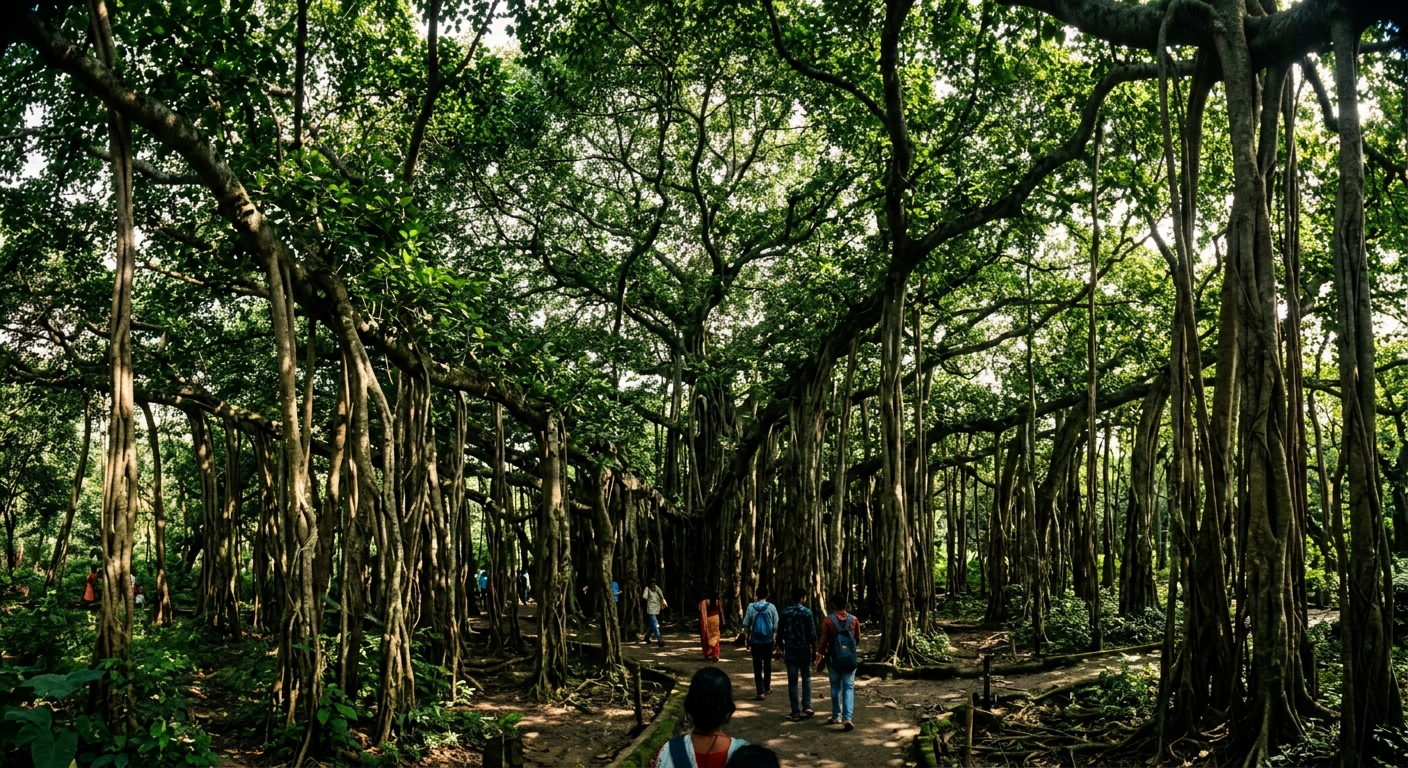
Imagine a single tree so ambitious that it refuses to stay put in one spot. Instead of growing taller like its botanical neighbors, this remarkable plant has mastered the art of multiplication, creating what appears to be an entire forest from a single seed. Meet the banyan tree, nature’s ultimate overachiever that has turned the concept of ‘tree’ completely upside down.
The Tree That Defies Logic
Most trees grow up and out, reaching for sunlight while anchoring themselves with a single root system. The banyan tree (Ficus benghalensis) laughs in the face of such conventional wisdom. This extraordinary plant grows down from the sky, sending aerial roots cascading from its branches like nature’s own curtain of life.
What starts as a single tree gradually transforms into something that looks more like a small city. The banyan’s aerial roots dangle from its horizontal branches, swaying in the breeze until they finally touch the ground. Once they make contact with soil, these roots thicken and solidify, becoming additional trunks that can support even more branches and, in turn, produce even more aerial roots.
The Science Behind the Magic
The banyan’s incredible growth strategy is called ‘clonal propagation,’ and it’s essentially nature’s version of copy-and-paste. Each new trunk that forms from an aerial root is genetically identical to the original tree, creating a massive organism that spans incredible distances while technically remaining a single individual.
How Aerial Roots Actually Work
These hanging roots aren’t just for show. They serve multiple crucial functions:
- Nutrient absorption: Even while dangling in mid-air, these roots can absorb moisture and nutrients from the humid atmosphere
- Structural support: Once they reach the ground, they provide additional support for the ever-expanding canopy
- Water transport: They create an extensive network for moving water and nutrients throughout the massive tree system
- Propagation: Each new trunk can produce its own branches and aerial roots, continuing the cycle indefinitely
Record-Breaking Giants
The most famous example of banyan magnificence is the Great Banyan in Kolkata’s Acharya Jagadish Chandra Bose Indian Botanic Garden. This single tree covers over 4.67 acres and has more than 3,300 aerial roots acting as trunks. Walking through it feels like exploring a vast hall with living columns, each one a testament to the tree’s incredible persistence.
Even more impressive is the banyan tree in Thimmamma Marrimanu, India, which holds the Guinness World Record as the largest tree by canopy coverage. This colossal organism spreads across an astounding 5.2 acres and is estimated to be over 550 years old. To put this in perspective, you could fit nearly four football fields under its canopy.
The Millennium Tree Phenomenon
Some banyan trees are so old that they predate written history in their regions. These ancient giants have witnessed the rise and fall of civilizations, serving as living landmarks for countless generations. In many cases, entire villages have grown up around these trees, with the banyan serving as a natural town square, temple, and gathering place all in one.
Cultural Significance and Sacred Groves
Throughout South Asia and the Pacific, banyan trees hold profound spiritual significance. Hindus consider the banyan sacred to Lord Vishnu, while Buddhists revere it because the Buddha is said to have achieved enlightenment under a related fig tree. The tree’s ability to create shelter and sustain life for countless creatures has made it a symbol of eternal life and wisdom.
In many traditional cultures, banyan groves serve as sacred spaces where communities gather for ceremonies, meditation, and important decisions. The tree’s massive canopy creates a natural amphitheater, while its complex root system symbolizes the interconnectedness of all life.
An Ecosystem Within an Ecosystem
A mature banyan doesn’t just create the illusion of a forest: it actually functions as one. The complex structure provides numerous ecological niches for wildlife. Birds nest in the upper branches, while the hollow spaces between aerial roots shelter small mammals, reptiles, and countless insects.
The tree’s figs provide food for over 1,200 species of animals, making it a keystone species in tropical ecosystems. Monkeys, bats, birds, and even elephants depend on banyan figs for sustenance, especially during dry seasons when other food sources become scarce.
Modern Challenges and Conservation
Despite their incredible resilience, banyan trees face mounting pressures from urbanization, pollution, and climate change. Many historic specimens have been damaged or destroyed to make way for development, representing the loss of centuries of growth and countless ecological relationships.
Conservation efforts now focus on protecting existing giant banyans while also educating people about their ecological and cultural importance. Some cities have begun incorporating young banyan trees into urban planning, recognizing their value as natural air purifiers and community gathering spaces.
The Future Forest
The banyan tree represents something profound about life’s potential for growth and adaptation. In a world where we often think in terms of individual achievement, the banyan demonstrates the power of connection and continuous expansion. Each aerial root reaching toward the ground is like an act of faith, a belief that there’s always room to grow and new ground to explore.
As we face environmental challenges that require thinking beyond traditional boundaries, perhaps we can learn something from the banyan’s approach: sometimes the most extraordinary growth happens when we stop trying to simply reach higher and instead focus on spreading our roots wider, creating networks of support that can sustain not just ourselves, but entire communities of life.


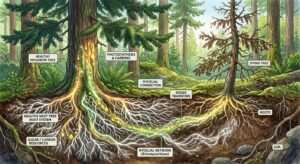
This is absolutely wild and honestly it makes me think about what’s happening *below* those aerial roots too, because I guarantee the soil biology under a 5-acre banyan is just as mind-bending as what we see above ground. All those new root systems creating different soil horizons, feeding different communities of mycorrhizal fungi, nematodes, and microbes… it’s basically a living laboratory for belowground succession. The banyan isn’t just becoming a forest, it’s creating entirely new soil food webs with each root descent. Nature really said “why be one tree when you can be a whole ecosystem” and I’m here for it!
Log in or register to replyOh man, you’re hitting on something I think about constantly, Natalie – like the banyan is basically running this epic underground party that nobody talks about! Each of those aerial roots touching down is creating its own little soil microhabitat with fresh fungal networks, bacterial communities, maybe even different nematode populations finding their niches in these developing root zones. I’d genuinely love to see someone map out how the mycorrhizal associations shift across those different “root generations” because I bet the oldest root systems have completely different fungal partners than the newest ones. The tree really is experiencing itself as multiple organisms with multiple belowground identities, and that’s honestly way more fascinating than the aerial drama.
Log in or register to replySylvia’s point about the soil biology is so good – I’m sitting here wondering what the fungal networks must look like under something that massive, and honestly whether a tree that sprawling even experiences itself as “one organism” the way we assume. Like, we know trees communicate through mycorrhizal networks, but what is it *like* to be a banyan that’s basically a distributed entity spread across acres? Does each aerial root trunk develop semi-independent sensing and decision-making, or is there some central coordination happening? I’d love to know if anyone’s studied the neural-like signaling patterns in these things.
Log in or register to reply