
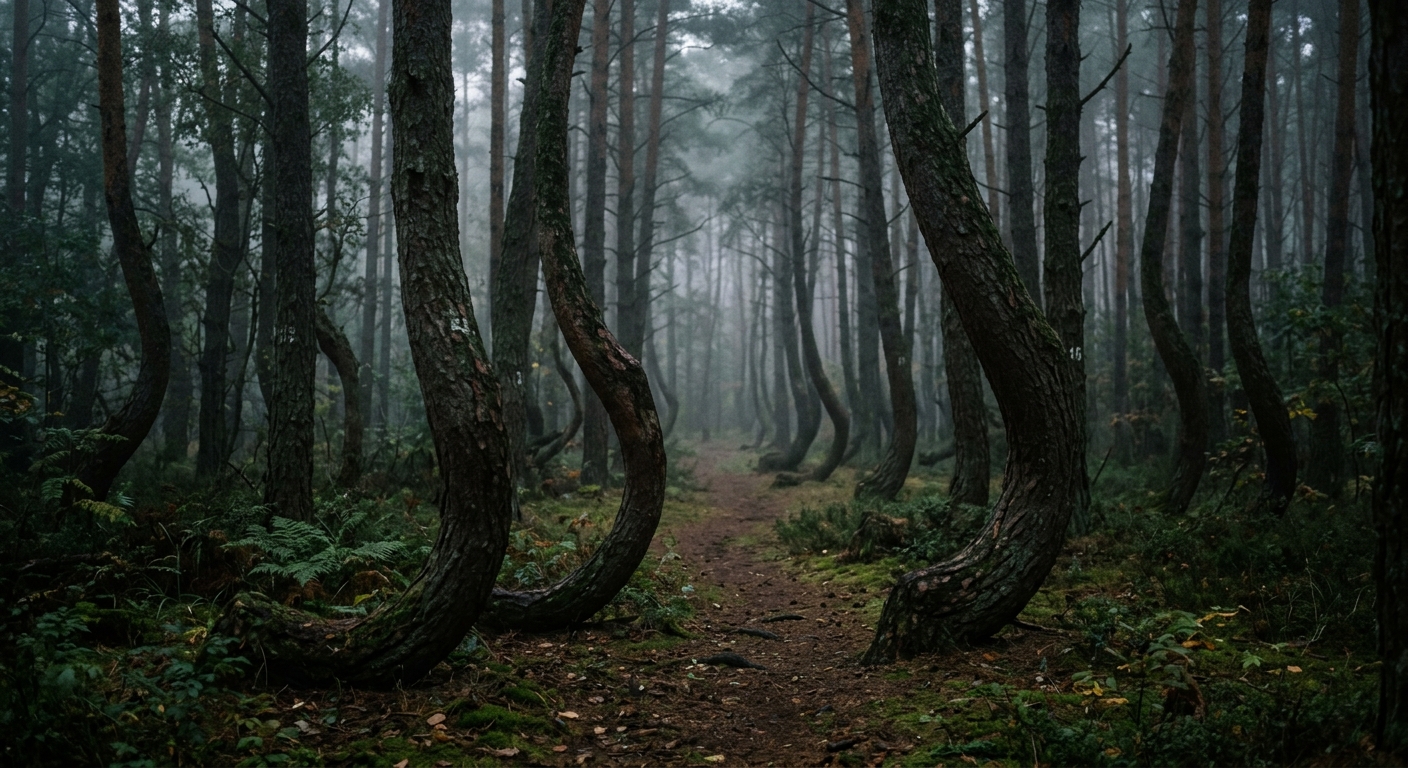
Deep in the forests of western Poland lies one of nature’s most perplexing mysteries. The Crooked Forest, or ‘Krzywy Las’ in Polish, is home to approximately 400 pine trees that defy everything we know about how trees should grow. Each one bends at a sharp 90-degree angle near its base, creating a perfect J-shape that has left botanists, foresters, and scientists scratching their heads for decades.
A Forest That Defies Logic
Located near the village of Nowe Czarnowo in West Pomerania, the Crooked Forest occupies just a small grove within a larger forest of perfectly normal, straight pine trees. What makes this phenomenon even more baffling is that the curved trees are surrounded by their straight-growing siblings, all planted around the same time in the 1930s.
The trees begin growing normally for the first few feet, then suddenly bend dramatically toward the north at their base before curving back upward to reach for the sky. This creates an otherworldly landscape that looks more like something from a fairy tale than a natural forest. The curve in each tree occurs at roughly the same height, about 1-3 feet from the ground, and the bend is so uniform that it appears almost intentional.
The Numbers Don’t Lie
What makes the Crooked Forest even more mysterious is the consistency of the phenomenon:
- All 400 affected trees show the same northward bend
- The curvature begins at approximately the same height on each tree
- All trees were planted around 1930, making them roughly the same age
- The trees are healthy and continue to grow normally after the initial curve
- Surrounding trees from the same planting show no abnormalities
Theories That Don’t Quite Add Up
Scientists have proposed numerous explanations for the Crooked Forest, but none fully account for all aspects of this botanical puzzle.
The Human Intervention Theory
The most widely accepted explanation suggests that local farmers deliberately manipulated the trees when they were saplings, possibly to create naturally curved timber for shipbuilding or furniture making. This theory proposes that mechanical devices or techniques were used to bend the young trees, with the intention of harvesting them later for their unique shape.
However, this explanation raises its own questions. Why would someone go to such elaborate effort for just 400 trees when thousands of straight trees were available? And if this was the plan, why were the trees never harvested? The outbreak of World War II might have interrupted the project, but decades have passed since then.
Environmental Catastrophe
Another theory suggests that an environmental disaster struck when the trees were young. Possibilities include:
- Heavy snowfall that bent the saplings and somehow ‘trained’ them to grow in this pattern
- A localized ice storm that affected only this particular grove
- Shifting soil or a minor landslide that tilted the young trees
Yet none of these explanations account for why only these specific trees were affected while others in the immediate vicinity remained perfectly straight.
Gravitational or Magnetic Anomaly
Some researchers have proposed that a localized gravitational or magnetic anomaly could be responsible for the trees’ unusual growth pattern. This would explain the uniform direction of the bend and why it affects only trees in a specific area.
However, no such anomalies have been detected in the area, and this theory doesn’t explain why the effect would be limited to trees planted in a specific time period.
What Makes Trees Grow Straight?
To understand why the Crooked Forest is so unusual, it helps to understand how trees normally grow. Trees possess a remarkable ability called gravitropism, which allows them to detect gravity and grow upward toward light while extending their roots downward into the soil.
When a tree is knocked over or bent by external forces, it typically responds by growing additional wood on the underside of the bend to straighten itself out over time. The fact that the Crooked Forest trees maintain their curves suggests that whatever caused the initial bending either permanently damaged this self-correcting mechanism or that the trees were continuously influenced by the same force during their formative years.
A Tourist Destination Born from Mystery
The Crooked Forest has become a popular tourist destination, drawing visitors from around the world who come to witness this botanical anomaly firsthand. The site has been featured in documentaries, scientific papers, and countless travel blogs, yet the mystery remains unsolved.
Local guides often share various legends and theories with visitors, but even they admit that no explanation fully satisfies the scientific community. The forest has become a symbol of nature’s ability to surprise us and remind us that there are still mysteries in our world waiting to be solved.
The Ongoing Investigation
Modern researchers continue to study the Crooked Forest using advanced techniques including soil analysis, growth ring examination, and detailed photographic documentation. Some scientists have taken core samples from the trees to study their growth patterns, while others have analyzed the soil composition for clues about what might have influenced the trees’ development.
Despite these efforts, the Crooked Forest keeps its secrets. Each new study seems to raise more questions than it answers, adding to the legend of this extraordinary place.
The Crooked Forest stands as a testament to the mysteries that still exist in our natural world. In an age where satellite imagery can map every corner of the Earth and genetic sequencing can unlock the secrets of life itself, it’s both humbling and exciting to know that a simple grove of trees can still baffle our best scientific minds. Whether the answer lies in human intervention, environmental catastrophe, or some force we haven’t yet considered, the Crooked Forest continues to bend our understanding of how nature works.






Wait, so these trees are all bending the same direction at the same angle? That’s wild, but I’m wondering if there’s a navigation/orientation angle here that hasn’t been explored – like, could the trees be responding to some kind of geomagnetic anomaly in that specific grove the way migratory birds use magnetic fields to orient? I know that sounds far fetched for trees, but animals navigate using Earth’s magnetic field all the time, and I’m genuinely curious if anyone’s measured magnetic variation in that area or checked if the bend direction correlates with magnetic north. The fact that it’s localized to one grove is the really intriguing part.
Log in or register to replyomg this is teh kind of mystery that would make attenborough lose his mind lol! ive read that some pines do weird stuff under snow pressure when theyre young saplings, like if they get buried and then the snow melts they shoot upward, but 400 trees at the exact same angle?? that seems way too coordinated tbh. sebastian makes a good point about environmental stress – could there have been some insane wind event or maybe even magnetic anomalies affecting the growth patterns? what kind of soil conditions were present in that grove compared to the surrounding area?
Log in or register to replyhonestly this reminds me of how animals in the savanna adapt to crazy environmental pressures, like how certain grasses grow at angles to survive heavy grazing patterns. makes me wonder if theres some seasonal stress factor hitting that grove all at once, maybe heavy snow load or wind during a critical growth window? the fact that 400 trees responded identically is really intriguing though, almost like they’re responding to a specific environmental signal the same way a predator learns to hunt a certain way. id be curious if anyone checked whether those trees share some kind of root network or if theyre all the same age cohort, cause that could explain the synchronized weirdness
Log in or register to reply