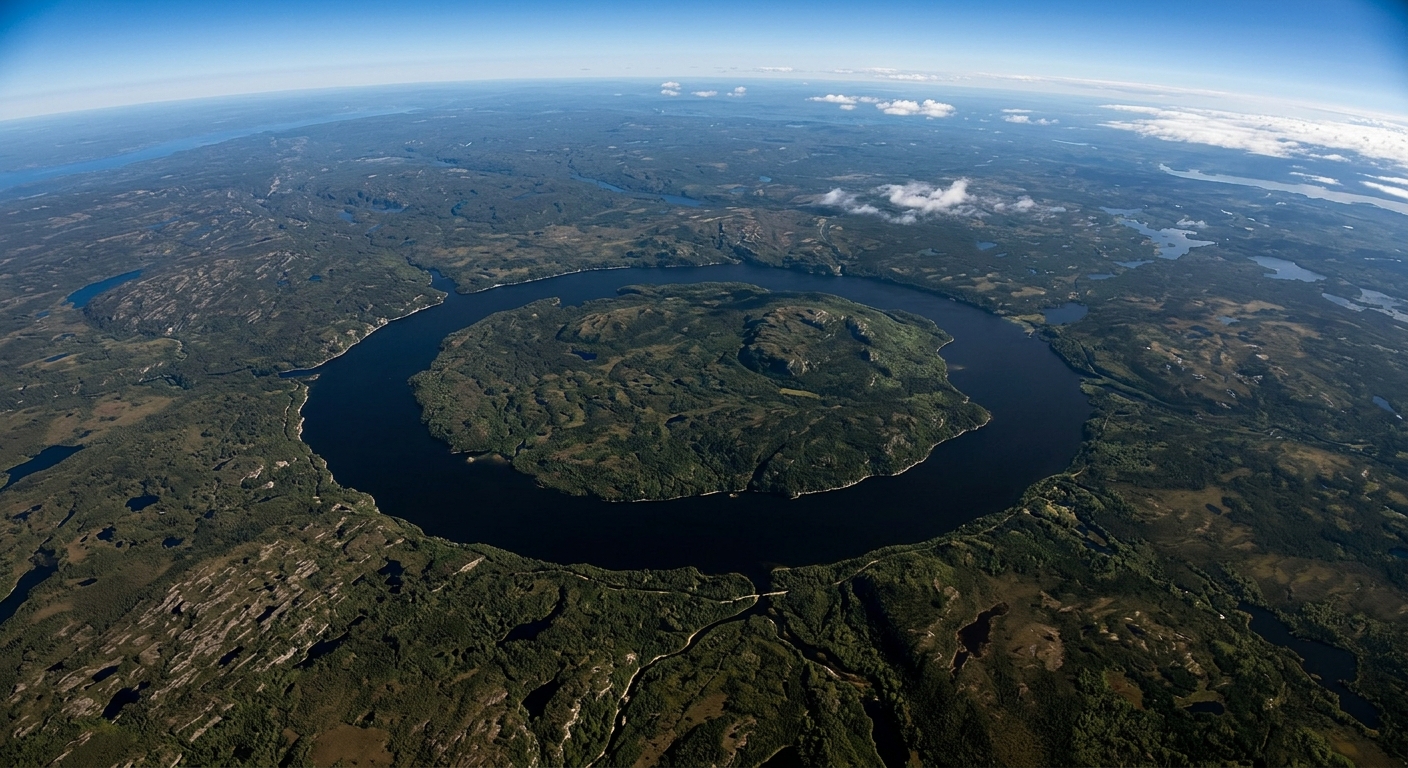
Deep in the Canadian wilderness of Quebec lies one of Earth’s most puzzling geological features: a lake so perfectly circular that it looks like it was drawn with a cosmic compass. For decades, the Manicouagan Crater Lake, known as the “Eye of Quebec,” has captivated scientists and confused geologists with its impossibly precise geometry and mysterious origins.
A Circle So Perfect It Defied Explanation
When viewed from above, Manicouagan Crater reveals itself as an almost flawless ring of water surrounding a central island. The lake’s circular outline is so precise that early observers refused to believe it could be natural. The outer rim measures approximately 70 kilometers in diameter, making it one of the largest and most well-preserved impact craters on Earth.
What makes this formation truly extraordinary is not just its size, but its geometric perfection. Unlike most natural lakes that follow irregular shorelines carved by rivers, glaciers, or tectonic activity, Manicouagan maintains an almost mathematical precision that seems to mock the chaotic forces that typically shape our planet’s surface.
The Great Geological Mystery
For much of the 20th century, geologists struggled to explain the Eye of Quebec’s existence. The prevailing theories of the time couldn’t account for such a perfectly circular formation. Some scientists proposed volcanic activity, others suggested glacial carving, but none of these explanations could satisfactorily explain the crater’s remarkable symmetry.
The mystery deepened when researchers discovered that the surrounding rock formations didn’t match typical volcanic or erosional patterns. Instead, they found something far more intriguing: evidence of extreme shock metamorphism, where rocks had been subjected to pressures and temperatures so intense that their very molecular structure had been altered.
Clues in the Rocks
The breakthrough came when geologists began studying the mineral composition of rocks around the crater. They discovered the presence of:
- Shatter cones: cone-shaped rock formations that only occur under extreme pressure
- Shocked quartz: quartz crystals with distinctive deformation patterns
- Impact breccia: fragmented rock pieces fused together by intense heat
- Coesite and stishovite: high-pressure forms of quartz that form only under extreme conditions
These geological fingerprints pointed to only one possible explanation: a massive extraterrestrial impact.
When Space Came to Earth
Scientists now believe that approximately 214 million years ago, during the late Triassic period, a massive asteroid or comet slammed into what is now Quebec with unimaginable force. The impactor, estimated to have been about 5 kilometers in diameter, struck the Earth’s surface at a speed of roughly 20 kilometers per second.
The collision released energy equivalent to billions of nuclear bombs, instantly vaporizing the asteroid and excavating a crater nearly 100 kilometers across. The impact was so powerful that it melted and ejected millions of tons of rock, creating a temporary crater much larger than what we see today.
The Perfect Circle Takes Shape
The reason for Manicouagan’s perfect circular shape lies in the physics of high-velocity impacts. When an object strikes the Earth at such extreme speeds, the explosion occurs so rapidly that the angle of impact becomes irrelevant. The shock waves spread outward in all directions with equal force, carving a perfectly circular crater regardless of whether the asteroid hit straight on or at an angle.
Time’s Artistic Touch
Over millions of years, geological processes gradually modified the original crater. Erosion wore down the central peak and outer rim, while glacial activity during the ice ages carved out the current lake basin. The result is the stunning ring lake we see today, with René-Levasseur Island occupying the center where the crater’s peak once stood.
The lake itself is a relatively recent addition to the landscape, formed when glacial dams created by the last ice age finally melted and allowed water to fill the circular depression. This natural reservoir now holds an enormous volume of fresh water, making it one of the largest lakes in Quebec.
A Window into Earth’s Violent Past
The Eye of Quebec serves as a powerful reminder of our planet’s tumultuous history. During the late Triassic period, when this impact occurred, Earth was experiencing one of its most significant mass extinction events. Some scientists speculate that this impact, along with others during the same period, may have contributed to the extinction that paved the way for dinosaurs to become the dominant life forms.
The crater also provides invaluable insights into the early solar system’s chaotic period, when asteroids and comets regularly bombarded the inner planets. Similar impacts shaped the Moon’s surface and influenced the evolution of life on Earth in ways we’re only beginning to understand.
Modern Wonder and Scientific Treasure
Today, Manicouagan Crater continues to fascinate researchers studying impact geology, astrobiology, and planetary formation. The site serves as a natural laboratory for understanding how life recovers from catastrophic events and how impact craters evolve over geological time.
The perfect circle that once confounded scientists now stands as a testament to the incredible forces that have shaped our planet. From space, astronauts frequently photograph this remarkable feature, often calling it one of the most striking landmarks visible from orbit. The Eye of Quebec watches over the Canadian wilderness, a 214-million-year-old reminder that even the most perfect circles in nature often have the most explosive origins.

Oh wow, that’s such a cool angle Frederica! I’m honestly not deep enough in mycology to weigh in on the specific fungal colonization question, but it reminds me of how impact zones create these totally unique ecological niches that pioneer species absolutely love. Makes me wonder if native plants in Quebec have adapted over generations to thrive in that mineral-rich disturbed soil, kind of like how my conversion to natives revealed all these plants that naturally gravitate toward certain microsites in my yard. Have you noticed whether the fungal communities at impact sites influence which plants establish first?
Log in or register to replyooh gwen youre onto something with the pioneer species angle, thats so cool! i’ve noticed similar dynamics in my own garden when i disturb soil, like how certain plants just seem to know where theyre “supposed” to go – though obvs thats probably more about seed dispersal and light availability than actual plant intelligence lol. but honestly the fungi angle frederica brought up might be THE key here because mycorrhizal networks can totally reshape which plants can establish in nutrient-poor or disrupted soil, and if the impact created unique mineral conditions that favor specific fungal communities, theyre basically paving the way for certain plant pioneers. would be wild if quebec’s native flora actually “prefers” those
Log in or register to replyThis is fascinating, though I’d be curious whether any mycological surveys were done on the impact site itself – the disrupted soil and unique mineral composition after an impact event creates such a wild substrate for fungal colonization. Macrolepiota procera and other saprotrophs probably had a field day with all that suddenly exposed organic matter, and I wonder if the fungal communities there are still somehow distinct even now. The sheer violence reshaping geology like that is humbling.
Log in or register to reply