
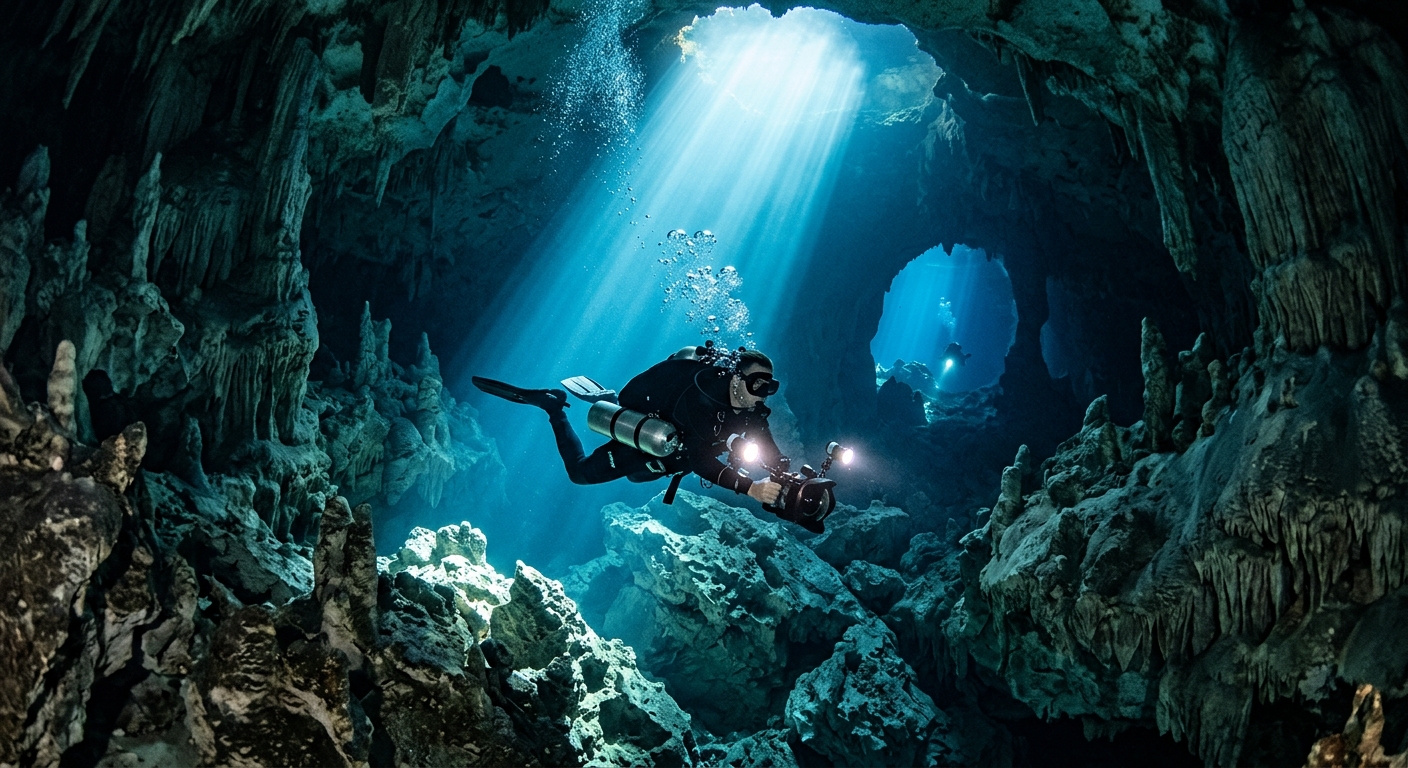
Deep beneath Mexico’s Yucatan Peninsula lies one of Earth’s most extraordinary secrets: a vast underground river system that connects hundreds of cenotes and spans thousands of miles. This hidden waterway, invisible from the surface, actually carries more water than any river on our planet, including the mighty Amazon.
What Are Cenotes?
Before diving into this underground marvel, let’s understand what cenotes are. These natural sinkholes, sacred to the ancient Maya, form when limestone bedrock collapses, exposing the groundwater beneath. The word ‘cenote’ comes from the Maya word ‘dzonot,’ meaning sacred well.
Scattered across the Yucatan Peninsula are over 6,000 known cenotes, ranging from small, intimate pools to massive caverns hundreds of feet across. What researchers have discovered is that these aren’t isolated water bodies but rather windows into an interconnected underground ocean.
The Discovery of the Underground River System
For decades, cave divers and researchers suspected that the cenotes were connected, but the true scale of this underground network remained a mystery. It wasn’t until advanced underwater mapping techniques and fearless cave diving expeditions that scientists began to grasp the enormous scope of this subterranean world.
In 2018, a team of underwater explorers made headlines when they connected two massive cave systems, Sac Actun and Dos Ojos, creating what is now recognized as the world’s largest underwater cave system at over 215 miles long. But this discovery was just the tip of the iceberg.
Mapping the Unmappable
Using sophisticated sonar equipment, underwater drones, and GPS technology, researchers have mapped thousands of miles of underwater passages. The network extends far beyond what anyone initially imagined, with some tunnels wide enough to accommodate entire buildings and deep enough to swallow skyscrapers.
Larger Than Any Surface River
Here’s where this story becomes truly mind-boggling: this underground river system carries an estimated flow rate that exceeds any surface river on Earth. While the Amazon River moves approximately 200,000 cubic meters of water per second, preliminary estimates suggest the Yucatan’s underground system may transport even more water through its vast network of tunnels and chambers.
The system operates differently from surface rivers. Instead of flowing in one direction toward the sea, water moves through multiple interconnected channels, creating a complex circulation pattern that scientists are still working to understand. Some passages flow toward the Caribbean coast, while others circulate inland, creating underground currents and even underwater waterfalls within flooded caverns.
The Numbers Don’t Lie
Consider these staggering statistics:
- Over 6,000 known cenotes serve as access points to the system
- More than 1,000 miles of underwater passages have been mapped so far
- Some chambers reach depths of over 400 feet
- The system extends across an area larger than the state of Florida
- Water temperatures remain constant at around 77°F year-round
A Unique Ecosystem Thrives in Darkness
This underground river isn’t just a geological wonder; it’s home to extraordinary life forms found nowhere else on Earth. Blind cave fish navigate the perpetual darkness using heightened senses, while transparent crustaceans scuttle along limestone walls that have never seen sunlight.
Scientists have discovered species of bacteria that have evolved to process chemicals instead of sunlight for energy, creating unique ecosystems that challenge our understanding of life on Earth. Some organisms found in these caves may hold keys to understanding how life could exist on other planets with similar conditions.
Living Fossils
Perhaps most remarkably, this underground world has preserved ancient life forms that have remained virtually unchanged for millions of years. Cave-dwelling species often evolve slowly due to the stable environment, making them living windows into Earth’s biological past.
The Maya Connection
The ancient Maya understood the sacred nature of cenotes long before modern science revealed their true scope. They considered these natural pools gateways to Xibalba, the underworld, and conducted ceremonies and offerings at cenote sites throughout their territory.
Archaeological discoveries within the cave system have revealed Maya artifacts, pottery, and even human remains, suggesting that ancient peoples ventured far into these underwater realms. Their reverence for cenotes takes on new meaning when we consider they were worshipping access points to one of Earth’s largest hidden water systems.
Environmental Importance
This underground river system serves as the primary freshwater source for the entire Yucatan Peninsula. Unlike surface rivers that can be easily contaminated, this underground network filters water through miles of limestone, creating some of the purest freshwater on Earth.
However, this same system faces threats from development, pollution, and climate change. Contamination at any point in the network can spread throughout the entire system, making conservation efforts crucial for protecting this hidden wonder.
A Fragile Balance
The delicate balance of this underground ecosystem depends on careful management of surface activities. Agricultural runoff, urban development, and tourism all pose potential threats to water quality throughout the system.
Still Exploring the Unknown
Despite decades of exploration, scientists estimate they’ve mapped less than 10% of the entire system. New passages, chambers, and connections are discovered regularly, suggesting that the true scope of this underground river may be even more vast than currently imagined.
Each diving expedition reveals new wonders: underwater stalactite forests, air-filled chambers the size of cathedrals, and passages that seem to extend infinitely into the darkness. The Yucatan’s underground river system continues to rewrite our understanding of freshwater systems and reminds us that our planet still holds secrets waiting to be discovered.
In a world where we think we’ve mapped everything, the cenotes of Yucatan prove that some of Earth’s greatest wonders remain hidden beneath our feet, flowing silently through the darkness in volumes that dwarf even our mightiest surface rivers.


This is incredible stuff, and I’m totally with Frederica on the measurement questions since aquifer systems are genuinely hard to quantify accurately. What really gets me though is imagining those cave ecosystems – I’ve been fortunate enough to explore some cenote systems in the Yucatan, and the isolation down there creates such wild evolutionary pressures compared to the canopy biodiversity I usually obsess over. I’d love to know if anyone’s studied how these subterranean communities compare in terms of endemism rates to, say, the upper canopy in Borneo or the Congo, because I have a feeling that perpetual darkness is producing some mind-bending adaptations.
Log in or register to replyThis is absolutely wild, though I’m curious about the measurement methodology here – comparing water volume in subterranean systems versus a massive surface river seems tricky. What really gets me is thinking about the fungal communities thriving in that perpetual darkness, especially the saprotrophs breaking down organic matter without any sunlight. The mycorrhizal networks in those cave ecosystems must operate in such a fundamentally different way than what we see in aboveground forests, and honestly I’d love to know more about what’s actually documented down there versus speculation.
Log in or register to replyThis is fascinating stuff, and Frederica makes a great point about measurement challenges with groundwater systems. I’m genuinely curious about how the water chemistry differs in these cenotes compared to surface rivers like the Amazon, because that would totally shape what organisms can actually thrive down there. As someone who monitors dissolved oxygen and nutrient levels in rivers, I’m wondering if anyone’s done serious biogeochemical work on these systems, since perpetual darkness changes everything about productivity and food webs versus what we see in flowing surface waters.
Log in or register to reply