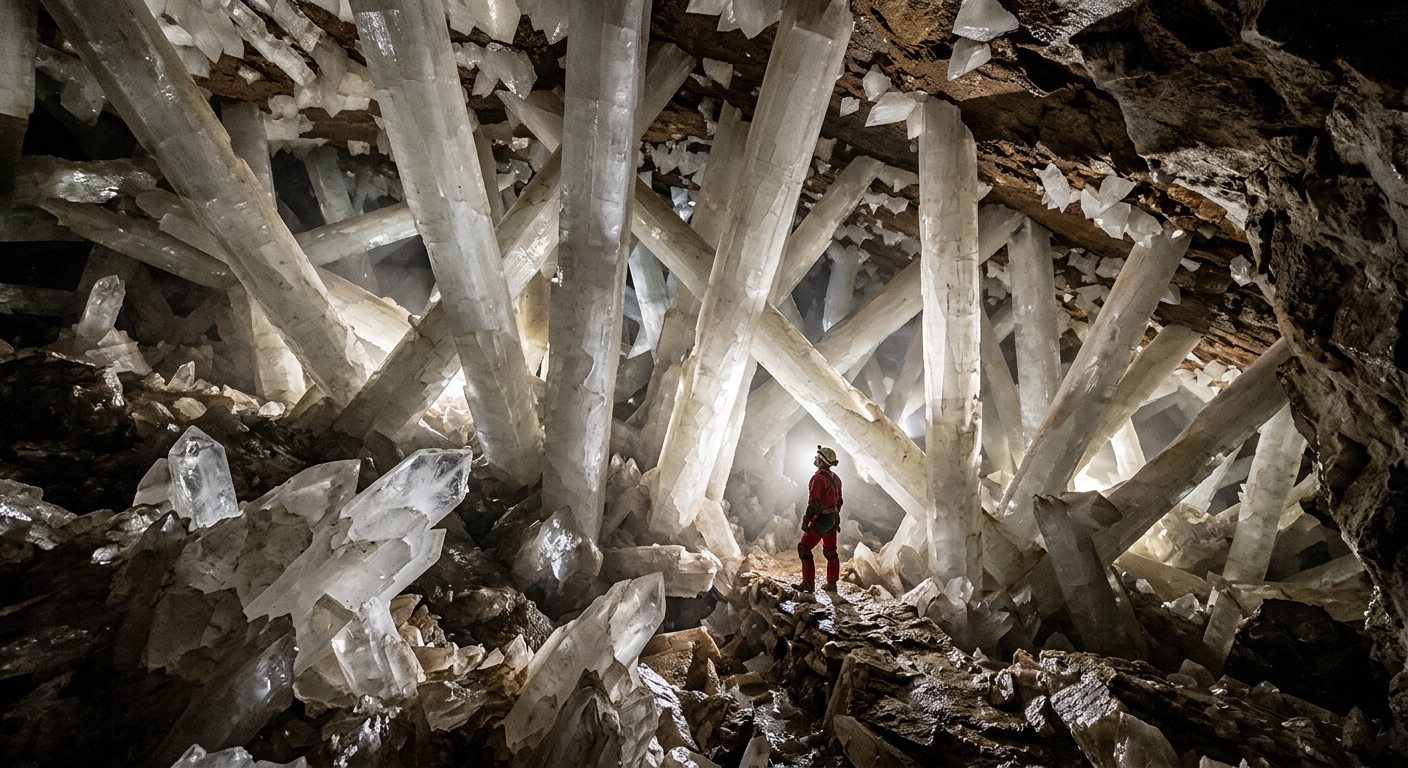
Deep beneath the Mexican desert, in a cavern so hostile that humans can survive only minutes without specialized equipment, lies one of Earth’s most spectacular hidden treasures. Welcome to the Cave of Crystals, where nature has spent half a million years crafting crystal formations so massive they dwarf the tallest trees.
Located 300 meters below ground in the Naica mine in Chihuahua, Mexico, this subterranean wonderland contains selenite crystals that reach lengths of up to 36 feet and weigh as much as 55 tons. To put this in perspective, these crystals are longer than a school bus and heavier than a fully loaded semi-truck.
A Discovery That Rewrote Geology Books
The Cave of Crystals was discovered by accident in 2000 when miners were excavating new tunnels in the Naica lead, zinc, and silver mine. What they found defied every expectation of what crystals could become. Brothers Juan and Pedro Sanchez were the first humans to lay eyes on these colossal formations, stumbling into what can only be described as a natural cathedral made entirely of crystal.
The cave itself measures about 30 feet wide and 90 feet long, but its relatively modest dimensions only make the enormous crystals within seem even more impossible. Some crystals are so large that visitors must climb over and around them like navigating a forest of transparent tree trunks.
The Perfect Storm of Geological Conditions
The formation of these giant crystals required a perfect storm of geological conditions that persisted for an almost unimaginable length of time. Scientists have determined that these selenite giants grew over approximately 500,000 years, in an environment that remained remarkably stable throughout this entire period.
The Temperature Factor
The cave maintains a constant temperature of around 58°C (136°F) with humidity levels near 100%. This extreme heat comes from the magma chamber located just beneath the cave system. For half a million years, this natural furnace kept the groundwater at the perfect temperature for crystal growth.
The Chemical Recipe
The groundwater was saturated with gypsum (calcium sulfate), creating the ideal conditions for selenite crystal formation. The water needed to be just hot enough to keep the gypsum dissolved, but not so hot that it prevented crystallization. This delicate balance was maintained for millennia, allowing the crystals to grow slowly and continuously.
- Constant temperature of 58°C (136°F)
- 100% humidity levels
- Gypsum-saturated groundwater
- Complete absence of vibrations or disturbances
- Stable conditions for 500,000 years
A Hostile Environment for Human Exploration
While the Cave of Crystals is breathtakingly beautiful, it represents one of the most hostile environments on Earth for human beings. The extreme heat and humidity create conditions that can be lethal within minutes. Without proper equipment, a person’s body temperature would rise to dangerous levels in less than 10 minutes.
Researchers must wear specialized cooling suits that circulate ice-cold water through tubes to keep their body temperature stable. Even with this equipment, they can only spend about 20 minutes in the cave before the cooling systems become overwhelmed. The air is so hot and humid that it can burn the lungs with each breath.
Breathing Underwater While Standing on Dry Ground
The humidity in the cave is so extreme that breathing becomes similar to drowning. The air contains so much water vapor that lungs cannot effectively extract oxygen, and the superheated air can cause burns to respiratory tissue. Scientists describe the experience as trying to breathe underwater while standing in an oven.
Scientific Discoveries Beyond the Crystals
The Cave of Crystals has yielded discoveries that extend far beyond its spectacular formations. In 2017, scientists announced they had found ancient microorganisms trapped within the crystals themselves, some potentially up to 60,000 years old.
These microbes appear to have survived in tiny fluid inclusions within the crystals, essentially preserved in time. When revived in laboratory conditions, some of these ancient organisms showed signs of life, offering unprecedented insights into how life can persist in extreme environments. This discovery has profound implications for astrobiology and the search for life on other planets.
A Race Against Time
Tragically, the Cave of Crystals faces an uncertain future. The cave remained flooded for most of its existence, which protected the crystals and allowed them to continue growing. However, mining operations have pumped out the water, exposing the crystals to air for the first time in their half-million-year history.
Without the protective groundwater, the crystals have begun to deteriorate. The perfect conditions that created these giants no longer exist, and experts estimate that the crystals may begin to show significant degradation within decades. Some sections have already started to crack and crumble due to temperature fluctuations and exposure to air.
Conservation Efforts
Scientists and conservationists are working frantically to document and study the cave before its treasures are lost forever. High-resolution 3D mapping, detailed chemical analysis, and extensive photography are creating a permanent record of this geological wonder.
There have been proposals to reflood portions of the cave to halt the deterioration, but the logistics and costs are staggering. The ongoing mining operations also complicate any long-term preservation efforts.
Other Crystal Caves in the Naica System
The Cave of Crystals is not alone in the Naica mine system. Several other crystal caves have been discovered, though none match the sheer scale of the main chamber. The Cave of Swords, discovered in 1910, contains smaller but still impressive selenite formations. The Queen’s Eye and the Candles Cave round out this underground crystal kingdom.
Each cave represents a different phase in the geological history of the region, offering scientists multiple windows into the processes that create these magnificent formations.
A Window into Earth’s Hidden Wonders
The Cave of Crystals serves as a humbling reminder of the incredible forces and timeframes involved in shaping our planet. These crystal giants grew slowly and steadily while ice ages came and went, while species evolved and went extinct, while human civilization rose from its earliest beginnings to the modern age.
The cave also highlights how much we still don’t know about our own planet. Hidden just 300 meters below the surface, this geological masterpiece remained unknown to science until just over two decades ago. It makes us wonder what other incredible discoveries await in the unexplored depths beneath our feet.
As climate change and human activity continue to alter our planet’s most remote and pristine environments, the Cave of Crystals stands as both an inspiration and a warning. It shows us the incredible beauty that nature can create given enough time and the right conditions, while reminding us how fragile these wonders can be when those conditions change.
oh man gwen is asking the right question because those extreme environments are basically untapped for documentation, have you checked if anyone’s logged observations from cave systems like this on iNaturalist? even if its just photos of the cave entrance or the microbes themselves, citizen scientists have actually been finding some wild extremophile stuff in similar conditions, so theres definitely potential for some real discoveries there if the researchers are open to crowdsourcing IDs
Log in or register to replyThis is absolutely wild, and honestly makes me think about how much we still don’t understand about what’s happening literally under our feet! I’d love to know if there’s any microbial or fungal life thriving in those extreme conditions, since I’m always fascinated by how organisms adapt to survive in places we think are impossible. It’s a great reminder that “habitat” means SO much more than just the plants and pollinators I’m tracking in my yard, and that nature’s engineering at every scale puts anything humans build to shame.
Log in or register to replyYou’re touching on something I think about a lot with my journal work, Gwen – those moments when you realize you’ve been looking at such a narrow slice of the living world. I’ve been tracking the same forest edge for 15 years and still feel like I’m barely scratching the surface, so imagining what’s adapting in those caves makes me feel both humbled and curious about what we’d see if we could document it systematically. The microbes and fungi you mention are probably undergoing seasonal shifts too, just on timescales and in conditions so removed from our experience that we’d need patient, careful observation to even notice.
Log in or register to reply