
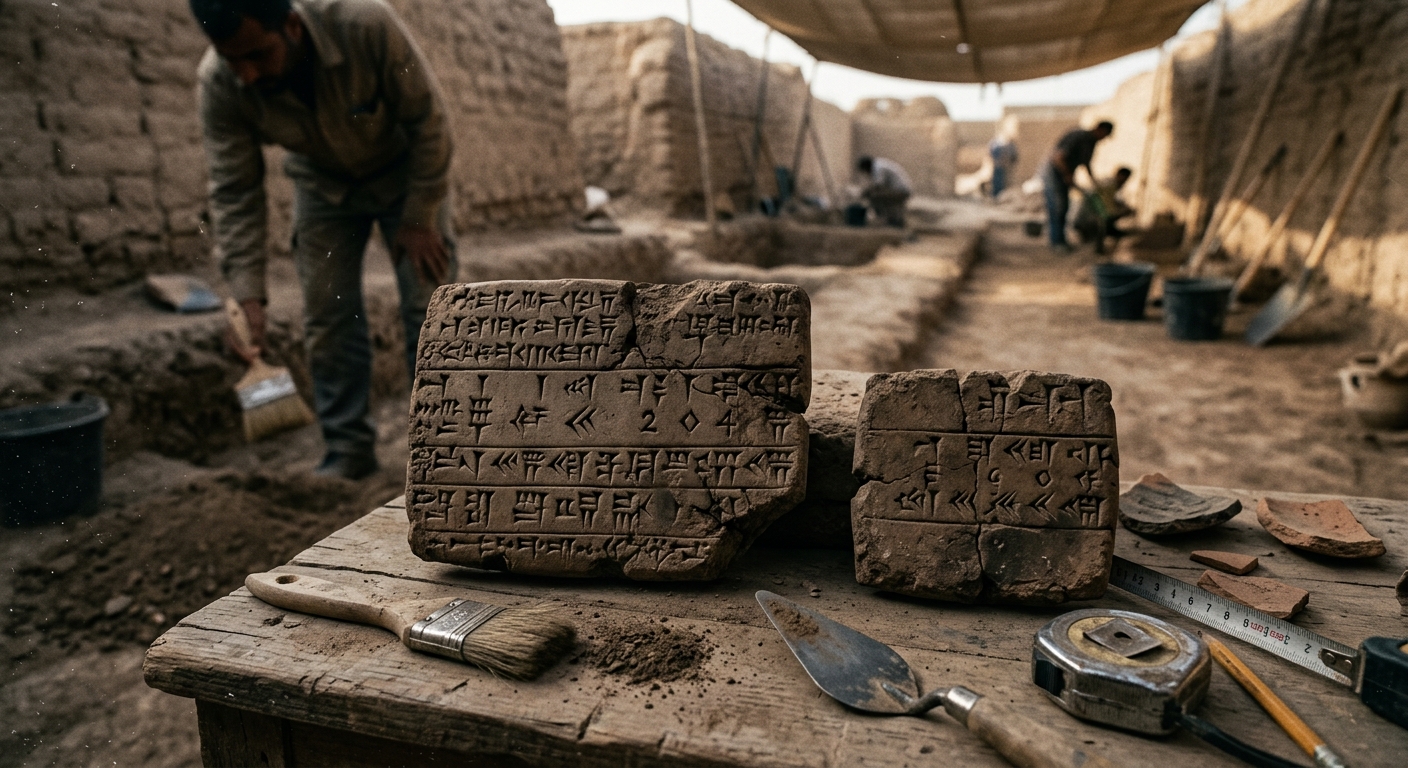
Deep within the dusty archives of archaeological museums, ancient clay tablets hold secrets that continue to astound mathematicians and historians alike. Among these weathered fragments lies evidence of one of humanity’s most profound intellectual achievements: the independent discovery of zero by ancient Mesopotamian scribes, centuries before it appeared in other civilizations.
The Revolutionary Power of Nothing
To understand why this discovery is so remarkable, we must first appreciate what zero truly represents. Zero isn’t just the absence of something; it’s a sophisticated mathematical concept that allows for positional notation, advanced calculations, and abstract thinking about nothingness as a tangible entity. Without zero, modern mathematics, computer science, and virtually every technological advancement would be impossible.
For thousands of years, civilizations struggled with this concept. The ancient Greeks, despite their mathematical prowess, never developed a true zero. The Romans, with their complex numeral system, had no symbol for nothing. Yet in the fertile crescent of Mesopotamia, between the Tigris and Euphrates rivers, Babylonian mathematicians were quietly wrestling with this abstract idea.
Cuneiform Clues: Decoding Ancient Mathematics
The evidence comes from cuneiform tablets dating back to the 4th and 5th centuries BCE, though some scholars argue the concept may have emerged even earlier. These tablets, inscribed with wedge-shaped marks pressed into soft clay, reveal a sophisticated understanding of mathematical principles that wouldn’t appear in other cultures for centuries.
The Mesopotamian number system was sexagesimal, based on 60 rather than our familiar base-10 system. This system still influences us today through our measurement of time (60 seconds, 60 minutes) and angles (360 degrees in a circle). Within this framework, Babylonian scribes encountered a crucial problem: how to represent empty positions in their positional notation system.
The Birth of an Empty Space
Initially, Babylonian mathematicians simply left blank spaces where we would place a zero. However, this created obvious problems. How could you tell the difference between 12 and 102 if both were represented by symbols for 1 and 2 with varying amounts of space between them? The solution was revolutionary: they began using a specific symbol to represent this emptiness.
The Mesopotamian zero wasn’t a circle like our modern symbol. Instead, it appeared as two small wedge marks placed at an angle, resembling a sideways quotation mark. This symbol, called “nothing” in their language, functioned as a placeholder that transformed their entire mathematical system.
Mathematical Innovations That Changed Everything
With their newfound concept of zero, Mesopotamian mathematicians achieved remarkable feats:
- Advanced Astronomical Calculations: They could predict eclipses, track planetary movements, and create accurate calendars with unprecedented precision
- Complex Algebraic Problems: Tablets show solutions to quadratic equations and sophisticated geometric calculations
- Positional Notation Mastery: They could represent enormous numbers and perform calculations that would stump mathematicians using other ancient number systems
- Early Calculus Concepts: Some tablets hint at understanding of infinite series and early differential concepts
The Great Mathematical Race
What makes this discovery even more fascinating is how it compares to the development of zero in other civilizations. The Maya independently developed zero in Mesoamerica around the 4th century CE, using it primarily for their complex calendar systems. In India, the concept of zero (śūnya) emerged around the 5th century CE and was later transmitted to the Islamic world and then to Europe.
However, the Mesopotamian development predates these by several centuries, making it potentially the earliest known mathematical conceptualization of zero as both a placeholder and a number in its own right.
Lost and Found: Why This Knowledge Vanished
If Mesopotamians had zero so early, why didn’t it spread immediately throughout the ancient world? The answer lies in the rise and fall of civilizations. As Babylon declined and was conquered by various empires, much of their mathematical knowledge was lost or forgotten. The cuneiform writing system fell out of use, and clay tablets were buried beneath the sands of time.
It wasn’t until the 19th and 20th centuries, when archaeologists began systematically excavating Mesopotamian sites and scholars learned to read cuneiform, that we rediscovered these mathematical treasures. Many tablets remain untranslated, suggesting that even more mathematical secrets may yet be revealed.
Modern Implications of Ancient Wisdom
The Mesopotamian invention of zero reminds us that mathematical thinking has deep roots in human civilization. These ancient scholars, working by lamplight in mud-brick buildings over 2,000 years ago, grappled with the same conceptual challenges that would later puzzle medieval European mathematicians.
Their work also demonstrates the interconnected nature of mathematical progress. The same pressures that led Mesopotamians to develop zero, practical needs for calculation and record-keeping, would eventually drive other civilizations to the same breakthrough. Mathematics, it seems, has a kind of inevitability: given enough time and need, humans will always push toward greater abstraction and understanding.
The Continuing Mystery
Today, thousands of Mesopotamian tablets remain untranslated in museums around the world. Each one potentially holds new insights into ancient mathematical thinking. Recent discoveries have revealed sophisticated understanding of calculus-like concepts, advanced geometry, and even early forms of algebra that predate known developments in other civilizations by centuries.
The story of Mesopotamian zero serves as a powerful reminder that human intellectual achievement knows no boundaries of time or geography. In the cradle of civilization, ancient minds wrestled with the concept of nothingness and emerged with something that would transform human understanding forever. Their clay tablets, fragile yet enduring, continue to teach us that the most profound discoveries often come from the simplest questions: What happens when there’s nothing there at all?






This is fascinating stuff about zero, though I gotta say it makes me think about how we’re still discovering hidden knowledge literally buried underground, just like how cave systems preserve records of ancient life through their geology and fauna. I wonder if there are clay tablets or other mathematical artifacts still waiting to be found in cave deposits that archaeologists haven’t fully explored yet, since caves create such ideal preservation conditions. The patience required to decode cuneiform must be similar to the detective work of mapping cave ecosystems where every tiny adaptation tells a story about isolation and survival, honestly pretty cool how both fields reveal worlds we didn’t know existed.
Log in or register to replyThis is a great observation about discovery, though I’d gently push back on one thing – the Babylonians’ placeholder zero and, say, how cave ecosystems preserve biological records are actually pretty different kinds of “hidden knowledge” if that makes sense? The clay tablets are cultural artifacts we had to learn to read, whereas cave fauna tells us about past environments through ecological relationships that never stopped operating. Both cool finds, but one is decoding information humans intentionally recorded and the other is reconstructing history from what organisms left behind. Either way, you’re touching on why I spend half my weekends at the museum just getting people to realize we’re constantly rewriting our understanding of what came before us!
Log in or register to replyYou’re totally right that I was conflating two different types of records – I appreciate the push back! Though I’d argue that cave fauna actually *is* recording information too, just in a different medium than clay tablets, like how the loss of eyes in troglobites over generations is basically evolution leaving us data about environmental pressures that surface species never had to adapt to. The cool part to me is that both require this detective work to interpret what’s being “told” to us, whether it’s cuneiform or skeletal anatomy. And hey, if you ever want to see some of these biological archives in person, there are some amazing cave systems around here with populations that haven’t seen sunlight in thousands of years!
Log in or register to reply