
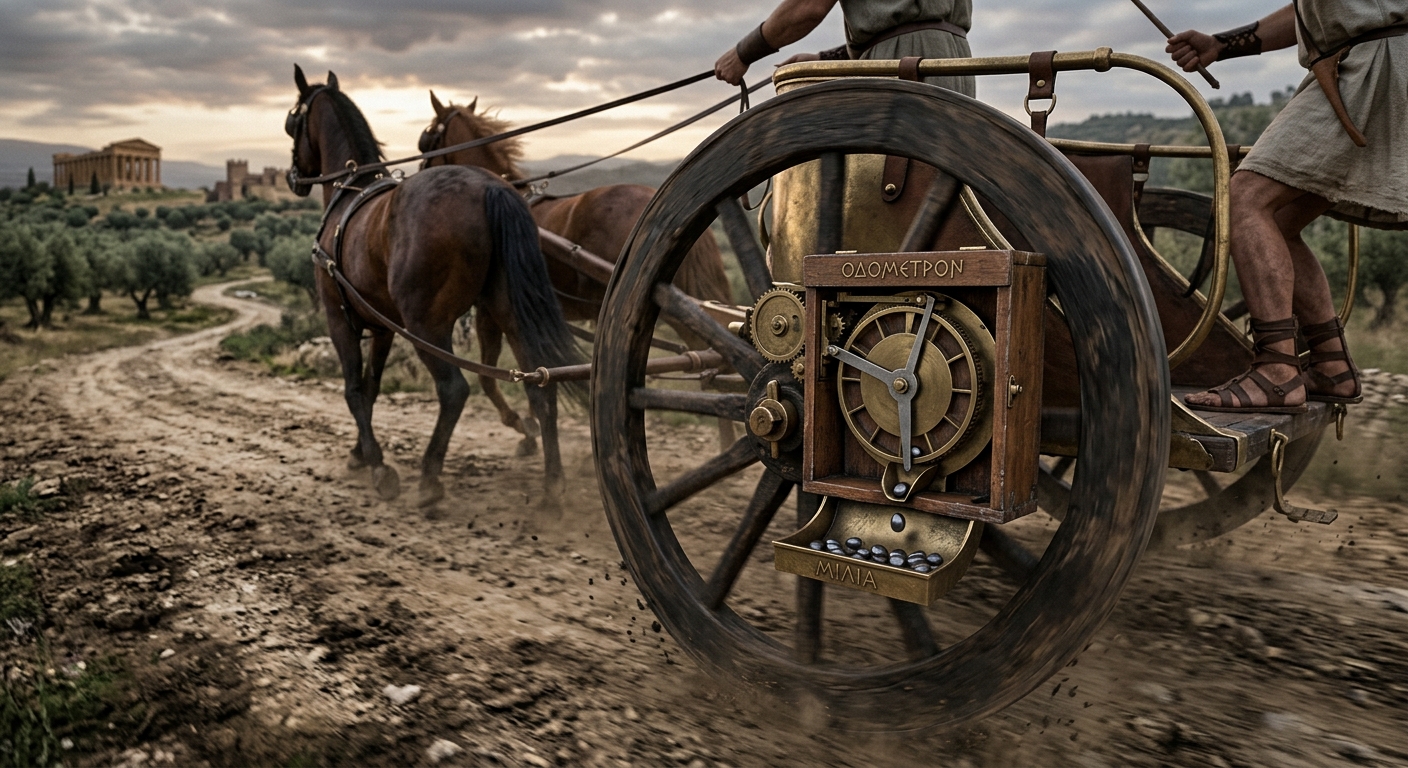
Long before GPS satellites orbited Earth and digital odometers tracked our every mile, ancient Greek engineers created a mechanical marvel that would make modern inventors jealous. The hodometer, a ingenious device that automatically counted distances traveled by methodically dropping pebbles into a container, represents one of humanity’s most brilliant early attempts at automated measurement.
This remarkable invention, dating back over two millennia, demonstrates that the ancients possessed far more sophisticated engineering knowledge than many people realize. The hodometer wasn’t just a simple counting device: it was a complex mechanical computer that solved a critical problem of the ancient world with elegant precision.
The Genius of Ancient Greek Engineering
The hodometer emerged from the brilliant mind of Heron of Alexandria, a Greek mathematician and engineer who lived during the first century CE. Heron was already famous for inventing the world’s first steam engine, automatic doors, and various other mechanical wonders that wouldn’t be reinvented for centuries.
The device operated on surprisingly sophisticated mechanical principles. Attached to a cart or chariot wheel, the hodometer used a series of precisely calibrated gears that would trigger the release of a single pebble after the wheel completed a specific number of rotations corresponding to one Roman mile (approximately 1,480 meters).
At the end of any journey, travelers could simply count the pebbles in the collection container to determine exactly how far they had traveled. No complex mathematics required, no room for human error in counting wheel rotations, just elegant mechanical automation doing the work.
How the Ancient Odometer Actually Worked
The mechanical complexity of the hodometer rivaled clockwork mechanisms that wouldn’t appear in Europe for another thousand years. The device consisted of several key components working in perfect harmony:
The Gear System
A primary gear attached directly to the cart’s wheel drove a series of reduction gears. These gears were carefully calculated so that after exactly 1,000 wheel rotations (equivalent to one Roman mile), a specific gear would complete one full rotation and trigger the pebble-dropping mechanism.
The Release Mechanism
The most ingenious part of the system was the automatic release mechanism. A small chamber held individual pebbles, and a rotating cam would periodically open a tiny door, allowing exactly one pebble to drop into the collection container below. The precision required to ensure only one pebble dropped per mile demonstrates remarkable engineering skill.
The Collection System
The dropped pebbles fell into a bronze container that could be easily removed and emptied. Some versions allegedly included bells or chimes that would sound each time a pebble dropped, providing real-time audio feedback to travelers about their progress.
Why Ancient Civilizations Desperately Needed Accurate Distance Measurement
Modern people might wonder why ancient Greeks cared so much about precise distance measurement, but accurate travel distances were absolutely critical for several reasons that determined the success or failure of entire civilizations.
Military Campaign Planning
Roman legions needed to know exactly how far they had marched to plan supply deliveries, estimate arrival times, and coordinate complex military maneuvers. A miscalculation of just a few miles could mean the difference between a successful siege and a disastrous defeat when supplies ran out.
Trade Route Optimization
Merchants traveling dangerous trade routes needed accurate distance information to plan rest stops, calculate travel times, and estimate costs. Knowing precise distances allowed traders to optimize their routes and avoid running out of water or food in hostile territories.
Taxation and Administration
The Roman Empire collected taxes based partly on transportation distances. Accurate measurement tools like the hodometer helped ensure fair taxation and prevented disputes between merchants and tax collectors over shipping costs and route distances.
The Lost Technology That Vanished for Centuries
Perhaps the most fascinating aspect of the ancient hodometer is how completely this technology disappeared from human knowledge. After the fall of the Roman Empire, the engineering expertise required to build these mechanical marvels was largely lost to European civilization.
It wasn’t until the Renaissance that European inventors began rediscovering similar principles, and even then, they often created inferior versions of devices that ancient Greeks had perfected centuries earlier. The hodometer represents one of many examples of ancient technological sophistication that challenges common assumptions about linear technological progress.
Modern Rediscovery and Reconstruction
Today, mechanical engineers and historians have successfully reconstructed working hodometers based on ancient descriptions and archaeological evidence. These reconstructions reveal the extraordinary precision of ancient Greek mechanical engineering and demonstrate that the devices actually worked exactly as described in historical texts.
Modern reconstructions have confirmed that ancient hodometers could achieve accuracy levels comparable to early modern odometers, with error rates of less than 2% over long distances when properly calibrated and maintained.
The Lasting Legacy of Ancient Innovation
The hodometer represents far more than just an ancient counting device. It exemplifies the innovative spirit and mechanical genius of ancient civilizations that modern people often underestimate. This remarkable invention demonstrates that human ingenuity has been solving complex problems with elegant solutions for thousands of years.
Every time we check our car’s odometer or use GPS to track our travel distance, we’re using descendants of technology that ancient Greek engineers pioneered over two millennia ago. The next time you hear that satisfying click of your car’s odometer rolling over another mile, remember the gentle sound of pebbles dropping in a bronze container as ancient travelers made their way across the classical world, their journey precisely measured by one of humanity’s most ingenious early machines.






ok this is wild but now im sitting here thinking about how tardigrades literally have their own internal odometers in a way, like theyre navigating these impossibly tiny environments and somehow know where theyve been and what theyve encountered, and its making me realize that whether youre an ancient greek engineer or a microscopic water bear, the core problem of tracking movement through space is just this fundamental thing living things gotta solve! the hodometer is basically a macroscopic tardigrade sensory system lol, except the tardigrade does it all internally with like eight legs and a nervous system smaller than a grain of salt, which honestly might be even more impressive than gears
Log in or register to replyThis is such a cool reminder that ancient people were problem-solving geniuses, honestly. I’m sitting here thinking about how modern dive computers work with similar precision tracking, and it makes me realize we’re not inventing new concepts so much as refining old ones. The gear systems they used back then? Still the same basic principles we see in underwater equipment today. Makes you appreciate that human ingenuity was already firing on all cylinders 2,000 years ago.
Log in or register to replyThis is making me think about how organisms have been solving the “distance tracking” problem way longer than the Greeks, you know? Like, fireflies navigate through meadows with incredible precision to find mates, and while we don’t fully understand their internal mapping system yet, there’s definitely some kind of odometer happening in their tiny brains. But here’s what gets me: all those precision navigation systems, whether mechanical gears or neural circuits, require light to work properly, and we’ve just been flooding the night with artificial light for the last century. We’re essentially breaking the ancient problem-solving toolkit that evolution spent millions of years perfecting.
Log in or register to reply