
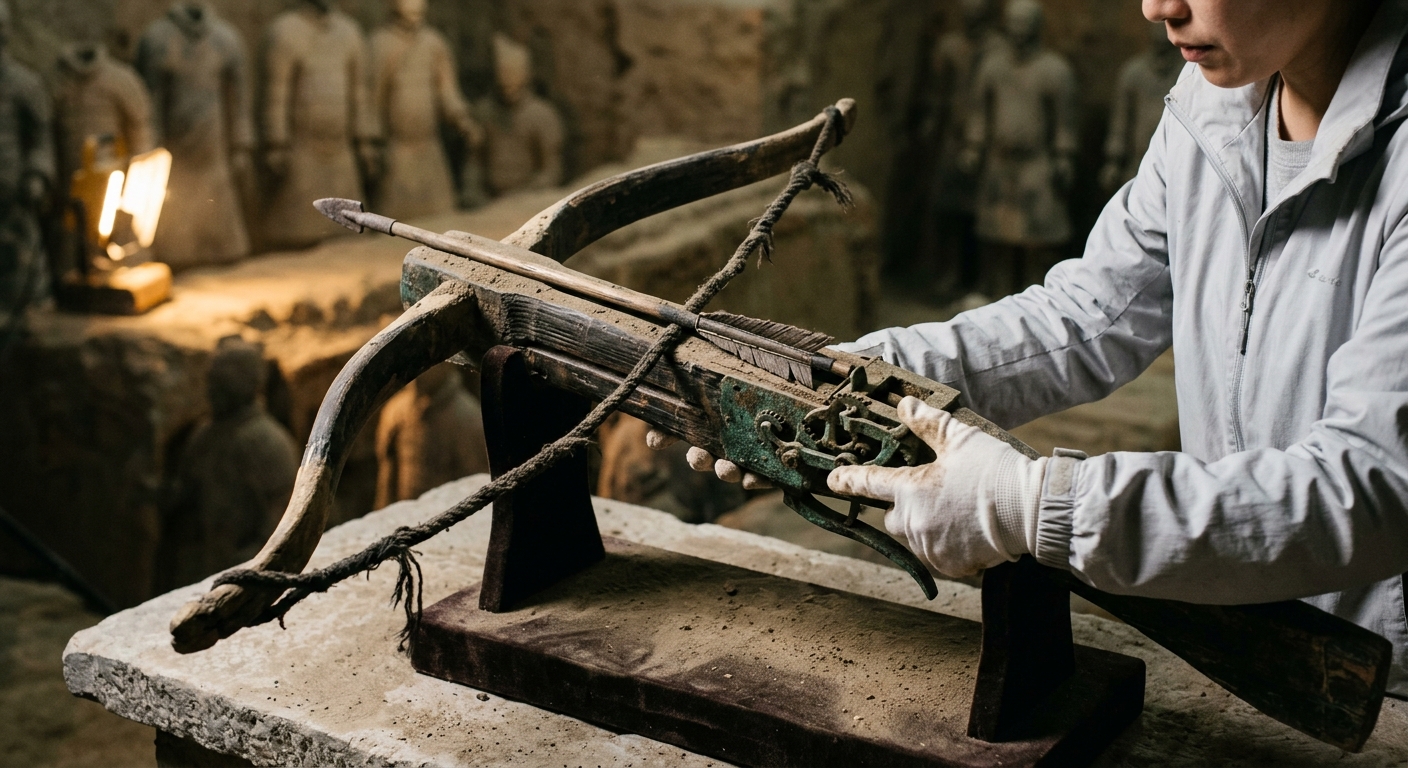
Hidden beneath Chinese soil for over two millennia, one of history’s most incredible archaeological discoveries continues to astound researchers and visitors alike. The Terracotta Army, discovered in 1974, wasn’t just an artistic marvel of ancient craftsmanship. Among these silent clay guardians lay weapons so advanced and well-preserved that they remain functional today, defying everything we thought we knew about ancient technology.
The Accidental Discovery That Changed History
In March 1974, farmers digging a well near Xi’an, China, struck something hard. What they unearthed would become one of the most significant archaeological finds of the 20th century. But it wasn’t just the thousands of life-sized terracotta warriors that shocked the world. It was the arsenal buried alongside them.
Among the bronze swords, spearheads, and arrowheads, archaeologists discovered something extraordinary: crossbows that, despite being buried for over 2,200 years, remained in working condition. These weren’t ceremonial replicas or symbolic offerings. They were fully functional weapons, engineered with precision that rivals modern manufacturing.
Engineering Marvels From the Qin Dynasty
The crossbows found in the Terracotta Army pits showcase the remarkable technological sophistication of ancient China. Each weapon was crafted with standardized bronze trigger mechanisms that demonstrate mass production techniques we associate with the industrial age, not ancient civilizations.
Precision Manufacturing
What makes these crossbows truly remarkable is their standardization. Archaeological analysis revealed that the bronze trigger mechanisms were manufactured to identical specifications across hundreds of weapons. This level of standardization required:
- Advanced metallurgy knowledge
- Sophisticated quality control systems
- Mass production capabilities
- Interchangeable parts manufacturing
The bronze triggers were so precisely made that parts from one crossbow could be swapped with another and still function perfectly. This interchangeability wouldn’t be seen in European warfare for another 2,000 years.
Superior Preservation Technology
But how did these weapons survive intact while similar artifacts from other civilizations crumbled to dust? The answer lies in ancient Chinese metallurgy that was centuries ahead of its time.
The bronze components contain trace amounts of chromium, creating a protective oxide layer that prevented corrosion. This chromium plating technique wasn’t rediscovered by Western science until the 1950s, yet Chinese artisans were using it over two millennia ago.
The Crossbow That Defied Time
The most famous of these ancient weapons is a crossbow that archaeologists actually tested. When carefully examined and reassembled using traditional methods, the weapon not only held together but could still fire bolts with deadly accuracy.
The crossbow’s wooden stock had mineralized over time, becoming harder than the original wood while maintaining its structural integrity. The bronze trigger mechanism showed no signs of wear or corrosion, moving as smoothly as the day it was buried.
Technical Specifications
These ancient crossbows weren’t primitive weapons. They featured:
- Bronze trigger mechanisms with multiple safety catches
- Standardized bolts with bronze points
- Draw weights comparable to medieval European crossbows
- Effective ranges exceeding 200 meters
- Semi-automatic loading capabilities
The Army That Never Fought
Emperor Qin Shi Huang, the first emperor of unified China, commissioned this underground army to protect him in the afterlife. The irony is that these perfectly preserved weapons, capable of devastating effectiveness, were meant never to be used by the living.
Each warrior was positioned according to military formations of the time, creating battle-ready units complete with infantry, cavalry, and archers. The crossbow units were strategically placed to provide covering fire, just as they would in actual combat.
Beyond the Battlefield
The functional nature of these buried weapons raises fascinating questions about ancient Chinese beliefs regarding the afterlife. Unlike purely symbolic burial goods found in other cultures, the Qin Dynasty clearly believed their emperor would need real, working weapons in death.
This practical approach to burial goods suggests a worldview where the afterlife was seen as a continuation of earthly existence, complete with potential conflicts requiring military preparedness.
Modern Implications
The discovery of these functional ancient weapons has revolutionized our understanding of historical technology transfer and innovation. The sophisticated manufacturing techniques found in the Terracotta Army predated similar European developments by centuries.
Today, materials scientists study these ancient crossbows to understand corrosion-resistant alloys and precision manufacturing. The chromium-enhanced bronze offers insights into sustainable preservation techniques that could benefit modern conservation efforts.
Ongoing Mysteries
Despite decades of study, many questions remain unanswered. How did ancient Chinese metallurgists discover chromium enhancement? What other technological innovations lie buried with the still-unexcavated portions of the Terracotta Army?
Archaeologists estimate that only a fraction of the site has been fully explored. Ground-penetrating radar suggests thousands more warriors and their weapons remain buried, potentially holding even more technological surprises.
A Testament to Ancient Innovation
The functional crossbows of the Terracotta Army stand as monuments to human ingenuity and the often-underestimated sophistication of ancient civilizations. They remind us that innovation and precision engineering aren’t modern inventions but fundamental aspects of human creativity that have existed for millennia.
These 2,200-year-old weapons, still capable of their deadly purpose, bridge the gap between ancient and modern worlds, proving that sometimes the most mind-blowing discoveries are the ones that still work exactly as intended, even after lying silent in the earth for over two thousand years.



That’s a fascinating question about preservation conditions, Alma! While I’m more of a spider person than an archaeologist, I’d guess the sealed tomb environment (low oxygen, stable humidity, consistent temperature) probably did wonders for metal conservation, similar to how amber preserves insects perfectly for millions of years. Speaking of which, if they ever found ancient spider silk in those tombs, that would be absolutely incredible, since spider dragline silk is stronger than steel of the same thickness and would theoretically preserve even better than metal. Anyway, this kind of precision engineering makes me appreciate how nature figured out similar efficiency in spider spinnerets way before humans were making crossbows!
Log in or register to replyThat’s wild how preserved these weapons are, though I have to admit this is pretty far from my usual Arctic rabbit hole! I’m curious though, does anyone know if the preservation conditions in those tomb chambers are similar to how permafrost preserves organic materials? Like, I’m always thinking about how extreme environments lock things in time, and I wonder if the sealed burial environment worked kind of the same way for these crossbows as deep frozen ground does for ancient bones and artifacts. Either way, those ancient metallurgists were seriously ahead of their time.
Log in or register to replyThat’s such a cool parallel you’re drawing between the tomb conditions and permafrost preservation, Alma! I’m way more into migration routes than archaeology, but the sealed, stable environment thing definitely reminds me of how animals navigate using consistent environmental cues – like, if conditions stay constant over millennia, materials can survive in ways that seem almost impossible. I’m now wondering if anyone’s actually tracked how long-distance migrants like the Arctic tern stumble upon preserved food sources in those ancient permafrost sites during their journeys, since you mentioned deep frozen bones and artifacts!
Log in or register to reply