
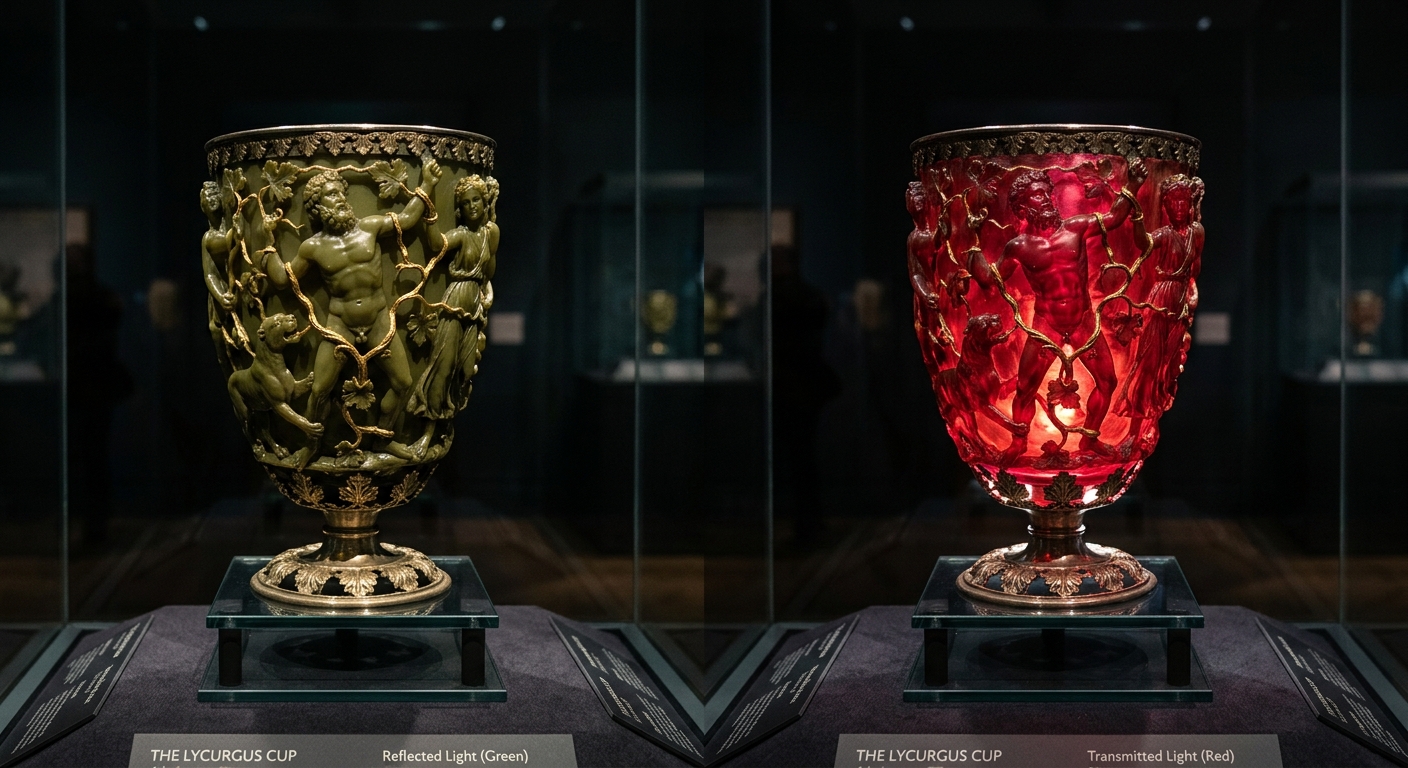
Hidden away in the British Museum sits one of history’s most mind-bending artifacts: a 1,600-year-old Roman chalice that appears to break the laws of physics. The Lycurgus Cup looks like an ordinary green vessel when lit from the front, but shine light through it from behind and it transforms into a brilliant ruby red. For centuries, this color-changing phenomenon baffled scientists and historians alike.
The Mystery That Stumped Experts for Decades
Named after the legendary King Lycurgus of Thrace, this fourth-century Roman masterpiece depicts the mythical king entangled in grapevines as punishment from the gods. But the real magic isn’t in the story it tells, it’s in the material itself. When museum curators first noticed the dramatic color shift in the 1950s, they had no explanation for how ancient craftsmen achieved such an impossible effect.
The cup appears jade green when light reflects off its surface, yet glows like molten rubies when illuminated from within. This dual nature made it seem almost supernatural, leading some to wonder if Roman artisans possessed secret knowledge lost to time.
Nanotechnology in Ancient Rome
The answer came in 1990 when researchers finally analyzed tiny samples of the glass under electron microscopy. What they discovered revolutionized our understanding of ancient Roman craftsmanship: the glass contained microscopic particles of gold and silver, each measuring just 50 nanometers across. That’s about 1,000 times smaller than the width of a human hair.
These nanoparticles were so perfectly distributed throughout the glass that Roman artisans had unknowingly created one of history’s first examples of nanotechnology, predating modern nanoscience by over 1,500 years.
The Science Behind the Magic
The color-changing effect occurs due to a phenomenon called surface plasmon resonance. Here’s how it works:
- Green reflection: When light hits the cup from outside, the gold nanoparticles absorb red wavelengths and reflect green ones
- Red transmission: When light passes through the glass from inside, different optical properties take over, allowing red wavelengths to transmit while blocking others
- Perfect size matters: The 50-nanometer particle size is precisely the right dimension to create this dual optical behavior
How Did Romans Create Nanotechnology?
The million-dollar question remains: how did fourth-century craftsmen achieve such precise nanoparticle distribution without modern equipment? Researchers believe Roman glassmakers likely added gold and silver to molten glass, possibly in the form of powdered metals or chloride salts.
Through careful temperature control and mixing techniques passed down through generations, they managed to create the perfect conditions for nanoparticle formation. The exact recipe died with its creators, making the Lycurgus Cup an irreplaceable treasure.
Not Just Lucky Accident
Some scholars initially theorized the effect was accidental, but the precision of the nanoparticle size and distribution suggests intentional craftsmanship. Roman artisans may not have understood the science, but they clearly knew their technique produced extraordinary results.
Modern Applications of Ancient Wisdom
The Lycurgus Cup has inspired cutting-edge research in multiple fields:
- Medical diagnostics: Scientists have developed ultra-sensitive pregnancy tests using similar nanoparticle technology
- Chemical detection: The same principles help create sensors that can detect incredibly small amounts of dangerous substances
- Smart materials: Researchers are developing new materials that change properties based on environmental conditions
Other Ancient Color-Changing Artifacts
The Lycurgus Cup isn’t entirely unique. Archaeologists have discovered other Roman glass pieces with similar properties, though none as dramatically effective. Medieval Islamic craftsmen also created lustrous pottery using metallic nanoparticles, and some Chinese ceramics display comparable optical effects.
These discoveries suggest that ancient civilizations worldwide stumbled upon nanotechnology principles through experimentation and artistic innovation, achieving results that modern science is only now beginning to fully understand and replicate.
The Cup Today
The Lycurgus Cup remains one of the British Museum’s most prized possessions, though it’s rarely displayed due to its fragility. When exhibited, special lighting allows visitors to witness the remarkable color transformation that has captivated observers for over 1,600 years.
This ancient masterpiece serves as a humbling reminder that human ingenuity and artistic vision often transcend the supposed limitations of their time. Sometimes the most profound scientific discoveries come not from laboratories, but from the creative minds of artists pushing the boundaries of their craft.





This is genuinely fascinating stuff, and I love how it shows humans have always been experimenting with materials! Though I gotta say, as someone who spends way too much time thinking about bat biology, I’m reminded that nature figured out nanostructures way before Rome – bat wing membranes use similar nano-scale architecture for their acoustic properties. Doesn’t diminish what the Romans did at all, just wild how the same principles show up everywhere once you start looking!
Log in or register to replyok so this isnt really evolution related but i gotta say this is such a cool example of convergent evolution in materials science / human innovation, like ancient romans figured out gold nanoparticles through trial and error the same way nature “figured out” how to use structural color in birds and butterflies, except theirs was purely accidental. makes you wonder what other ancient civilizations stumbled onto that we just dont know about yet!
Log in or register to replyMan, this is wild! I pick up Roman pottery shards all the time and never thought about what they might contain at that scale, but it really drives home how the materials available during that era shaped what ancient craftspeople could create. The gold nanoparticles thing reminds me of how we find different mineral compositions in geological layers from different periods, each one telling us what was actually accessible in that place and time. Makes you wonder what other techniques from deep history we’ve just overlooked because we were looking at the wrong magnification level!
Log in or register to reply