Deep beneath the romantic streets of Paris, past the bustling cafés and iconic landmarks, lies one of the world’s most macabre tourist attractions. The Paris Catacombs house the remains of approximately six million people in a labyrinthine network of tunnels that stretches for miles under the City of Light. This underground ossuary represents one of humanity’s most extraordinary solutions to an urban crisis that plagued 18th-century Paris.
From Quarries to Crypts: The Origins of Paris’s Underground Empire
The story of the Paris Catacombs begins not with death, but with construction. Starting in the 13th century, limestone quarries were carved beneath Paris to provide building materials for the growing city above. These quarries created a vast underground network of tunnels and chambers that would eventually span over 200 miles beneath the French capital.
For centuries, these quarries served their purpose, providing the very stones that built Notre-Dame Cathedral and countless other Parisian landmarks. However, by the 18th century, the abandoned quarries had become a forgotten underworld, while above ground, Paris faced a growing crisis that would transform these empty chambers into something far more sinister.
A City Drowning in Death
By the 1780s, Paris was literally overflowing with the dead. The city’s cemeteries, particularly the Cemetery of the Innocents, had been used for burials for over 600 years. Bodies were stacked upon bodies in mass graves, and the situation had become a serious public health hazard. The smell was overwhelming, groundwater was contaminated, and disease was spreading through the densely populated city.
The Cemetery of the Innocents alone contained the remains of over two million people in an area no larger than a city block. During heavy rains, decomposing bodies would literally spill into the streets and nearby buildings. Something had to be done, and it had to be done quickly.
The Great Migration of Bones
In 1786, Parisian authorities made the decision to relocate the contents of the city’s overflowing cemeteries to the abandoned limestone quarries. This massive undertaking required years of careful planning and execution. Workers, operating primarily at night to avoid disturbing the public, began the grim task of exhuming millions of bodies and transporting their remains through the streets of Paris in horse-drawn carts covered with black cloth.
The process took years to complete and involved not just the Cemetery of the Innocents, but dozens of smaller parish cemeteries throughout the city. Workers had to carefully separate bones from soil and debris, then transport them through narrow tunnel systems to their final resting place in the former quarries.
An Artistry Born from Death
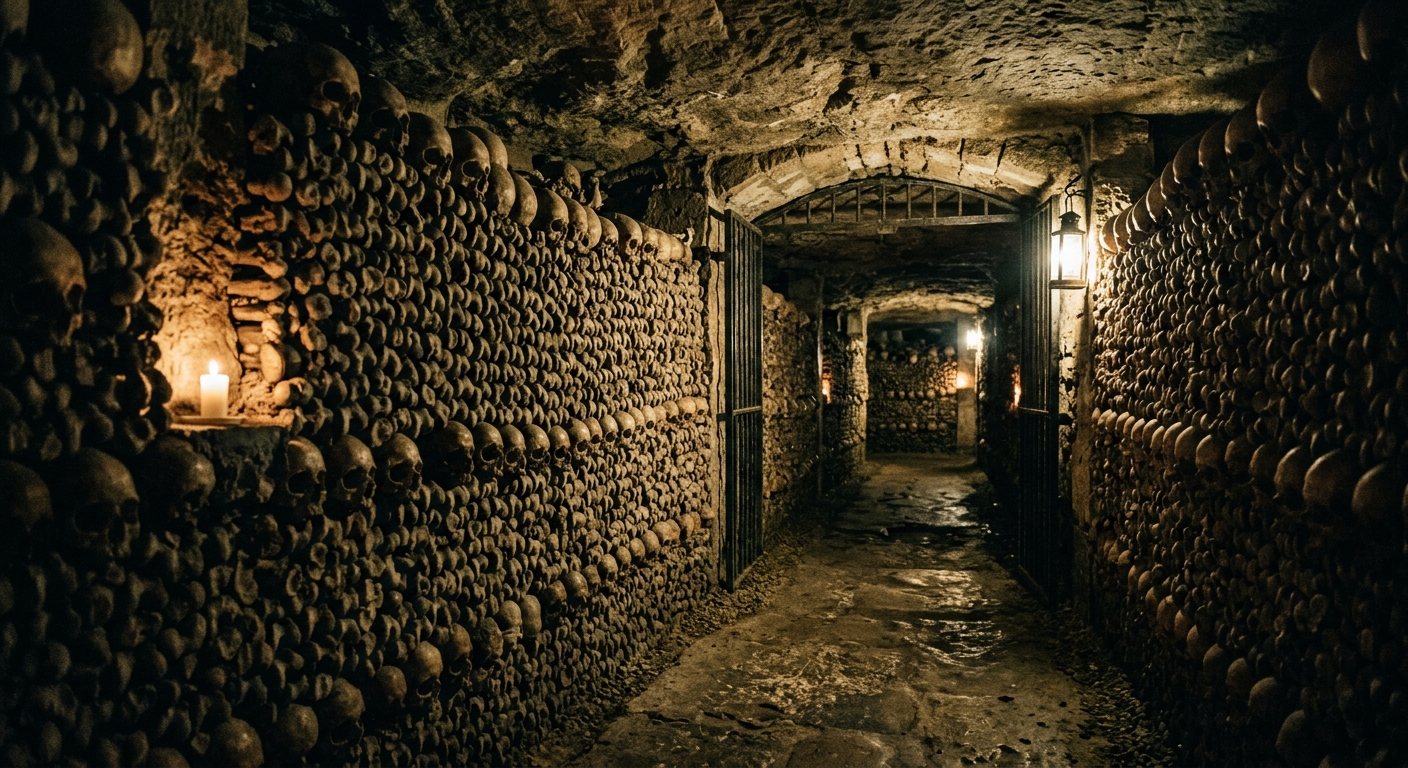
What makes the Paris Catacombs truly extraordinary is not just the sheer number of remains they contain, but the way these bones were arranged. Rather than simply dumping the skeletal remains in piles, workers created elaborate displays that transformed the catacombs into a kind of underground art gallery.
The bones were carefully sorted by type: femurs, skulls, ribcages, and other bones were arranged in decorative patterns that line the tunnel walls. Skulls were often used to create intricate designs, bordered by neat rows of leg bones and arm bones. The result is both beautiful and deeply unsettling, a testament to human creativity even in the face of mass death.
Messages from Beyond
Throughout the catacombs, visitors encounter various inscriptions and poems carved into stone plaques. These messages, written in French and Latin, serve as reminders of mortality and the fleeting nature of life. One of the most famous reads: “Arrête! C’est ici l’empire de la Mort” (Stop! This is the empire of Death).
A Living Piece of History
Today, only a small portion of the Paris Catacombs is open to the public. The official tour route covers about 1.5 miles of tunnels and displays the remains of approximately one million people, though the entire catacomb system contains six times that number. The temperature remains constant at 14°C (57°F) year-round, creating an eerie atmosphere that preserves both the bones and the experience.
The catacombs have become one of Paris’s most popular tourist attractions, drawing over 500,000 visitors annually. However, the vast majority of the tunnel system remains off-limits to the public and is patrolled by a special police unit known as the cataflics.
Modern Mysteries and Urban Legends
The restricted areas of the catacombs have given rise to numerous urban legends and continue to attract unauthorized explorers known as “cataphiles.” These modern-day urban explorers risk hefty fines and imprisonment to access forbidden sections of the tunnels, where they sometimes discover hidden chambers, illegal art installations, and even underground nightclubs.
A Monument to Human Ingenuity and Mortality
The Paris Catacombs represent far more than a tourist curiosity. They stand as a testament to human problem-solving, artistic expression, and our complex relationship with death and mortality. In transforming a public health crisis into an underground monument, 18th-century Parisians created something that continues to fascinate and horrify visitors more than two centuries later.
This hidden city beneath Paris serves as a powerful reminder that even in death, humans seek to create meaning, beauty, and order. The six million souls resting in the Paris Catacombs may have found their final peace in the very stones that built the city they once called home, creating an eternal bond between the living Paris above and the silent world below.






Yeah, the catacombs really do hit differently when you’re standing there, don’t they? I’m genuinely curious about what you mean re: the Parisian wetlands though, because that’s something I haven’t heard much about and now I’m wondering if there’s a connection to the original overcrowding problem that led to the catacombs in the first place. Did those wetlands used to act as a natural buffer for the city’s waste management?
Log in or register to replyGreat point about the wetlands, Beth – that’s actually a fascinating parallel to think about. The catacombs themselves are kind of a macabre monument to how humans reshape their environment, and honestly seeing millions of skeletons arranged so carefully makes you realize we’ve been moving around/reorganizing nature (including our own dead) for centuries. The wetlands loss is just the modern version of that same impulse, except we’re usually not as thoughtful about it. Have you noticed any changes in the bird populations there since those wetland alterations?
Log in or register to replyive actually toured the catacombs a few times when doing birding trips in europe and the sheer scale of it is honestly pretty sobering, though i have to say the real tragedy is what theyve done to the parisian wetlands and grasslands that used to host some incredible migratory species. anyway interesting piece, makes you think about how cities reshape themselves completely over time, both above and below ground
Log in or register to reply