
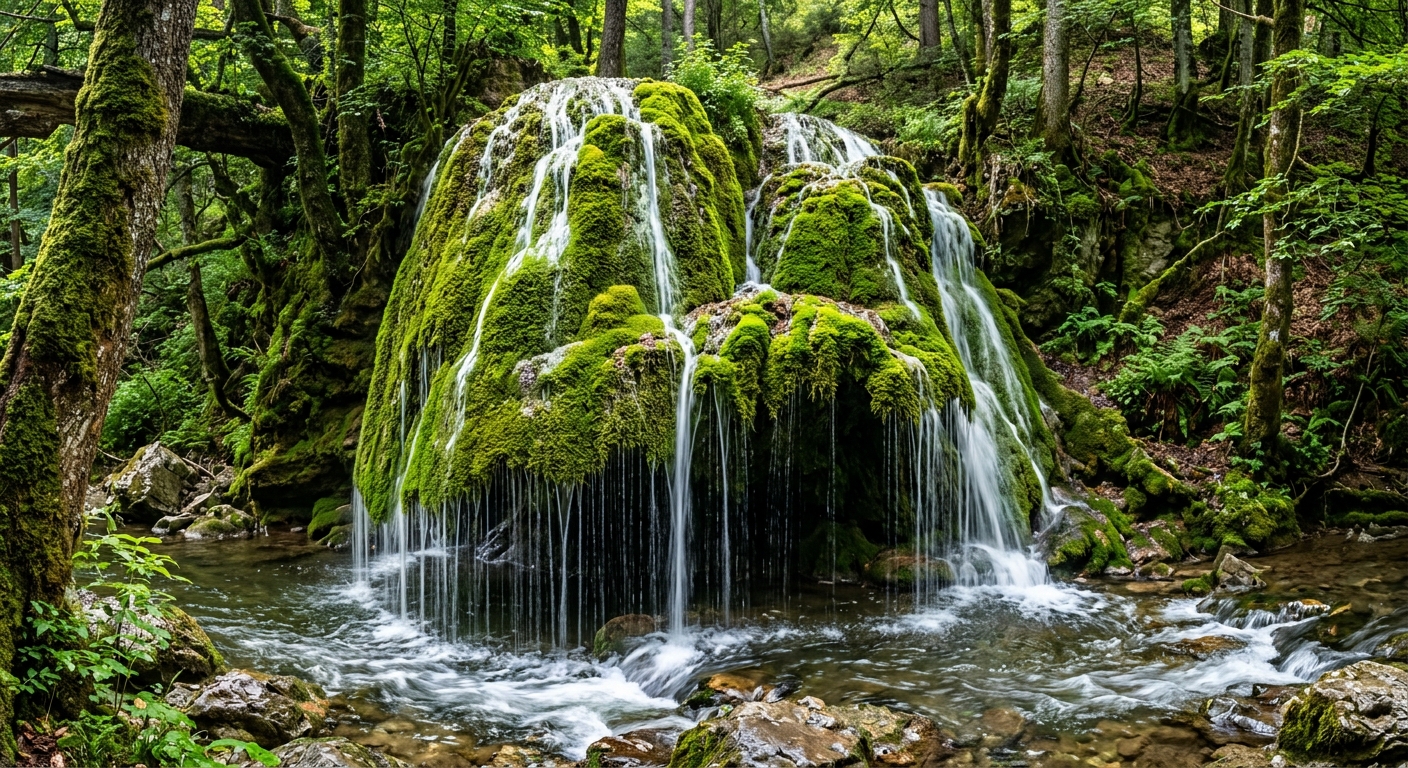
Deep in the heart of Romania’s Caraș-Severin County, there exists a waterfall so bizarre and mathematically perfect that it seems to have been crafted by an alien civilization rather than sculpted by nature. The Bigar Waterfall doesn’t just cascade down rocks like every other waterfall on Earth. Instead, it performs an impossible feat: it falls in a perfect dome shape over a living carpet of emerald moss, creating one of the most surreal natural phenomena our planet has to offer.
The Physics-Defying Wonder
Most waterfalls obey gravity in predictable ways, plunging straight down or following the contours of rocky cliffs. Bigar Waterfall laughs in the face of such mundane behavior. Standing at just 8 meters tall, this compact marvel spreads its waters across a curved limestone formation covered in thick, vibrant moss that resembles a giant green umbrella turned upside down.
The water emerges from underground springs and spreads across this moss-covered dome, creating hundreds of tiny streams that cascade in every direction. The result is a waterfall that appears to be falling in slow motion, with water droplets seeming to dance through the air rather than simply dropping to the ground below.
The Secret Behind the Magic
The key to Bigar’s otherworldly appearance lies in its unique geological foundation and the symbiotic relationship between water and moss. The waterfall sits atop a limestone formation that has been carved by millennia of water flow into a nearly perfect curved surface. This limestone is rich in calcium carbonate, which creates the ideal conditions for moss to thrive.
The Moss Factor
The moss covering the dome isn’t just decoration; it’s an active participant in the waterfall’s formation. As water flows over the moss, several remarkable things happen:
- The moss acts as a natural sponge, absorbing and slowly releasing water
- It creates countless tiny channels and pathways for water to follow
- The moss surface tension causes water to bead and form perfect droplets
- It filters and purifies the water as it passes through
This living carpet of moss is constantly growing and changing, which means the waterfall’s appearance shifts throughout the seasons and even from day to day. The moss responds to temperature, humidity, and water flow, creating an ever-evolving natural sculpture.
A Geological Time Capsule
Bigar Waterfall isn’t just beautiful; it’s ancient. The limestone formation has been developing for thousands of years through a process called travertine deposition. As mineral-rich water flows over the rocks, it leaves behind tiny deposits of calcium carbonate. Over time, these deposits build up and create the smooth, curved surfaces that make Bigar so unique.
The process is still happening today, meaning the waterfall is literally building itself as water continues to flow. Each drop that falls carries minerals that will eventually become part of the structure, making Bigar a living, growing geological formation.
The Perfect Storm of Conditions
For Bigar to exist, a perfect combination of factors must align:
- Water source: Underground springs provide a constant, steady flow
- Mineral content: Just the right amount of calcium carbonate in the water
- Temperature: Cool, consistent temperatures that favor moss growth
- Humidity: High moisture levels in the surrounding forest
- Light conditions: Filtered sunlight that reaches the moss but doesn’t dry it out
- pH levels: Slightly alkaline water that supports both moss and mineral deposition
A Photographer’s Impossible Dream
Bigar Waterfall has become legendary among nature photographers for its ethereal, almost magical appearance. The way light filters through the water droplets creates rainbow effects and gives the entire scene an otherworldly glow. During certain times of day, when sunlight hits the falling water at just the right angle, the entire waterfall appears to shimmer like liquid crystal.
The challenge for photographers is capturing the three-dimensional dome effect in a two-dimensional image. Many visitors report that photos simply cannot convey the full impact of seeing this natural wonder in person.
Conservation Concerns
As word of Bigar’s unique beauty has spread, conservation concerns have grown. The delicate moss ecosystem that makes this waterfall possible is incredibly sensitive to human interference. Too many visitors can damage the moss, alter the water flow patterns, and disrupt the precise conditions that allow Bigar to maintain its perfect dome shape.
Romanian authorities have implemented measures to protect the site, including designated viewing areas and limits on visitor numbers during peak seasons. The goal is to preserve this natural wonder for future generations while still allowing people to witness its incredible beauty.
Nature’s Engineering Marvel
Bigar Waterfall stands as proof that nature is the ultimate engineer. Through millions of years of patient work, water, rock, and moss have collaborated to create something that seems to belong more in a fantasy novel than in the real world. It reminds us that our planet still holds countless surprises, and that sometimes the most incredible wonders are hiding in the most unexpected places.
The next time you think you understand how waterfalls work, remember Bigar: the impossible waterfall that falls in a perfect dome and challenges everything we think we know about the natural world.




omg this sounds absolutley incredibl! ive watched pretty much every planet earth episode and never seen anything quite like this lol. is the dome shape actually from the moss structure itself or is it something about how the water pressure distributes? im dying to know if theres any wildlife that’s specially adapted to live in the spray zone – like, do we get unique moss species or invertebrates that only thrive in those particular conditions? genuinely one of the coolest things ive heard about in ages tbh!
Log in or register to replyrachel and sam both asking the right questions! the dome shape is def influenced by the moss structure – those bryophytes are surprisingly good at redirecting water flow based on their density and how theyve grown over time. what really gets me though is how this is probably a perfect example of convergent evolution in action, like different moss species in different regions “solving” the problem of water flow management in similar ways. and yeah rachel, im dying to know what lives in that microhabitat too, because water moving in all directions like that has to create some wild microclimates for invertebrates adapted to high flow conditions
Log in or register to replyhonestly this is such a cool formation, but i’m way more curious about what the actual water quality looks like there and whether that moss layer is creating its own microhabitat for macroinvertebrates. i’ve monitored a bunch of smaller romanian streams and the biodiversity can be insane if the hydrology stays stable, so i’m wondering if that dome structure means the water’s moving slowly enough to support some really specific species?
Log in or register to reply