
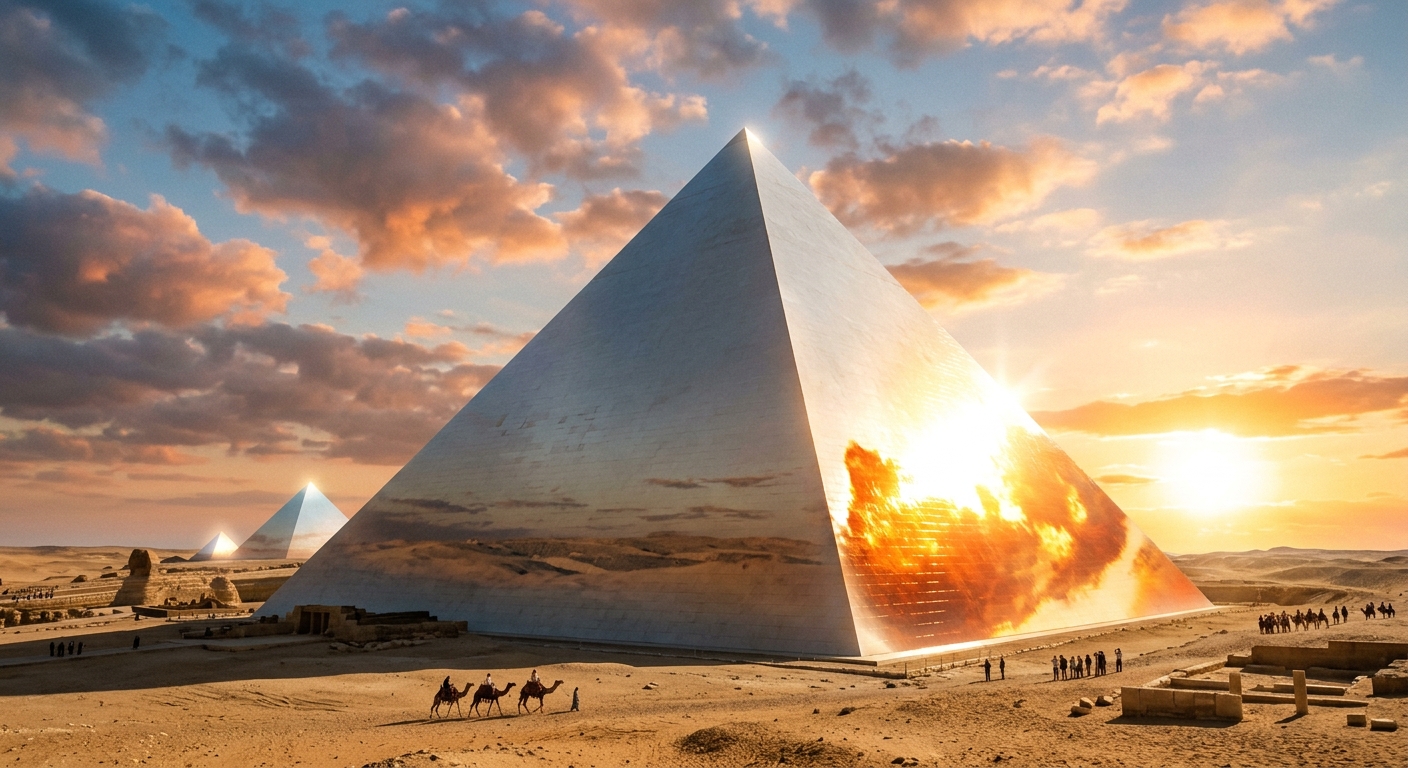
Imagine standing in the shadow of the Great Pyramid of Giza 4,500 years ago. Instead of the weathered, stepped limestone blocks we see today, you would have gazed upon a structure so brilliant it could blind you from miles away. The pyramids weren’t always the sandy-colored monuments we know, they were once encased in polished white limestone that transformed them into colossal mirrors reflecting the Egyptian sun across the desert.
The Vanished Glory of White Casing Stones
The original pyramids at Giza were architectural marvels that went far beyond their impressive size. Each pyramid was covered from base to apex in highly polished white Tura limestone casing stones, fitted together with such precision that the joints were barely visible. These weren’t rough-hewn blocks, but carefully crafted pieces of stone that created perfectly smooth, angled surfaces.
The Great Pyramid alone required approximately 144,000 casing stones, each weighing between 15 to 20 tons. When new, these white limestone blocks were polished to such a degree that they created a mirror-like surface that could reflect light across vast distances. Ancient accounts describe how the pyramids would gleam like jewels in the desert, visible from incredible distances as brilliant white beacons.
Engineering Perfection That Defies Modern Understanding
The precision required to create these smooth surfaces challenges our understanding of ancient Egyptian capabilities. The casing stones were cut and fitted with tolerances that would impress modern engineers:
- Joints between stones were less than 1/50th of an inch wide
- The stones were angled perfectly to create the pyramid’s precise slope
- Each block was individually shaped to fit its exact position
- The surface was polished to an almost glass-like finish
This level of precision required tools and techniques that archaeologists are still trying to fully understand. The ancient Egyptians somehow managed to quarry, transport, shape, and polish millions of tons of limestone to create these magnificent reflective surfaces.
The Tura Limestone Quarries
The white limestone used for the casing stones came from quarries at Tura, located on the east bank of the Nile River, about 8 miles south of modern Cairo. This particular limestone was prized for its fine grain and brilliant white color when freshly cut. The stone was so pure and dense that it could be polished to an almost mirror-like finish.
Transporting these massive blocks from Tura to Giza was an engineering feat in itself. The Egyptians likely used the annual Nile flood to float the stones on barges, then employed ramps and sledges to move them into position. The logistics of this operation would challenge even modern construction teams.
A Lighthouse Effect That Could Be Seen for Miles
When the morning sun struck the eastern face of the pyramids, the reflected light would have been visible from extraordinary distances. Ancient writers described how the pyramids would appear to glow with their own internal light, creating an almost supernatural effect. The reflection was so intense that looking directly at the pyramids during peak sun hours would have been nearly impossible.
This wasn’t just an aesthetic choice. Many researchers believe the brilliant white appearance served important religious and symbolic purposes. In ancient Egyptian religion, the color white was associated with purity, rebirth, and the divine. The pyramids, serving as eternal resting places for the pharaohs, were meant to be visible links between earth and the heavens.
Where Did All the Casing Stones Go?
Today, only a few of the original casing stones remain at the base of the Great Pyramid, leaving most people unaware of their former glory. The disappearance of these magnificent stones tells its own fascinating story of human history and the recycling of ancient monuments.
The Great Medieval Stone Rush
The majority of the casing stones were stripped away during medieval times, particularly following a major earthquake in 1303 AD that loosened many of the blocks. Medieval Cairo was a growing city in need of building materials, and the pyramids became a convenient quarry of pre-cut, high-quality stone.
Much of medieval and early modern Cairo was built using stone from the pyramid casings. Mosques, palaces, and fortifications throughout the city contain limestone that once blazed white under the desert sun. In a sense, the pyramids weren’t destroyed, they were transformed and scattered throughout one of the world’s great cities.
Evidence of the Lost Brilliance
While most of the casing stones are gone, compelling evidence of their former existence remains:
- Remaining casing stones at the pyramid bases still show their polished surfaces
- Ancient accounts from Greek and Roman historians describe the brilliant appearance
- Pyramid of Meidum still retains some upper casing stones, showing their original smooth surface
- Archaeological excavations have uncovered fragments with mirror-like polish
- Mathematical analysis of remaining blocks reveals the precise angles needed for smooth surfaces
A Lost Wonder of the Ancient World
The original appearance of the Giza pyramids represents one of history’s greatest lost wonders. These weren’t just massive piles of stone, but sophisticated architectural achievements that combined engineering precision with breathtaking beauty. The mirror-like surfaces would have created a spectacle that few modern structures could match.
Understanding the pyramids’ original appearance changes how we view ancient Egyptian civilization. These weren’t primitive builders working with crude tools, but sophisticated engineers and artists who created monuments of stunning beauty and technical precision. The white casing stones represent a level of craftsmanship that continues to inspire wonder and respect for the achievements of our ancient ancestors.
Next time you see images of the pyramids with their weathered, stepped appearance, remember that you’re looking at the skeleton of structures that once blazed like mirrors in the desert sun, reflecting the glory of one of history’s greatest civilizations across the sands of time.




honestly this is wild to think about, like imagining those polished surfaces reflecting the sun across the nile valley must’ve been absolutely stunning but i gotta ask – how much of that reflective quality would actually survive in the desert environment? the dust storms and sand abrasion in giza seem pretty intense even now, so im curious if they had to do regular maintenance or if the casing stones were treated with something to keep that mirror finish intact over time
Log in or register to replyGreat question Sebastian! I think about this kind of thing a lot, actually – like how the Perseverance rover’s shiny instruments reflect Mars sunlight in ways that would’ve looked totally alien to ancient observers. Those polished limestone surfaces would definitely degrade over centuries from wind and sand abrasion, but even a partially reflective pyramid catching sunrise or sunset must have been genuinely breathtaking, you know? It makes me wonder if something similar could help us spot structures on other worlds someday, if we ever find evidence of ancient construction elsewhere in the cosmos.
Log in or register to replythis is such a cool detail that gets me thinking about how observation changes depending on perspective, kinda like how birders notice things in their backyards that other people miss just by paying attention differently. the limestone casing stones are a great example of how ancient engineering was optimized for specific effects, and sebastian’s point about desert weathering is solid – even the most polished surface would degrade over time with sand and wind. id love to see if theres any archaeological documentation comparing the patina or wear patterns on remaining casing stones to get a sense of how fast that reflective quality might’ve faded, seems like the kind of thing citizen scientists could help map out if given access to detailed photos.
Log in or register to reply