
Imagine calculating the exact size of our planet using nothing more than shadows, a well, and brilliant mathematical reasoning. No satellites, no modern instruments, just pure intellectual prowess. This isn’t science fiction: it’s exactly what Eratosthenes of Cyrene accomplished over 2,200 years ago, achieving a level of accuracy that would make modern scientists proud.
The Man Who Measured the World
Eratosthenes wasn’t just any ancient scholar. Born around 276 BCE in Cyrene (modern-day Libya), he was a polymath who served as the chief librarian of the legendary Library of Alexandria. While his contemporaries were still debating whether the Earth was flat or round, Eratosthenes had already moved on to a far more ambitious question: exactly how big is our spherical planet?
His nickname among fellow scholars was “Beta” because he was considered second-best in every field he studied. Little did they know that this “second-place” genius was about to achieve one of the most remarkable scientific breakthroughs in human history.
The Brilliant Observation That Started Everything
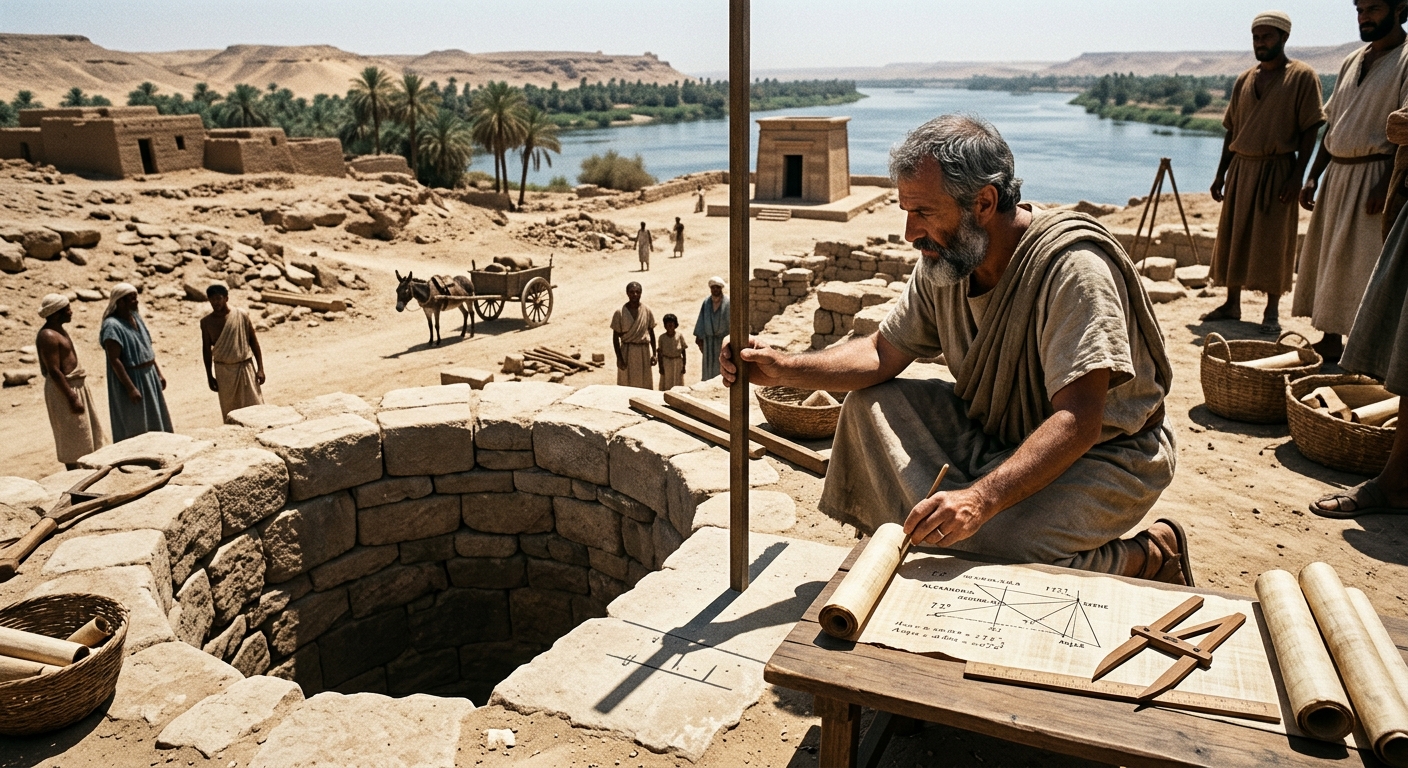
The story begins with a fascinating observation about the city of Syene (modern-day Aswan, Egypt). Eratosthenes had heard that on the summer solstice, something magical happened there: the sun shone directly down a deep well without casting any shadows on its walls. At noon on June 21st, the sun was positioned perfectly overhead, creating what we now know happens when you’re directly on the Tropic of Cancer.
But here’s where Eratosthenes’ genius kicked in. He realized that at the exact same time in Alexandria, roughly 800 kilometers north of Syene, vertical objects still cast shadows. This simple difference in shadow length between two cities would become the key to unlocking one of Earth’s greatest mysteries.
The Ingenious Experiment
On the summer solstice, Eratosthenes conducted what might be history’s most elegant scientific experiment. In Alexandria, he placed a vertical stick in the ground and carefully measured the shadow it cast at noon. Using basic trigonometry, he calculated that the shadow indicated the sun was positioned at an angle of approximately 7.2 degrees from directly overhead.
Now comes the stroke of pure genius: Eratosthenes realized that if the Earth was indeed a sphere, this 7.2-degree difference represented the angular difference between Alexandria and Syene as measured from the Earth’s center. Since 7.2 degrees is exactly one-fiftieth of a complete 360-degree circle (7.2 × 50 = 360), the distance between the two cities should represent one-fiftieth of Earth’s total circumference.
The Mathematical Magic
The calculation was elegantly simple:
- Distance between Alexandria and Syene: approximately 5,000 stadia
- This distance represents 1/50th of Earth’s circumference
- Therefore, Earth’s circumference = 50 × 5,000 = 250,000 stadia
Converting ancient stadia to modern measurements is tricky because different regions used slightly different standards. However, most scholars believe Eratosthenes’ result translates to approximately 39,350 to 46,620 kilometers. The actual circumference of Earth is 40,075 kilometers, meaning his calculation was accurate to within 1-2 percent!
Why This Achievement Was Absolutely Mind-Blowing
To truly appreciate Eratosthenes’ accomplishment, consider what he achieved with the technology available in 240 BCE. He had no precision instruments, no global communication systems, and no way to verify his results through independent measurements. Yet he managed to calculate Earth’s size with stunning accuracy using only:
- Careful observation of shadows
- Basic geometric principles
- Knowledge of the distance between two cities
- Brilliant logical reasoning
His method was so sound that it remained the most accurate measurement of Earth’s circumference for over 1,500 years. Even more remarkably, he did this during an era when many people still believed the Earth was flat.
The Assumptions That Made It Work
Eratosthenes’ calculation required several key assumptions that turned out to be remarkably accurate:
Earth as a Perfect Sphere
While Earth is actually an oblate spheroid (slightly flattened at the poles), it’s close enough to a perfect sphere that this assumption didn’t significantly affect his results.
Parallel Sun Rays
He assumed that sunlight reaches Earth as parallel rays, which is essentially true given the sun’s enormous distance from our planet.
Alexandria and Syene on the Same Meridian
Eratosthenes assumed both cities lay on the same north-south line. While not perfectly accurate, they’re close enough that this assumption didn’t introduce major errors.
The Legacy of Ancient Precision
Eratosthenes’ achievement represents more than just an impressive calculation. It demonstrates the power of careful observation, logical reasoning, and mathematical thinking. His work proved that ancient scholars were capable of sophisticated scientific reasoning that rivals modern methods in creativity and elegance.
This measurement also had practical implications. It helped ancient navigators better understand the scale of their world and influenced later explorers and scientists. When Christopher Columbus planned his voyage to the Americas, he used calculations partly based on Eratosthenes’ work (though Columbus made some significant errors in his interpretations).
A Testament to Human Ingenuity
Perhaps most remarkably, Eratosthenes accomplished this feat using what we might consider primitive tools by today’s standards. No computers, no satellites, no laser measurements. Just shadows, mathematics, and an incredibly sharp mind. It stands as one of history’s greatest examples of how human curiosity and intelligence can unlock the secrets of our universe.
The next time you see a shadow cast by the sun, remember Eratosthenes and his incredible achievement. Sometimes the most profound discoveries come not from complex technology, but from asking the right questions and having the wisdom to find elegant answers in the simplest observations.

That’s a genuinely cool example of observation and logic, though I gotta say it reminds me of how we approach herpetology too, honestly. Like, people assume we need fancy equipment to understand reptiles, but sometimes the best insights come from just watching your ball python’s behavior patterns or noticing how a colubrid responds to temperature gradients. Eratosthenes didn’t need to overthink it, just like you don’t need to fear snakes because of myths, just observe and measure what’s actually there.
Log in or register to replyomg eratosthenes was such a legend, seriously like watching a david attenborough doc where he just sits there observing and suddenly cracks the mystery of the whole ecosystem you know? the elegance of using shadows reminds me of how animals navigate by the sun and stars – like loggerheads (caretta caretta) using earths magnetic field to find there way home thousands of miles away. makes you wonder what other ancient peoples figured out just by paying atention to how light and shadow work in nature, right?
Log in or register to replydude thats so cool, the whole observation thing really hits different when you think about it – like watching lion prides in the mara, you dont need fancy tech to understand their dynamics, just patience and noticing patterns in their behavior. eratosthenes basically did field research without leaving home, and honestly thats the same approach that gives us the best insights into predator prey relationships, you catch something nobody else is looking for and suddenly everything clicks
Log in or register to reply